Friday, July 30, 2021

The Best of an Emergency

Famously, John Singer Sargent (1856-1925) once remarked that making watercolor paintings was to "Make the best of an emergency!" In the event he was talking about his personal approach to outdoor watercolors, which he did mostly while vacationing. Those works by Mr. Sargent certainly show speed and masterful brushwork, loose and painterly, and his broad command of color. Just looking at one or two of his pieces is a refreshing exercise. In "Bridge of Sighs, Venice," he shows us the 17th century landmark from a gondola on the Rio di Palazzo, giving us dazzling light and beautiful, open shadows. At the time his work was considered startling and not at all conventional. His lights in this particular work were made by reserving whites (as many do) but also by scratching and by using opaque white. The buildings are simply shapes in color, juxtaposed against one another, showing the aspiring painter that minute, detailed drawing is unnecessary.

John Sargent, "Bridge of Sighs," 1903


Below is another well-known watercolor by Mr. Sargent. In Muddy Alligators he again shows us bright light, attention to form and color and less attention to detail. the trees are little more than stripes of color and the alligators are deftly delineated with his dazzling brush.

John Sargent, "Muddy Alligators," 1917


Carrying a Sargent-like attitude into plein air work is something to strive for, seems to me. In my more recent oils that's been the idea--shapes and color not lines and details. For one thing, when working outdoors in changing light and unforgiving weather, speed is important. For me that means looking and thinking more and smearing paint less. It sounds paradoxical, the if you spend enough time looking, you don't have to use as many strokes of paint. Furthermore, descending into the rabbit-hole of minute details and "fiddling" are excellent ways to make dull work. Better the bold statements and contrasts of Sargent's watercolors. 

Here is a plein air oil from this week. The bridge is a city bridge over the Des Moines River, painted from the river bank. It was early morning, with the sun slanting across from right to left. Although standing in the middle of the city the sounds on the river were few--a calling bird or two, a nearby splash from a fish--and the scene might as easily have been out in the countryside some place. As I usually do, I toned the panel with burnt sienna and then drew the basic composition with my brush. After laying in lights and darks came broad areas of color, working top to bottom. That is, sky (mostly cerulean and white), then the foliage colors, the river, and lastly the bridge. The idea was to do most of the surroundings before the center of interest. The greens are a mix of sap green, cad lemon, cobalt blue, ivory black and sometimes raw umber). Give how quickly the light was changing, this was finished in about ninety minutes.

'Sixth Avenue Bridge," oil on panel, 9x12


Tuesday, July 27, 2021

A Saturday Sketch

The Saturday sketch group chose a variety of places to paint this week, about half of us choosing Greenwood Park, which is actually the park that provides the setting for the Des Moines Art center. It has a rose garden, sculptures, an amphitheater, walking paths, and a beautiful lagoon nestled in a mature grove of hardwoods. I sat in the shade of a kind old tree and let the scene carry me away. It was a hot afternoon but in the shade the breeze off the water was pleasant and cool. 

"The Lagoon, Greenwood Park," wc

I used a pale green wash, then established darks and medium values, mixing greens by using cad yellow and sap green with a touch of burnt sienna to mute the green. Dried foliage was painted with ochre and a touch of burnt sienna, and the stand of reeds along the water indicated with sap green darkened with Payne's grey. Masses of smoother color, darker masses washed into lighter greens, indicated reflections. I let each pass of color dry at least a few minutes before adding another layer. Watercolor dries fast in hot weather. When the colors were dry I used a mechanical pen to show foliage, especially tree edges, reeds, and the shore of the lagoon.

Besides my companions there were families with small kids, walkers, at least one fisherman (who hooked a medium-sized one just in front of me), and a few cyclists. Since the pandemic it seems parks get a lot more use. What is certain is that I'll be back here with my oil paints one of these days.

Friday, July 23, 2021

Turpentine vs Other Solvents

Solvents in oil painting have a bad name. That is, many fear that sovents are significantly toxic, harmful, or explosive. For some years there has been a movement of painters who try to avoid or reduce their uses of solvents while painting. But for those who use solvents, here is a list of the various solvents available and a few notes on their usage.

"Upstream, Druid Hill Creek," oil on panel, 2020

Turpentine 
The traditionally used solvent in oil painting is known as "turpentine," but in fact is a product distilled from turpentine, known as "rectified turpentine." Turpentine is actually the resinous sap of a specific kind of tree, many in the Pinus species. The sap is distilled, or rectified, producing a clear to yellow liquid that is used to thin oil paint, make varnishes and mediums for painting, and in various chemical processes. Rectified turpentine is a complex substance with a slightly oily but scanty residue. 
 
Oil of Spike Lavender
A traditional solvent derived from the spike lavender plant (Lavandula spica) and is said to have been used by masters of the past in thinning their oils. It is often listed as an essential oil. Colloquially known as "oil of spike," it's used mostly as a component of various painting mediums along with oil and a resin of one kind or another. Because of scarcity and expense oil of spike is rarely used as a simple solvent.

Mineral Spirits
Mineral spirits are solvents derived from crude oil. Sometimes called "white spirit," especially in Britain, mineral spirits come in smelly and odorless forms. The odorless form is sold by several companies under various brand names but in general comprises straight-chain hydrocarbons (C7-C13), while the smellier variety contains "aromatics" or ring compounds too. These solvents have many industrial applications as well as finding use in oil painting. (Brand names include Gamsol, Turpenoid, and others.)
"Downstream, Druid Hill Creek," oil on panel, 2020

Suggestions for using solvents:
  • Buy high quality solvents. Typical hardware store turpentine is not suitable for artwork. Odorless mineral spirits are similar to one another regardless of brand names but artist-grade spirits are more likely to be high quality.
  • Ventilate your studio well. Solvents evaporate but will remain in still studio air. An open window is the minimum ventilation but an exhaust fan is optimum. Keep your solvent container covered unless it's a very small cup.
  • Use the least solvent necessary. Overuse of solvent can result in paint with less oil binder per unit volume so that the resultant paint film will be more fragile or "underbound." Using the least solvent also releases less into the atmosphere.
  • Dispose of used solvent (brush washing jars, etc) responsibly. Mineral spirits are polluting. 
  • In general, citrus-based solvents are only useful for cleaning brushes.


Tuesday, July 20, 2021

On the River

As the routine of drawing and painting has settled down from my jaunt to the Adirondacks I've managed a number of trips to one of my favorite spots along the right bank of the Raccoon River. The spot is in a huge parkland of meadows and woods with the river meandering through. It's full of silty runoff from farms upstream and filled beyond limits with nitrates used on corn and soybeans, so the water is often a murky green/brown that reflects the blue-grey sky. When you look away from the sun the water is darker and smooth.

"Raccoon Bend, July 2021," oil on panel, 9x12

This painting is from a session this week. The sun was low above the eastern horizon, slanting into the distant trees. At this point the river flows in a big bend, coming from the right (west) and curving around to run almost directly toward my painting spot before bending again toward the north. That is, my position faced southwest. I toned a small panel with a very thin wash of burnt sienna, except the sky, which I left white. Next I sketched in the major shapes of the trees and river banks, then established darker and lighter values. The thin underpainting dries very quickly if you thin your paint with turpentine. Once satisfied with general values and shapes I quickly sketched the sky using cerulean blue and white. The darkest darks and darkest greens came next, then middle values of greens in warm mixes with cad lemon and various greens and blues, then cooler greens made by mixing white and cad lemon with darker greens. The distant river bank is actually a dull yellow ochre, but I let the red underpainting show through and underlined it with a very dark red that fades into very dark green at the extreme of the river bend (right). The entire study took about 90 minutes.

Friday, July 16, 2021

The Chinese Pavilion

Working outdoors this week was fun but occasionally frustrating. The first few days were fine and sunny but the last ones cloudy, rainy and a lot less convenient. Monday and Tuesday were good days painting at the Asian Garden near the Botanical Center. The Chinese pavilion is a traditional building with curving rooflines, each successively smaller. It has a set of marble railings and decorations that were damaged some years ago by a deranged man with a hammer, but has been undergoing restoration of the rails and of the gardens. I painted from the southern side of the pagoda, trying to catch the effect of early morning sun on the dark reds.

"The Chinese Pavilion,' oil on panel, 14x11


Tuesday, July 13, 2021

With the Saturday Sketch Group

Last Saturday, I joined a half dozen fellow painters who sketch together at various locations around the city. We meet in one of the parking lots at the Des Moines Art Center, agree on a location for painting and off we go. This time we went to the Des Moines Botanical Center, which comprises a delightful set of indoor and outdoor gardens ranging from a dome that houses tropicals like palms and orchids, to extensive formal outdoor pavilions and gardens--even a huge lily pond complete with frogs. The setting provides any number of opportunities to sketch plants, trees, and so on. And if you're bored with that, the Des Moines River is a stone's throw away.

This time I set up near the entrance to the dome, where perennials, bulbs, and temperate zone annuals are in profuse flower. Several of the group did the same, so that I was able to include one of us in my offering that day. The sky was dark and cloudy, at least part of the time, threatening rain. At one point several enormous drops rattled down but then nothing followed. We were spared a soaking and I even had enough time to add a few details.

At the Botanical Center, watercolor,


Friday, July 09, 2021

Winslow Homer

Winslow Homer, ca 1880. Source: National Gallery website
A couple of posts back, in writing about outdoor painting, Winslow Homer's work was one of the examples. Winslow Homer (1836-1910) is justly considered one of the great American painters. Born in Boston, he was apprenticed to a lithographer at age 19 but by 1857 Homer struck out on his own as an illustrator. The work appealed to him and he was good at it. During the Civil War he spent time with units of the Army of the Potomac and produced hundreds of drawings and sketches of camp life, individual soldiers, and battles.

"Snap the Whip," 1872

Mr. Homer seems to have been a very self-assured young man who later commented that once he left his apprenticeship he never had another master. And indeed, with the exception of that apprenticeship he seems to have been mostly self-taught, although he did learn the basics of painting from another artist and briefly attended the National Academy of Design. He clearly understood composition and drawing and assimilated the tenets of painting very quickly. After the Civil War he turned to domestic subjects--women, childhood ("Snap the Whip," above, for example), and a sense of home and nostalgia, and by 1875 had completely abandoned illustration for a career as a painter. 

"Breezing Up (A Fair Wind)," 1873-76

In his maturity Mr. Homer first lived in Gloucester, Massachusetts, where he had customarily spent summers, becoming enraptured by the sea, those who made their living on it. His subject matter changed too, reflecting that interest. He began exhibiting pictures like "Breezing Up" (above), which was very popular when first shown and later was the subject of a U.S. postage stamp. Later, settling in Prouts Neck, Maine, where he produced a number of important paintings of marine subjects. 

"The Herring Net," 1885

"The Life Line," 1884

Besides oil paintings Mr. Homer also produced brilliantly executed watercolors either as stand alone artworks or as preliminary studies for oils. Although his marine paintings were praised, they seem to have been a hard sell, but his watercolors provided him with both opportunities to work and a reasonable amount of income. He spent winters in warmer places like Key West, the Bahamas, and Cuba, and made many watercolors during those visits, as well. 

"Salt Kettle, Bermuda," watercolor, 1899  

"Key West, Hauling Anchor," watercolor, 1903
"The Homosassa River," watercolor, 1904

Today, at least to my eyes, his watercolors are still fresh and timely. Mr. Homer may have been mostly self-taught, but he remains one of the finest painters ever produced in North America.


Tuesday, July 06, 2021

Art and Emotion

"If I could say it in words there would be no reason to paint," at least according to Edward Hopper, the famous American painter. Sometimes "you" is substituted for the first person singular, but usually it is clear that Mr. Hopper was talking about himself rather than the rest of the world. Regardless, many visual artists, whether painters, sculptors, photographers or others recognize the truth in his words. For most of us, the reason to make art is in the emotion--to evoke a wordless but deeply-felt experience in the viewer. 

Francisco Goya, "The Third of May, 1808," oil, 1814

All of the above is not to say that people these days always produce evocative artwork. There is a legion who make pretty things that people enjoy having in their public and private spaces. The world is a better and more livable place because of that. Nonetheless, visual artists quite commonly have a personal need to connect with the viewer on a gut level, not an intellectual one. Artists like Rembrandt speak to us by showing the world-weariness and seamed faces of the Dutch bourgeoisie, while his contemporary Adriaen Brouwer showed us the good humor and foolishness of the common folk. Two centuries on, Francisco Goya gave us "The Third of May, 1808," (above), sometimes considered as one of the first modern paintings in the sense that it depicts the horrors of war, in this case the Spanish resistance to Napoleon's occupation. Hundreds were summarily executed at several locations in Madrid on the date in the title, in reprisal for rising against the occupation. Goya may or may not have witnessed these events but his revulsion and horror are palpable in the painting. 

Kathe Kollwitz, "Frau mit totem kind (Woman with Dead Child)," 1903

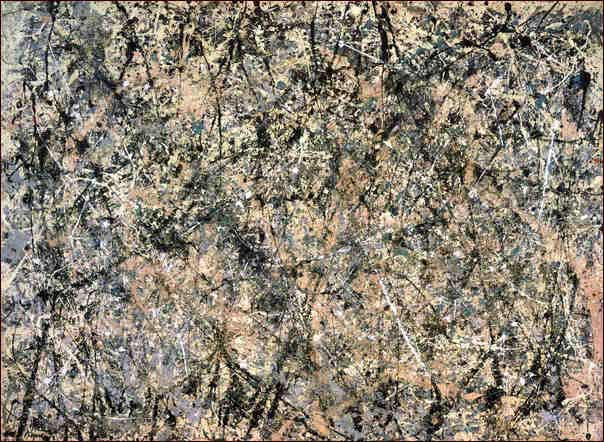
In our own time, painting underwent enormous change, yet the idea of evoking an emotional response has remained. In a century of war and depression, artists like Kathe Kollwitz faced its horrors with stubborn resolve. Others chose abstraction as a way to make the viewer experience emotion--Abstract Expressionism, for example. In large scale works, painters exemplified by Jackson Pollock avoided representative forms, substituting actions like dripping or pouring paint. Other abstract expressionists chose to use fields of color as a visual trigger.
Jackson Pollock, "Number 1, Lavender Mist," 1950

Whatever the image, representative or otherwise, the most serious intent in visual art is emotion.


Friday, July 02, 2021

En Plein Air

The phrase en plein air is French meaning outdoors--literally something like "in the open (or full) air"--and is commonly used these days when talking about painting outdoors. Painting outside is much different than painting in a studio or indoors.The term is more than two hundred years old, coined by a French painter Pierre-Henri de Valenciennes who painted from nature and advocated what he called a "landscape portrait," a painting of the landscape done from within it and striving to capture the actual color, value and other attributes of the scene. A few decades into the 19th century painters of the Barbizon School who worked outside Paris near a village by that name. Painters like Jean-Baptiste Camille Corot and Jean-Francois Millet painted in the open air and worked hard to produce the landscape portrait. 

Jean-Baptiste Camille Corot, "Fontainebleau: Oak Trees at Bas-Breau," oil, 1832 or 33

An excellent example is Mr. Corot's "Fontainebleau: Oak Trees at Bas-Breau," (above) executed in about 1832. The trees are rendered in an exceptionally lifelike manner, their masses of foliage given shape and substance. For an outdoor painter, the work is as fresh and exhilarating as it was when new. As we do today, he often used these outdoor (en plein air) works to inform his larger and more ambitious studio works. 

Joaquin Sorolla, "Pescadora Valenciana," oil, 1916

Later artists with access to newer, brighter pigments painted en plein air in various European countries during the latter 19th century. The Macchiaioli in Italy, the Impressionists in France, among others became quite famous for their finished outdoor works, going beyond the sketchwork studies of their predecssors in the Barbizon movement to make ambitious works entirely on location. From their example, painters as diverse as Joaquin Sorolla and Winslow Homer also moved into the great outdoors. 

Winslow Homer, "Artists Sketching in the White Mountains," oil, 1868


Today painting en plein air (I still mostly just say "outdoors") continues with same commitment and work ethic. World over, people paint outside. A well-known advocate for outdoor painting has claimed a goal of a million plein air painters. My guess is we're already there, worldwide.


Tuesday, June 29, 2021

Alice Neel Retrospective

The now-famous painter Alice Neel (1900-1984) has a retrospective exhibition at the Metropolitan Museum of Art until the end of August. For those who don't know her work, she was an American realist painter whose uncompromising work and steely vision informed the mid- to late 20th century. This the first exhibition of her work in over two decades, and if the online exhibition is all you can see in this time of pandemic, by all means do so. The current show comprises about one hundred works from all phases of a career spanning over fifty years in the middle of the 20th century.

Alice Neel photographed by Robert Mapplethorpe
Alice Neel was born in Pennsylvania in 1900 as one of a large brood. Although she worked to support her parents for a few years she eventually attended art classes at what was then known as the Pennsylvania School of Design for Women, winning prizes for her student work. She married a Cuban painter, Carlos Enriquez, with whom she had two daughters, one of whom died in infancy. After living in Cuba for a few years they returned to the U.S. but Enriquez deserted her (1930) and took their child to Cuba. Ms. Neel suffered a serious mental health break but eventually returned to painting, living the rest of her life in New York City.  

Kate Millett, 1970
Andy Warhol, 1974
Her style has been termed expressionist but she was more influenced by the Ashcan School and Robert Henri, according to her. During the Depression she began painting female nudes with a distinctly feminine eye that denied the male, sex-object viewpoint. Further, her early works were devoted to Depression scenes of protest and to Communism (though she was never a member of that party). One of most famous paintings is a 1930 portrait of her friend Ethel Ashton, a fellow painter, a precursor of her work with female nudes. Others She used color and line as a powerful way to show the form and penetrate the psychology of women, exaggerating and distorting forms. Still, Ms. Neel felt that she was a realist painter. She was relatively well-known before World War II, but had few shows or recognition until the 1960s.

In her later years, Ms. Neel's work was a significant part of the feminist movement, particularly her female nudes. Her growing recognition meant a commission to paint the author Kate Millett for the cover of Time, and later on a portrait of fellow artist Andy Warhol. . 

Self Portrait at 80, 1980
At the very end of her career she painted an unflinching nude self-portrait, sitting before her easel with white hair and sagging flesh. It is probably her most famous painting.

The exhibition at the Metropolitan covers Ms. Neel's entire oeuvre, and marks yet another show that I wish I could have seen.

Friday, June 25, 2021

This Week on the Raccoon

Great to be out on the Raccoon River this week. The morning sunlight slanting through the giant cottonwoods along the bank lights the river golden brown between the shadows. And unlike last week, the temperatures have moderated and the humidity too. A light breeze turned into a gust or two one morning, and in only the moment that my back was turned the easel tipped toward the river bank. Happily, the wind didn't interfere all that much. 

"Summer on the River," oil on panel, 11x14

This is a dry summer for Iowa, not so dry as some of the worst but dry enough that the river has been running very shallow. Because the Raccoon is the city water source, along with a reservoir or two, it's kept at a minimum depth. So there's been little change in the configurations and shapes of the banks and the surface, running lazily. In turn, keeping the image coherent from day to day is easier. Altogether it has been a delightful week to paint in Waterworks Park. 

My plan for the remainder of the summer is to set regular hours for painting plein air using various familiar spots nearby.


Tuesday, June 22, 2021

Watercolor Sketch

When sketching in watercolor it seems to me that the outcome depends on intent. That is if the watercolor is as a record of information--for a subsequent painting, or memory, or other reasons--it may be done loosely and without minute details. The idea is recording color, shape, value, and so on of whatever the subject may be, paying little attention to strict rendering. on the other hand, sometimes a watercolor is intended as a stand alone artwork, and in most of those cases the image is more detailed in certain passages. 

I like to sketch small watercolors as mementos of a place or event, so while in the mountains last week I did this watercolor, about postcard size. It's a loosely painted rendering of a path we followed to a painting spot near a marsh. Light filtering through treetops gave a dappled appearance, with an occasional sunbeam penetrating to the forest floor. 

Here omitting detail a lot of detail didn't alter the feel of walking through a forest cathedral. 

The human brain often supplies details, even when the artist doesn't.

Friday, June 18, 2021

A Week in the Mountains

Today was the final day of the Publishers Invitational here in upper New York. Hosted by Eric Rhoads, this gathering is unlike workshops that feature a mentor-participant, teaching format. Instead we were all simply there to paint and relate. Every day was a full one of painting, talk, good food, music (several brought their instruments), and encouragement. This year was special as the tenth one, a reunion for those who had previously attended and a novel experience for newcomers. Eric is a human tornado whose career as an entrepreneur of media and promoter of art has spanned at least five decades. And it's his enthusiastic and infectious approach to outdoor painting that has brought artists together here in the Adirondacks. For the last six days we've enjoyed the break from the heat and the clamor of daily routine in favor of painting and camaraderie.

"Adirondacks, June 2021," oil on panel, 9x12
The weather has been spectacular--moderate temperatures, mostly sunny and bug-free. About 100 painters came together from around the country for the week of painting and art talk, a chance to spend time comparing experiences, hearing the successes and struggles of others, and got to know one another better. The group included beginners, accomplished amateurs, and seasoned professionals, a few quite famous but at this camp we were all equals. We stayed at a college in the northern Adirondacks this week along a beautiful lakefront with views in nearly every direction that called out for painting. We spent days painting vistas of mountains, the shimmer of lakes and marshes, and the ever-changing greens.

With a more intense schedule than usual, many painted at least two canvases a day--up to a dozen in all--but some painted even more. One participant actually produced more than twenty paintings. And all the while in company of old and new friends. No wonder about half of the group were repeat attendees.

"Saranac Village View," oil on panel, 9x12


Tuesday, June 15, 2021

Isaac Levitan

Valentin Serov, "Levitan, 1893"

Isaac Levitan (1860-1900) was born in a shtetl in what is now Lithuania into a poor Jewish family. When he was 10 the family moved to Moscow. He entered the Moscow School of Painting, Sculpture and Architecture at 13 and although both of his parents died by 1877 he was given a full scholarship to continue. He was successful at a young age and sold a painting to the famous art collector Pavel Mikhailovich Tretyakov (whose collection became the Tretyakov Gallery in Moscow) at age 19 while still a student. 

He eventually left the school to become a prolific, respected and even famous painter of mostly landscapes. He is particularly remembered for the moodiness of his works. He has been called an impressionist, but his colors were darker and more like the earlier Barbizon artists. His pictures are quiet, still, and most commonly devoid of figures or animals. To my eye they convey what seems a classically somber and very Russian view of the world.

"Birch Forest," 1889
"Vladimirka Highway," 1892

"Over Eternal Rest," 1894

"Dusk," 1900


Friday, June 11, 2021

Adirondacks

"Grays Lake, June, 2021" oil on panel, 9x12
In spite of recent heated days (above 90F) painting outside has been pleasant enough along the lake front with an onshore breeze. This month promises to be a productive one--I've managed three oils and a large watercolor since the first of the month, with a lot more to come.

This coming week I will be in upstate New York on a painting excursion. The event is simply six days of painting, no workshops no teaching no competition no prizes. Just painting. That makes this a truly unique event that sounds like a delight. From comments posted elsewhere about previous editions of this event it sounds like a time out of time--a complete break in the routine. The group is about 100 or so painters of all levels, everyone simply a fellow painter. It seems almost like a retreat, a chance for contemplation and reflection.

The Adirondacks are still heavily wooded and dotted with lakes large and small so there should be any number of beautiful views for painting. The weather forecast promises warm days, cool nights and not much chance of rain. So, with a bit of luck I could bring home eight or nine new works. Time will tell.


Tuesday, June 08, 2021

AAPL Auction in July

The American Artists Professional League, a century-old organization that promotes traditional realism, is holding a members-only, traditional timed online auction for ten days this July. The auction is a new venture of the League, taking place this year because of the pandemic. As a new member I'm very happy to be included. My contribution is "Outside the Brewpub," a look at a gathering of friends at a local watering-hole.

"Outside the Brewpub," oil on canvas 16x24


Click on this link to view the catalog of included works, or check out the video below of the 51 lots included in the auction: