Tuesday, May 11, 2021

Spring Cleaning Continued

One of the things people ought to do when cleaning out closets and storage spaces is a kind of triage. A friend of mine begins by throwing out everything that's obvious trash, from ticket stubs to a 1971 Neil Diamond concert to pay stubs from her first job--anything clearly useless. Next she winnows the remainder by sorting into separate piles--No, Maybe, and Keep. That way, she reasons, some items that seem doubtful have a second chance. So that's been my approach, too, during that last Spring Cleaning posted a while back. Below are a few odds and ends that made it into the Keep pile.

Life Study, 29x22, 2005

This is a figure in acrylic from a life painting group that I joined at the local art center. Unlike many she was excellent at holding her pose. She was our model for a considerable time, and a pleasure to work with.


"Mail Boxes," ink on paper, 2005


 This pen and ink drawing is another piece saved from the burn pile. It was done using an old-style, flexible nib in a holder. Those kinds of metal nibs respond to pressure by producing a variable line that can be very pleasing when done in an artful way. This was also done on a hand-made art paper that seemed useful for ink because it has enough surface finish to keep the ink from being absorbed.  


Study for Portrait of JM, 2009


And here's a charcoal study for a portrait. Sometimes a candid shot is awfully useful for character studies because it's more likely to capture an unguarded side of a personality. This sitter has a vivacious, open personality and it shows in the expression.


Friday, May 07, 2021

Thinking of Fair Time

Last year's Iowa State Fair was cancelled owing to the pandemic so all I could do is post about the 2019 fair. This year (so far anyway) it seems the Fair will return, doubtless modified significantly. The crowds will probably be different, likely smaller, and the event schedule will probably change too. But there will always be "fair food" from traditional to outright odd. We've all heard about fried pickles, even fried ice cream. The food booths and tents will always be there.  

"Breakfast at the Fair," 18x36, oil on canvas, 2019
One of the perennial favorite morning foods is a huge, gooey cinnamon roll. The booth opens as the sun slants in from the east and the long line at last begins to move. Everyone's hungry.

Tuesday, May 04, 2021

Spring Cleaning

During the middle part of this spring season the weather was both chilly and damp. Perfect time for spring cleaning in the studio. My project was a storage space I've used for more than twenty years, alas without cleaning up or sorting. To my surprise, quite a few things came to light, including an old test canvas that I'd forgotten, quite a few large figure studies in acrylic, a few oils and pastels I'd forgotten, and about twenty old sketchbooks. Sorting and tossing, photographing and scanning, and the work still goes on. Happily, there were quite a few pieces that could be tossed without a particle of regret. 

It has been the sketchbooks that have taken the most time. These are mostly 9x12, some larger, some smaller. Besides those, I've also been sorting through charcoal figure studies in large formats and saving a few. Some are posted below.

This drawing labelled only "Doc" was done in 1999 from a reference, and is a completely finished drawing. Doc was a jazz musician from the golden age, but details of his career are long gone from memory. His glasses, cap and cigar were probably what made me want to draw him.

The graphite sketch of a young boy crying uncontrollably dates from the time of Hurricane Katrina (2005) and was done in less than half an hour, from an still frame of a news report of the time. The devastation of that storm was and is astonishing. I drew quite a few people from published reports of the time.


Dance, particularly tango, has been an interest for a long time. Several drawings and sketches I found going through these old sketchbooks are of dramatic tango moves. The couple above are probably Argentinian and probably date from around 1999. 

The last is a formal drawing of the great French painter Jean Auguste Dominic Ingres that I did from one of his self-portraits. This dates from perhaps 1998, although I have lost the date and any accompanying notes. It was probably one of my very first efforts at chiaroscuro--the use of light to establish form--but when it came to the face my nerve seems to have failed me. The drawing does seem to be a reasonable likeness.

Friday, April 30, 2021

Cartooning

Drawing or painting an amusing panel or strip of panels has been a graphic art since at least the 18th century. Cartoons today are found in comic strips, one of the places they began, but also in full-length books--graphic novels--digital forms, animated shorts, full-length films, and of course digital video. Unlike traditional drawing or painting, cartooning often relies on caricature, too. Although not a cartoonist by training or occupation, I like doing them once in a while, just for fun. 

A Parody on Keep on Truckin' (with apologies to R.Crumb)
Sometimes I've copied or parodied famous cartoonists like RCrumb the famous ex-pat American. Other times a cartoon or caricature just appears on a sketch page, like "Saturday Show," below, a compound memory of many weekend art shows and festivals. 


Tuesday, April 27, 2021

Art Materials Research

Decades ago, one of my teachers used to rant about how little most artists those days understood about their materials. In fairness, at that time people without access to a large library had real problems getting information about paint, mediums, and so on, and accuracy was difficult to pin down. Big printed compendiums about art materials seemed out of date by then, perhaps biased besides. Beyond providing introductions to certain ideas encyclopedic books about materials could not provide needed depth. Original research information more difficult to access. Perhaps worse, a lot of what was available was "anecdotal." That is, information based on personal experiences instead of rigorous research protocols. In short, we knew and did what we were told others traditionally had done, more or less.

My teacher was adamant that to understand any particular material or substance--drying oils, paint formulations, mediums and so on--you should do your own testing. He had done personal testing of drying oils, for example, to see how quickly, completely and durably they form a film, once applied. There are dozens of possibilities for personal testing of simple things like oils or solvents alone. The obvious problem for most artists is the time needed while still doing whatever art they pursue. Artists mostly don't have time or the inclination to be researchers. Besides, evidence collected is then still limited to the experience of a single person--that is, it would be considered "anecdotal" at best. What to do?


Just a few days ago while tidying storage spaces I ran across an old test canvas from 2002 (above). It's an interesting set of tests involving various kinds of oils, resins, and mediums that interested me then. The test is on a piece of acrylic-primed canvs (titanium white). The Cennini paint company has been out of business for a decade or more, but Winsor and Newton, Doak, and Grumbacher still have lines of oils, resins, and so on. Winsor and Newton's Liquin is very popular. These squares were laid down in April 2002 and observed for months. My notes have disappeared, and this is the first I've looked at them in at least eighteen years. They've been in a dark, temperature-controlled storage space. As you can see, sun-thickened oil, stand oil, and linseed oils all yellowed substantially. Liquin (which may or not be the same as today's compound) yellowed too, though a bit less. Copal-based compounds yellowed even less, and mastic and dammar resins only yellowed somewhat. Since we know that oils and even dried oil films can bleach in sunlight, I'm now going to leave this canvas in the light and observe. 

Happily, there are a lot of alternatives to anecdotal or inaccurate materials information. Numerous places to visit online are replete with art materials research from a spectrum of sources. Besides manufacturers' public research efforts, museums in many countries do extensive research into materials as well when restoring art works. Restoration of art works provides information regarding the successes and failures of materials of the past. Finally, there are nonprofit organizations devoted to similar ends. Here are only a few.

Governmental
The National Gallery of Art maintains a Materials Study Center. If one is interested in original research into materials there is an extensive set of links to papers from the Center. Also linked are useful articles (e.g. spectral comparisons of historical pigments vs. contemporary ones). A number of special projects is also available, including a review of 16th century materials and methods. 
The Smithsonian Institution has a conservation division as well, The Lunder Conservation Center, which (pandemic excluded) is open to the public. Furthermore, there is a wealth of recorded material online at the site.

Corporate
The Golden Paint company provides an exceptionally useful and balanced publication, Just Paint that provides a wonderful resource for technical information about all kinds of paint. Golden not only makes acrylics but also oils (Williamsburg) and watercolors.

Foreign 
The National Gallery (UK) has researched much involving materials and methods as related to its own collection and the artists represented. Their Technical Bulletins are available on the website (linked), dealing with everything from dyestuffs, media, pigments, and so on. And free of charge.

Friday, April 23, 2021

What Kind of Paint?

Long ago, when I began painting, there were only two kinds of paint that I knew of, oil and watercolor. Other kinds existed, including gouache and a new kind called acrylic, but oil paint had been the standard for fine art for centuries. There are actually even more kinds of paint, including casein, and depending on how you view them, pastel is also considered painting. Watercolor was used by children and sometimes by oil painters like John Sargent when they went on vacations. So it should not be surprising that someone who first painted more than a half century ago would use oils. 

"The Large Sod (after Durer)," watercolor
Although I settled on oil paint as my primary medium long ago, it has been important to me to explore other mediums of visual expression. Over the years my explorations have included pastel, watercolor, casein, gouache, acrylics, oils (even water-mixables), and of course digital. In the end my interest has always circled back to oil paint. Actually, experience with each differing kind of paint helped form my oil paintings. Watercolor is transparent, for example, and that imposes significant demands, not the least of which is planning, and patience. Gouache dries quickly but otherwise handles similarly to oil paint and it goes utterly dead if overworked. Gouache was once more widely used because it dries matte and photographs well. Working with gouache imposes a need for planning too, plus quick but sure decisions during painting, especially careful and limited brush strokes. Each of those demands is also useful in making oil paintings.

"Head Study," acrylic on paper
Acrylics are probably the most versatile kind of paints we have. Thinned, they can be used almost like watercolors but with the bonus of a durable paint film. Used in a thicker preparation they handle much like oils and dry very fast (a benefit for some, a curse to others) but open time can be extended with the appropriate additive. When I was beginning to paint figures the studio where we met prohibited solvents, making acrylics or other water media the only choices. I painted many figure and head studies in acrylics. 

"Egon Schiele on His Deathbed," pastel

Another medium that's often considered painting is pastel. Unlike all of the others, though, pastel is generally a dry medium that involves considerably more drawing. Pastel masters like Degas made their paintings by layering one color over another, often by hatching. Pastel taught me layering and reinforced hatching and color skills. But pastel has yet to capture enough of my interest, though I've done a few dozen pastels in my career.

Despite experience with all kinds of paint, oils remain my choice. Foremost, oil paintings are widely considered the most desirable. Oil paintings sell for higher prices and are more collected than other sorts. Acrylic paintings are now selling well, too, but after a lifetime, oils are still my choice.  


Tuesday, April 20, 2021

Tronies Revisited

The other day I happened to glance into a dim and little-visited corner of my studio and saw "The Birthday Girl," a portrait of a woman in a yellow dress wearing an enormous, broad-brimmed hat. The painting was a portrait study based on photographic references from an online acquaintance. We were both habitues of an online painting group and he had been doing portraits in a mall window. A group of ladies of a certain age, clearly celebrating, came by and caught his eye and he caught theirs. They group was celebrating the birthday of one. He allowed me to use his photos. I suppose you could call this study a tronie.
"The Birthday Girl," oil on canvas, 24x18

Tronie is a 16th century Dutch term that indicated the kind of stock character we've all seen in television, videos, and so on--the drunk, the obnoxious character, etc. The word tronie actually means face, with the understanding we're discussing a common expression, or gesture or a recognizable costume. Rembrandt, Hals and numerous others produced memorable tronies. Hals in particular. Others Fragonard to Franz Messerschmidt to Norman Rockwell produced images that arguably are tronies. The Birthday Girl fits the tradition.
---
Similar Posts

Friday, April 16, 2021

Greening

Druid Hill Creek flows northward into Grays Lake. Regardless of season, about four to six inches of clear water runs constantly over its rocky and pebbly bottom. When heavy rain falls, though, the normally placid brook becomes nearly frightening, roaring and tumbling and sometimes reaching three or four feet in depth. Over the years I've painted and drawn the creek many times and in all seasons. It's comforting to think that this watercourse has very likely been here since before the city. 

Watching the creek change from season to season is instructive and one of the simple pleasures. Over the past ten days or so the undergrowth up and downstream has burst into a thousand shades of green. Most of the early growth is honeysuckle but there are all sorts of woodland plants below that, and not too far away a redbud tree, no doubt sown there by birds, has begun to show color along spindly branches. Now that the warmer weather has come, birdsong echoes among the trees and squirrels are chasing one another from branch to trunk to ground and back again. Naturalized narcissi are flowering, too. Spring at last, spring at last.

Spring Growth on Druid Hill Creek


I did the watercolor above in one of my sketchbooks this week, beginning in the usual way. This time I drew the basic composition with a red pencil, laid thin washes of red-brown over it and then put in the distant darks of the creekbed. Because it was more interesting to study the greens of honeysuckle and underbrush I omitted a lot of branches and grasses, especially on the left bank. after the color dried I lined the water, trunks, and branches using a technical pen and went over those with dark colors. I also  scribbled indications of foliage in the middle distance, where overlapping greens were most interesting. The very distant woods were left vague and unfocused.
--- 
Other Views of Druid Hill Creek 2021:


Tuesday, April 13, 2021

AAPL Election

Not long ago I posted here about a piece being accepted by the American Artists Professional League for their Spring Online Member Show. Like many such organizations, an artist can join as an associate in order to submit to the show jury, which is what I did. The organization is less well-known than some but has been around for a long while. In the event the piece I submitted, "By the Creek," was selected for the exhibition.

"MacDougal Street," oil on canvas, 18x36, 2018
The American Artists Professional League is a nearly century-old organization of professional artists. The League grew from a handful of members of the Salmagundi Club in New York and a few at the National Academy of Design, to promote professional artists and traditional realism. Another stated goal was furthering American art. They also worked to improve the chemical and physical purity of artists pigments and eventually helped set governmental standards.The League sponsors an annual Grand National Exhibition (shown at Salmagundi) that draws nationwide attention. While associate membership only requires no credentialing plus a small fee, an artist applicant must be elected. Today the organization has more than 400 members, mostly professionals.

As in many professions, membership in relevant art organizations can be very useful, providing access to fellow artists, continuing education, exhibition opportunities, and so on. After considerable thought and review of the stated mission and goals, I submitted an application for Elected Artist in the League a few weeks back and am delighted to report that notice just arrived of my acceptance. Next year, I'll enter the Grand National Exhibition, which is limited to elected members. 


Friday, April 09, 2021

Why Art

One of the questions that has floated around for many years involves the purposes of art. For me, there are two serious problems with the question itself. One is how to define art at all and second, any answers about purpose are likely to be myriad. For some people "art" is anything done creatively--everything from crocheted doilies to cute birdhouses to computer generated animation to belly dancing. Today everyone who makes anything is an artist. The fundamental reason people make things because that is simply one of the things we humans do. We are a species of makers. Of course, we have many reasons to make things--money, recognition, commentary, curiosity and so on. 

Hoff, "Santorini Rooftops," oil, 8x8, private collection

Like many, it has occurred to me to ask myself  why I make paintings and drawings. Being honest with myself, I admit to not knowing. Art classes in public schools were common when I was growing up and gave me great pleasure because of the opportunities to draw and make things. It was fascinating to study shapes and colors, perspective and faces. There was deep satisfaction to be had in making a successful drawing. Aside from school grades personal gratification was my motivation to make images. It was and is deeply satisfying to make a good drawing or painting, but the glow you feel when someone actually likes it is profound, at least in the beginning. Later on, there's the quiet fulfillment of doing something well regardless. Andrew Wyeth once said he didn't give a damn what happened to his paintings because he had the pleasure of making them. Exactly. 

Hoff, "Olive," oil, 8x8, private collection


Friday, April 02, 2021

Hierarchy of Art

For several centuries, people concerned with art and aesthetics ranked the genres of painting as follows (high to low):

  • History painting, which involves depictions of both documented historical events but also allegory, religious and mythological subjects.
  • Portraiture
  • Genre paintings, defined as scenes of everyday life. These were very popular in the Dutch Golden Age, for example works by Adriaen Brouwer.
  • Landscape paintings
  • Animal paintings, including all sorts of images, like George Stubbs' paintings of horses.
  • Still life

Michelangelo Merisi da Caravaggio, "Rest on the Flight Into Egypt," oil, 1597 --a history painting

Adriaen Brouwer, "The Bitter Draught," oil, ca 1635, a genre scene


Those advocating such a hierarchy thought that the knowledge and intellectual effort involved in the highest ranking art--history paintings--required intellect and refinement, while others like landscapes and still life were simply copies of the world. The fundamental idea seems to have been re-casting painting as an art on par with the liberal arts. Until then painters and sculptors were considered craftsmen rather than artists. Ranking subject matter--history above all--persisted in art into the late 19th century. 

At the dawn of the 20th century a full-scale revolution against the conventions of academic art raged widely. One of the casualties of the succession of "isms" from Impressionism on was the near-demise of history painting and the rise of portraits and landscapes. Genre paintings moved into the commercial field of advertising, for the most part. Still life and landscape became more and more popular, and portraiture became more important even with the rise of photography.

Henri Fantin-Latour, "Flowers and Fruit," oil, 1866
It's easy to set up a still life just by grabbing things lying about. The subjects are always there, ready for attention unless you've chosen perishables. Everything from lighting to positions is controllable. Further, although still life has been considered to occupy the lowest rung aesthetically, the content of still life paintings can be profound. One special area of still life known as "vanitas" for example, comments on the evanescence of life. Others might be statements on how we live or on history. Some of course are mostly decorative, like the floral works of Henri Fantin-Latour who was exceptionally successful in the 19th century.

Pieter Claesz, "Still Life with Skull and Quill," oil, 1628

As is the case with many beginners, my first works were still life, although none of those has survived. I still make still life paintings when the mood strikes. 

Hoff, "Alone," oil on panel, 2005

Hoff, "Triptych," oil, 2011


Tuesday, March 30, 2021

When

Another mass murder--this time in battered Colorado--has taken innocent lives. Ho hum. It's only one of daily mass murders here in the virtuous, religious, ethical, empathetic, courageous United States. We're used to these things. Another assault weapon, another group of lives. 

What are we to do? What shall we do? When will America ever figure this out?

How many more are going to be murdered?

Hoff, "Now What? (after Leyendecker)," oil on panel, 2014


Friday, March 26, 2021

Augustus Dunbier

Not long ago I saw a video of the cleaning of a portrait of a young woman by a painter named Augustus Dunbier (1888-1977). Although the portrait was unbelievably dirty--dark brown--when cleaned it was revealed as a wonderful image of a beautiful young woman. The colors were in a high key, clearly in line with the impressionist movement of the late 19th and early 20th centuries. Intrigued by the work, I went searching for more of his output.

Self Portrait, ca 1940
Augustus Dunbier was a painter who lived and worked in Omaha, Nebraska during the majority of the 20th century. In truth he may have been the first oil painter in Nebraska who actually made his living from his art. Although not well-known today, he was a widely respected landscape painter and portraitist. He was born in central Nebraska to pioneer German immigrants but as sometimes happened, pioneering didn't work out and the family returned to Germany in 1903 when he was fifteen. Mr. Dunbier was admitted to the Royal Academy of art at Dusseldorf in 1907, where he studied in a rigorous manner similar to other European schools. When World War I broke out, caught between his American birth (and citizenship) or being drafted into the German Army, he returned to the United States in 1914. He entered the School of the Art Institute of Chicago that winter and studied there until 1916, then returned to Nebraska. Until his death in 1977 Omaha was his home base. During the 1920s he was selected as a non-resident artist into the Salmagundi Club in New York. Besides his active painting career he was a respected teacher in Omaha at the Joslyn Museum as well as elsewhere.

Not long after establishing himself in Nebraska Mr. Dunbier began a lifelong habit of traveling to various locales to paint outdoors. A devoted plein air painter, he painted annually in Taos and often in locations like Alaska, California and Arizona but never moved from Omaha. He is said to have painted nearly all of his landscapes outdoors and taught many to work en plein air. 

Over his six decades of painting he made thousands of paintings, most of which are in private collections. The few collected here were scanned from a biography Augustus W. Dunbier Paint for the Love of Color which was written by his daughter-in-law and is widely available. 

"Sunday Afternoon Taos," 1925


"Spring Flood on the Platte River," 1958

Mr. Dunbier was more than a bit unconventional for Omaha, especially in his youth. He wore spats and a beret around town, was something of a rake as a bachelor, and seemed too freethinking for Omaha. Nonetheless, he was very popular both as a landscapist and portrait artist. Perhaps his most notable work is "Edith," a portrait of a vivacious black woman that he painted in the 1920s and exhibited in Philadelphia. The title is a swipe at Mrs. Woodrow Wilson, whose given name was Edith. President Wilson was a well-known anti-black and anti-semitic racist, which enraged Mr. Dunbier.

"Edith," 1921
Although he seems to have disliked being called an impressionist, his sense of color and use of complements certainly suggests that movement to me. His brushwork, sense of design, brilliant color and insistence on confronting the subject directly are the essence of his work, for me.

Tuesday, March 23, 2021

AAPL Member Show

Got word not long ago that my casein painting "By the Creek" will be included in this year's American Artist Professional League Spring Member Show. The League is a nearly century-old organization committed to traditional realism and to promotion of American art and was actually formed by a group of Salmagundi Club members in the early 1920s. 

"By the Creek," casein on bristol, 11x14

It's an honor to be included in this member show, which goes live online at the AAPL site on April 1 and will remain up until the end of August.

Saturday, March 20, 2021

Drawing

Most artists would agree that drawing skills are fundamental. Drawing is an innate human impulse after all. Drawing is actually communication skill. Think of cave drawings and paintings tens of thousand of years old, very likely happening long before writing. We humans employ drawing to give directions (maps), to show others things we have discovered (scientific charts), to direct how things are made (building plans), and a lot more. Moreover, drawing is the basis for representational art. Abstract and other nonrepresentational art may or may not depend so much on draftsmanship, but for the realist mastery of drawing is essential.

Michelangelo, "Study of a Seated Male," red chalk, c1510

My training and experience in artwork began in drawing. Although oil painting was an early pursuit, for years drawing was more important to me.  I continue to draw every day, using the practice to hone my skills, practice with new tools (digitally and otherwise), study the real world, and prepare for paintings. 

My practice continues in several mediums. Most days I do at least one digital drawing or painting, most commonly using a Wacom tablet and Sketchbook. But I also draw in graphite, metalpoint, and ink, and sometimes use other materials. 

Here are a few examples of drawings made using various mediums. 


Hoff, "Big Diesel," ink on paper, 2008

Hoff, "Le Rocher and the Sea (Monaco)" graphite on paper, 2019

Hoff, "Erasmus (after Holbein)," grahite on paper 2016

Hoff, "NR (After Rockwell)," charcoal on newsprint, 2010

Hoff, "The Bard," digital, 2019

Hoff, "Seated Woman," digital, 2021
As you can see from the variety of mediums and subject matter, drawing is fundamental to my art.

Tuesday, March 16, 2021

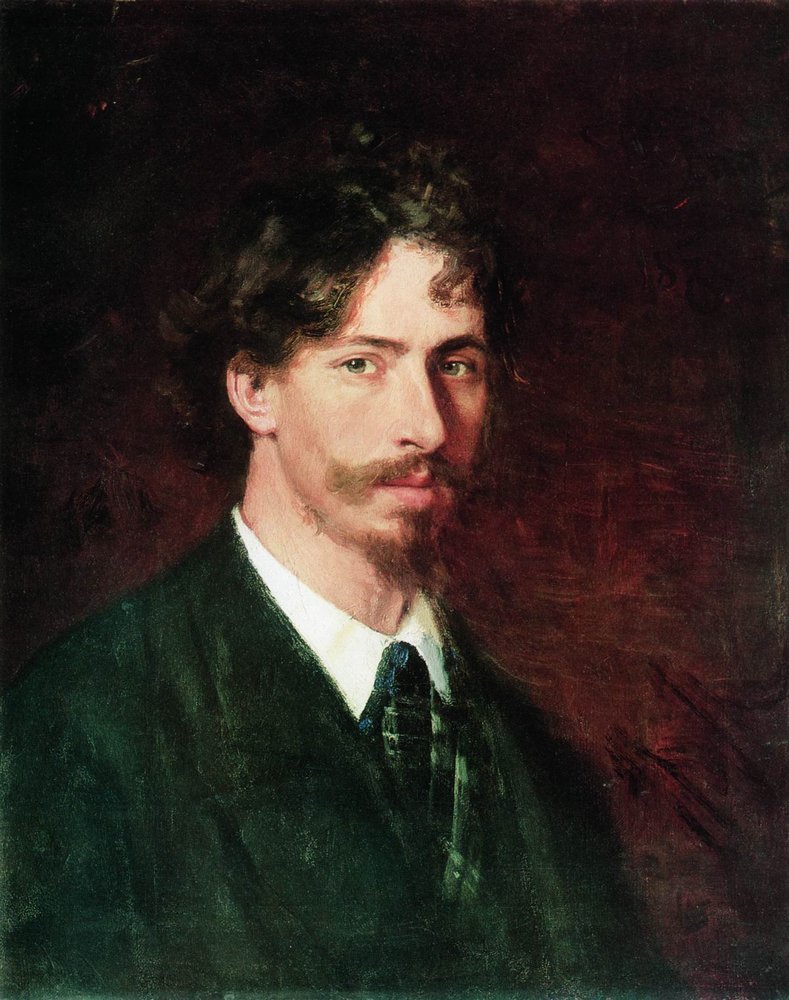
Favorite Artists 15-Ilya Repin


Likely because of the enmity between the old Soviet Union and western nations, much of Russian and Slavic art has been remote and little-known. My favorite of that large and neglected group of great artists is Ilya Repin (1844-1930). 

Ilya Repin, Modes Mussorgsky, 1881
Ilya Repin, "Ivan the Terrible and His Son," oil, 1885

I was reminded of him again not long ago when his portrait of the  famous Russian composer Modest Mussorgsky became the subject of an online demonstration. My introduction to Mr Repin's work came years ago when I stumbled on his incredibly moving "Ivan the Terrible and His Son on November 16,1581," a work of amazing power and horror that he painted in 1881. Ivan is cradling the head of his son, whom he has just struck across the temple in a fit of towering rage. The son, who was heir to the throne of Russia, subsequently died from the blow, marking the death knell of Ivan's dynasty. The expression on the face of Ivan is quite simply an astonishing mix of horror, loss, and hopelessness that is unparalleled in western art. 

Mr. Repin was born in Ukraine and studied in Russia at the St. Petersburg Academy of Arts from 1863 to 1870. Like many young artists in the late 19th century, he traveled to Europe after graduation, spending time in Italy and then settling in Paris for a few years (1873 to 1876), and exhibiting his own work in the Salon. He also had the opportunity to see the first Impressionist exhibition in Paris in those years, and though he was interested in their ideas of color and light he felt that their subject matter lacked serious content. One of his earliest works, often called Volga Boatmen (below), was an unsparing view of the hard-laboring peasants who hauled boats alongshore. In his social conscience, it seems to me, he was considerably closer to van Gogh.

"Barge Haulers on the Volga," oil, 1870
"The Surgeon E.V. Pavlov in the Operating Theater," oil, 1888


Settling in Moscow, Mr. Repin produced works ranging from portraiture to social realism to history paintings and became justly famous in Russia and the rest of the world, and is probably even now the most famous Russian.

"Leo Tolstoy," oil, 1887

Most of Mr. Repins prodigious output is in Russia, either in The Tretyakov Gallery or the Russian Museum in St. Petersburg. If the opportunity presents, visiting either or both of these outstanding collections is on my personal bucket list.

---

In this series: 
 

Friday, March 12, 2021

Two More Downstream

While organizing files it struck me that so far this year I've managed to do at least one watercolor of Druid Hill Creek every month since the beginning of the year, despite the snow and occasional harsh conditions. We've had more than double our usual snowfall so far this year (over 50 inches) and not so long ago the temperatures were barely making it above zero here in flyover land. But today it is 70 degrees and sunny. Spring. 


 The first watercolor in January of this year (above) came in mid-January when there had been an enormous snowfall that covered earlier accumulations. I did this standing in a studio window looking downstream. I washed in a warm tone on the top half of my sketchbook page, laid in the principal parts of the composition in watercolor pencil, then painted using QoR watercolors. This brand is made with a synthetic binder that hold more pigment, so the darks are darker and the lights brighter. This is 6x8 in a sketchbook. 

A little over a month later in February came another big snowfall and finally some clearing after days and days of deep cold. The creek was still frozen solid, but the light was somehow brighter. I posted that watercolor a couple of weeks ago. It was done very much in the manner of the January painting but I did augment it a bit with ink.

Now, about eight weeks after the January painting above is my first watercolor of the year with no snow on the ground. This view came after three or four days of bright sun and temperatures in the 50s. The whole is washed in a kind of gold spring light, especially early in the mornings, and the creek is flowing merrily between dark banks. Unlike other times of year, the water isn't as dark as coffee but seems more like caramel. Before long the undergrowth will start turning green. 

These new watercolors have been a wonderful addition to my studio. QoR watercolors come in tubes of standard colors.

Tuesday, March 09, 2021

The Great British Art Tour

During this pandemic year, closure of public cultural spaces like museums, theaters, galleries, and so on could have made life impoverished, but across the world cultural institutions have stepped up. For example, The Metropolitan Opera in New York has been streaming complete opera free every night for months. Vast museums worldwide offer free virtual tours of their otherwise-closed collections. Symphony orchestras stream innovative offerings from their members. Art schools now offer a wide range of workshops and courses via Zoom or other interactive media. 

Although not a virtual offering, one of my favorite series has been The Great British Art Tour published by the Guardian since the beginning of 2021. These articles each deal with a piece of art in public collections in the United Kingdom. The series is in collaboration with Art UK which is a nonprofit that collaborates with more than 3000 collections. Each week the series focuses on a single work from a public collection, providing background on the artist, the work, and it's location. So the bonus for the reader is a chance to learn about wonderful museums and public art that you'd probably never see.

A good example of the treats of the series is the nearly-unknown painting "A Game of Cut Throat Eucre," a large painting by Frank Gascoigne Heath, a British painter of the early 20th century. The painting shows us a group of fishermen, playing the Cornish card game euchre in the hold of their boat. It's almost five feet across and my guess is that if you could see it in person you'd feel as if you were in the boat too. The use of tenebrism, the dramatic light and dark we associate with Caravaggio, gives this work its charm, in my opinion. In addition, Mr. Heath has used the device of a single contrasting color at the center of interest--the red cap--against the other, duller colors. The painting only entered the Penlee House Gallery and Museum in Penzance in 2017 (it was in a private collection).

Frank Heath, "A Game of Cut Throat Eucre," oil, 1909

For all of us who are still isolated and unvaccinated, and probably for always, anyone who wants to see new art can follow the links, and disappear down many online rabbit holes and links. 

---
Google Museum Tours


Friday, March 05, 2021

Outdoors Again

This week marks my first outdoor oil painting excursion in months. Here in the upper midwest the weather has been cold and blustery. We have had snow on the ground for weeks and only two week ago the high temperatures here in Des Moines were single digits or less with lows below zero. But now, as if someone flipped a switch, the weather had abruptly improved. Pleasant days in the 50s and even 60s are forecast for the next ten days or so. 

On Wednesday, I managed two hours painting on the bank of Gray's Lake. The sun was bright and warm where I stood, sheltered from any wind. Despite the warmth, the lake was still frozen and white, the banks dark with withered and decayed foliage. The distant trees along the south bank are a dark tangle. Here and there you could see that spring was coming but not yet. This paintings is 8x10 on pre-toned panel. As always I laid in broad patches of colors then refined details. This is the product of ninety minutes or so. Afterward I did touch up the right side to unify the sky and trees and darkened the trees.

"Frozen Lake," oil on panel, 8x10


Tuesday, March 02, 2021

Singers and Painters

The sale of a painting by Winston Churchill, wartime UK Prime Minister and polymath, was in the news. The only painting Mr. Churchill did during the second world war sold for the unbelievable sum of more than $11 million. The painting depicts a mosque in Morocco, "Tower of Koutoubia Mosque," and was a gift to President Franklin Roosevelt, who had accompanied the painter to Marrakech after their summit meeting in Casablanca. Although Mr. Churchill was an accomplished amateur his work is hardly in stratospheric category the price might imply. On the other hand (price aside) I wouldn't mind putting it on my wall. It's attractive, though the palette is a bit electric for my taste.

Winston Churchill, "Tower of Koutoubia Mosque," oil, 1943

There are a lot of celebrities from all walks of life who have taken up a paint brush. Paul McCartney, Frank Sinatra, Jane Seymour, Peter Falk, even Prince Charles of England easily come to mind. There are many many others whose main occupation is or was in another field but who have also become known for their art. President Eisenhower was well-known for his oil painting hobby, and George W. Bush recently began showing his post-presidential works. 

Praise for works like the Churchill seem to me to arise more from surprise--''Oh, he painted?"--rather than from aesthetic enchantment. The high prices are more speculative than not and the works can be embarrassingly self-indulgent and unserious. But there are also many accomplished, even masterful painters whose main career was elsewhere. Two who deserve to be remembered for both music and art art are Tony Bennett and Joni Mitchell.

An excellent example of a talented painter who is famous in another way is Joni Mitchell. In an interview a couple of decades back she said she was a painter first and a musician second. She attended a year or so of art school before leaving and becoming a folk singer/song writer, but continued making drawings and paintings during the ensuing five decades. She has an excellent eye and a discerning vision. Her work has featured on album covers like "Clouds" (below) as well as standing on its own.

Joni Mitchell, "Clouds," gouache, 1969

Another singer whose work has garnered respect is Tony Bennett. Mr. Bennett has had a career in music spanning seven decades and even now has fans of all ages. He has also been recognized for his paintings and drawings, which he exhibits and sells under his real name, Anthony Benedetto. His work has been exhibited worldwide and is in several museum collections, including the Smithsonian American Art Museum. Mr. Bennett will be justly remembered for his music, but his art will likely also be his legacy.
Anthony Benedetto, "Central Park," oil, 1998