Friday, September 30, 2022

Water

Considering that it's transparent, water has a myriad of appearances. Because of its transparency, water reveals much. But when light strikes water at some angles the result is reflection--blue water is actual a reflection of the sky. Still water looks completely different from moving water. The ceaseless ocean has even more variations. 

My own studies of the qualities of water--especially flowing rivers--continues. In "Middle Raccoon," a studio work completed while I was at Whiterock, the river was flowing smooth and slow, leaving its surface a flat mirror of the deep sky. Along the banks of the river wildflowers were blooming in a riot of yellows and mauve-red. Although this was painted from photo references it was also based on hours of contemplation in peace and serenity. The only sounds were a gentle rustle of leaves and birdsong.

Hoff, "Middle Raccoon," oil on panel, 11x14

This particular painting will be offered on my website in a few days, so check there for new works--www.garyhoff.com

Tuesday, September 27, 2022

Whiterock Morning

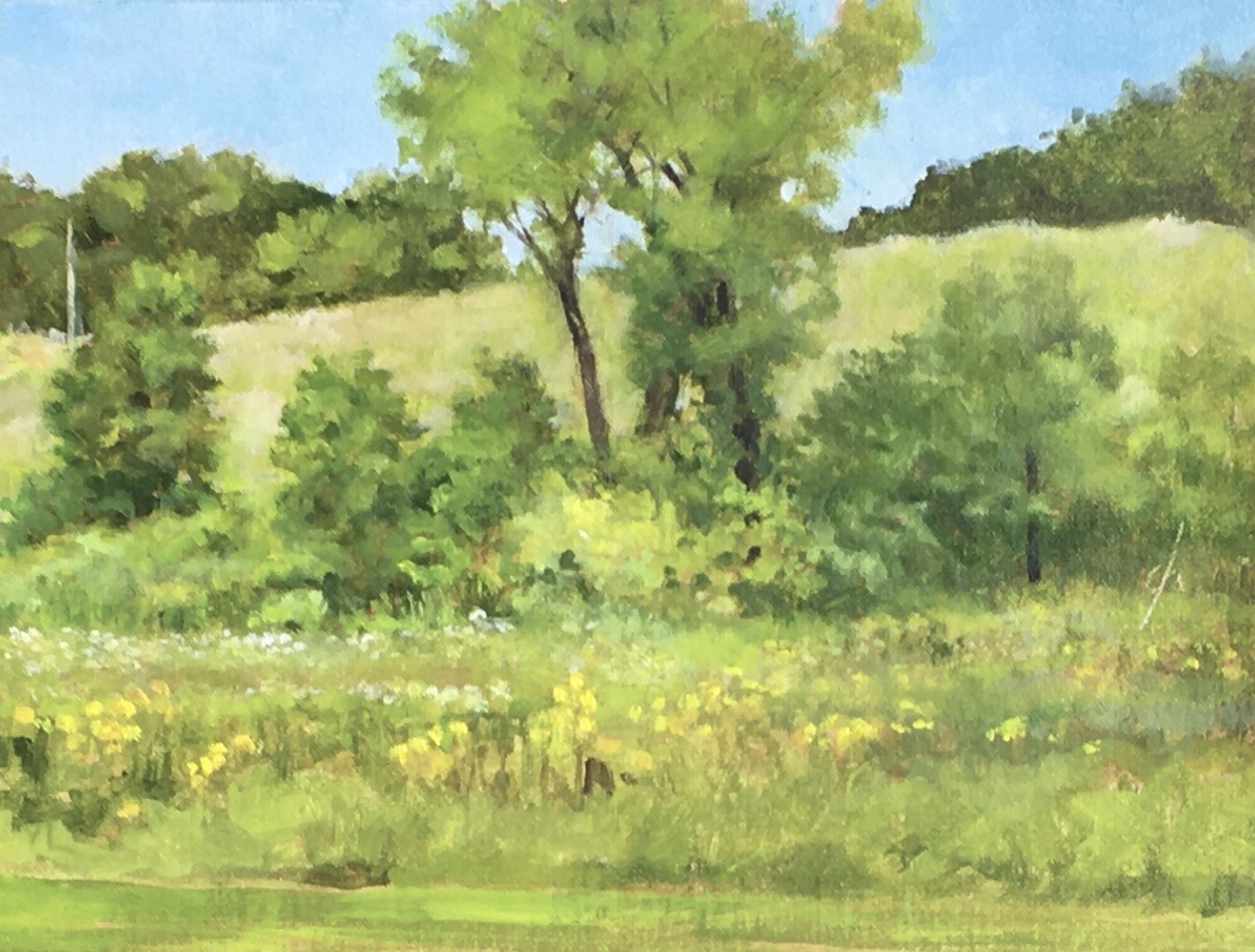
While I was at Whiterock Conservancy, my constant view was a hill just across the Middle Raccoon River from the River House, where I lived. Most mornings I sat on the vast porch that faces westerly, watching the light crawl down that hill, lighting the riotous wildflowers along the river. This plein air piece was done from that viewpoint, although outdoors, in two late morning sessions. 

Hoff, "Whiterock Morning," oil on panel, 9x12


The experience of spending time confronting and considering a subject was invaluable, and the surroundings were sublime. 

---
 

Friday, September 23, 2022

At the Park

During my residency at Whiterock, I facilitated three sessions of plein air painting, two at the conservancy and one at the Fort Des Moines Park. During those sessions I attempted to demonstrate a beginning and finish a small oil in the time allotted--about three hours. The site is one of the smaller parks in Des Moines and it's less visited too, even on a Saturday, when we painted there. Lack of rain during much of the month of August had driven grasses to yellow-brown dormancy but the trees still wore their deep summer greens. Along the banks low greenery still flourished. The small lake was placid, the breeze cooling, and distant music brought a smile.

Hoff, "Near Sunset, Ft. Des Moines," oil on panel, 9x12

A weather front threatened by the time this one was finished, The lowering sun caught the coming cloud tops. I managed to finish the painting in time to stay dry in the bargain.

Tuesday, September 20, 2022

Details

A useful tool for a painter to practice or advance skills is sketching. In particular, sketching small things like leaves, stones, branches and boles of trees. It isn't so much that each of these things must be drawn or painted with exactness. It is simply that it's difficult to accentuate, or deviate, unless you understand the shape being imitated. A good example is drawing or painting trees. A beginning painter will often encounter the advice to make the tree's foliage look like solid chunks of matter--balls or fluted vases or whatever and not try to draw each leaf or branch or twig. That is, suggestion is a more potent indicator of the world than tiny tiny details. Still it helps to understand structures. 

Hoff, "Study--opposite bank," iPad sketch

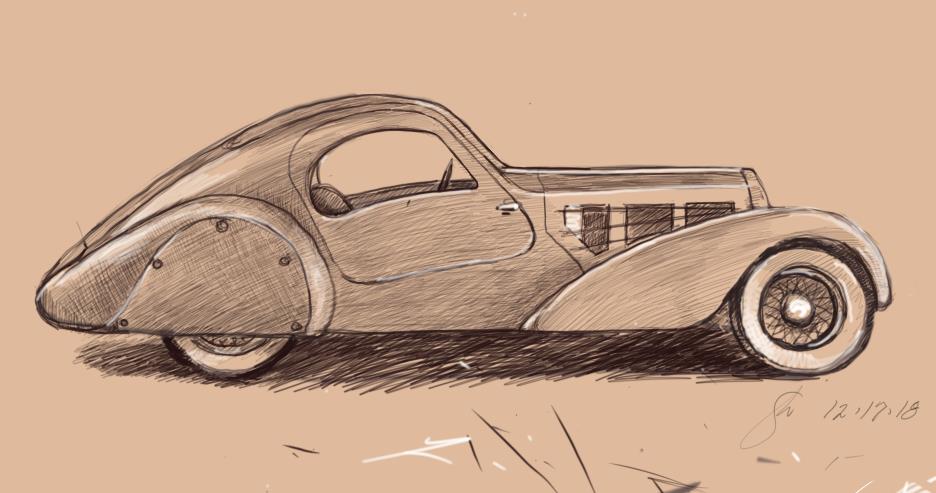
In "Opposite Bank," from 2019 I used an iPad and Procreate to simulate a drawing done with a soft graphite pencil. As you can see, the masses of leaves are treated as big solids, though here and there I gave in to the temptation to render leaves too. The grasses are also treated as masses and not individual stems. Knowing how this tree branches and how its smaller twigs end in the mass of leaves is a critical piece of detail  information. 


Hoff, "Before the Snow," wc on paper, ~5x9
The intrinsic shape of trees varies by species and type, and knowing the variations can help even when there are no leaf masses. Sometimes in late autumn through very early spring an artist is called on to make and image of leafless woods. In "Druid Hill Creek Before the Snow" (above) there are vague washes of color indicating bare branches in the far distance, against a blue-grey sky. Instead of trying to render distant branches I washed in massed color and then drew branches here and there delineated various stands of woods. Knowing the trees' intrinsic structure, a crucial detail, helped make this watercolor believeable. 

Hoff, "Across the River (plein air)," oil on panel, 9x12
In "Across the River," above, although details, again are missing in nearly every passage, this painting again demonstrates the importance of understanding them. 


Friday, September 16, 2022

Winold Reiss

The information age is wonderful Wide-ranging forays into the Internet turn up jewels among the offal. Time after time the 'net shows me new and really wonderful artists that I've never known about. The latest was Winold Reiss (1886-1953), a German-born painter and graphic designer. Like many he was successful and well-known while he lived but has faded into obscurity since his death. After reading a bit about his life I spent some time with his images. This is an artist who deserves to be remembered. Luckily, the New York Historical Society is currently exhibiting a wonderful collection of his works.

Hoff "Winold Reiss, ca. 1930" digital
Mr. Reiss was born in Germany into an artistic family. His father Fritz Reiss was a successful landscape painter and Winold's first teacher. Eventually Mr. Reiss attended the Royal Academy of Fine Arts, in Munich and the School of Applied Arts, also there. His training was therefore in both fine arts and in graphic design and it served him well. In 1913 Mr. Reiss came to New York City, where he settled permanently One of his most intense interests was ethnic portraits. He visited Montana and the remnants of the Blackfoot tribe, both surviving elders and younger generations, and painted several hundred portraits. He also traveled in Mexico where he painted revolutionaries--mostly indios. In addition he was a teacher at the Art Students League as well as founding his own schools and teaching studio. 

Much of Mr. Reiss' graphic work was ephemeral, published in periodicals that have also faded away, and much of his portrait work is in private collections. So far as I can tell, no exhibition or retrospective of his oeuvre has taken place either. I've done a bit of searching online and found a few well-known works and some that show his amazing skills.

Particularly interesting is his sketch of a male model with hands on his hips, gazing to his right. It reminds me strongly of Holbein, perhaps because of the pose but more likely because of the attitude depicted in the sitter's expression.

During the second half of the 1920s Mr. Reiss made a number of portraits of Harlem Renaissance, hired by the social welfare journal Survey Graphic. Later on he illustrated an anthology of Harlem Renaissance writings. Perhaps his most famous portrait from those days is Langston Hughes (below), but he made portraits of a number of others, including Zora Neal Hurston. 

The New York exhibition of Mr Reiss' works at the New York Historical Society will be on display until October (link below) that would merit a visit but alas I will not be able to attend. 

"Langston Hughes," 1925

"Zora Neil Hurston," 1925


"Turtle," 1920


--- 
Exhibition Links:

Tuesday, September 13, 2022

A Saturday Watercolor

Back in June the Saturday sketch group made our way to Waterworks Park to draw. The afternoon was grey and felt damp, but the group is seldom discouraged by weather. But by the time I was motoring along in the park fat droplets were hitting the windshield. The rain sputtered, starting and stopping, sometimes a brief shower but mostly just drips and drops. It didn't look promising, but I pulled off the park road at a pedestrian/bike bridge (actually an old, converted railroad bridge).

Although painting in the car isn't a favorite of mine, I spent about ninety minutes making a sketch of the bridge, a steel framed trestle that must date back nearly a century. It spans the Raccoon and the bike trail goes off into wild growth woods to the north before winding its way to a city park a few miles away. The open structure was a fun challenge. 

"Waterworks Park Bridge," wc on paper, about 6x9


Friday, September 09, 2022

Digital Dailies

Drawing every day is a discipline that I probably wouldn't have adopted without digital equipment. Like most codgers of my generation and background, drawing, to me, involved marks on paper or perhaps parchment. Drawing produced tangible results--you could hold the drawing in your hands, smell the ink (or smear it!). But daily drawing with traditional materials required a certain degree of preparation, appropriate pencils or drawing implements, and so on. Digital drawing seemed promising. It is considerably more convenient--computer on, program booted, draw. No cleanup. Save and power down. 


But digital drawing requires learning a completely new tool, a new tool that is not simple nor easily employed without significant commitment. Depending on the computer program, the platform (PC vs. Apple), drawing tablet, and more, it may take months to years to advance one's traditional drawing skills into the new medium.
 

My current equipment is a PC with a Wacom display tablet. I run several different programs on my desktop, including Sketchbook and Paint. These digital drawings were all done using that setup. 


---
Related Posts:

Tuesday, September 06, 2022

Reflections on the Residency

My stint as Artist in Residence at the Whiterock Conservancy here in central Iowa ended nearly a week ago. Three weeks living and working there were in many ways a personal retreat. With only drawing, painting, looking (seeing) and the small tasks of day-to-day living, the world seems to expand. The Conservancy is about six or seven square miles of preserved and/or restored lands, and my quarters were about in the center. The terrain is varied, from the valley and wetlands of the Middle Raccoon River, to now-rare oak savanna, to the rolling prairies that most of us associate with Iowa. The land has been husbanded and restored, with much of the area surrounding the river growing undisturbed for hundreds of years. In short, paradise for a landscape painter. Beyond the beauty of the scenery, the peace and serenity at The River House is incomparable. The sounds of the planet are audible there--the call of a catbird, a distant barking of a night-traveling coyote, a faint bovine bawl. And the darkness down by the river is nearly total, so that the stars blaze at night.

With such riches surrounding me, it was easy to abandon much of my electronic connection to the world. No television and no radio, little attention to social media, and fewer references to email meant much time for thought, observation, and even a kind of meditation. It is rare in many lives to have such an opportunity--to simply "be" and live in the moment. The residency was an eye-opening, remarkable experience, a true gift. 

Hoff, "Middle Raccoon, Whiterock," wc on paper
As a plein air enthusiast, it was difficult for me to decide whether to load up my gear in the ATV or paint in the small studio, so in the end my output was through both, which is ideal. This land is as it always was, festooned with yellow coneflowers, Queen Anne lace, several kinds of sunflower, Joe Pye weed, and more. The effect is big drifts of color along the banks of the river. The oil below was done in the studio, based on a watercolor study (right) and personal photos.

Hoff, "Riverbank," oil on panel, 11x14

I did a number of plein air works  too. Across the river from the barn a rounded hill looms, topped by old dark oaks. It slopes up to the northwest, and is covered by tall grasses. Perhaps the bluff was cleared and farmed once, but for whatever reason there is a meadow at the top, fronting the oaks. The lay of the land means its appearance changes a lot during the day. It was an interesting exercise to paint the scene at different times.  

The echoes of the residency will no doubt sound through my work for the next weeks and months. 


Friday, September 02, 2022

The Ashcan School

In the early 20th century, a motley group of illustrators and painters began producing realistic paintings mostly depicting the common city people going about their daily affairs. Their styles were similar but varied as were their social and political views. Nonetheless, these artists wanted to tell the truth of city life as they saw it--that is, they believed art should be like journalism. The eldest of them, Robert Henri (1865–1929) was probably the best known. Influenced by the poetry of Whitman, whose rough works celebrated the common man, Mr. Henri believe that art of his time should explore the lives of cities and working class people. The painters shared a fascination with subject matter, not technique or materials or even style. They produced works that were darker in palette and darker in social terms. The hard truths of modern city life appear in many of their works--prostitutes, street kids, the subways, boxers, and more.

John Sloan, "McSorley's Bar," 1912


William Glackens, "At Mouquin's" 1908
 Many works by Ashcan School painters were less finished, sketchier and more gestural, with juicy, vigorous brushwork. Although they painted the common people, Ashcan painters also did well by the upper classes. William Glackens' most famous work "At Mouquin's," gives us a peek into an upscale New York eatery of the time. The wife of the proprietor is the lady but the man is a wealthy playboy.

George Bellows, "Stag at Sharkey's," 1909


One of the more brutal examples of Ashcan works is "Stag at Sharkey's," by George Bellows (1882-1925). Two club boxers, clashing in a private club, glisten with sweat in center ring, slashing punches and elbows at one another as grotesque spectators crowd ringside. Bellows' brushwork features quick, thick strokes and hides the fighters' faces, emphasizing the anonymous brutality.

Works by the painters linked below are justly famous or well-known, but movements in the "art world" were diverging from representational art and realism in favor of cubism, abstraction, fauvism, and a host of movements. Nonetheless, these painters and their works repay study.
 
---

Tuesday, August 30, 2022

A Very Old Sketch

In other postings I've mentioned my process of reviewing previous works, mostly as a way to look at past techniques and accomplishments. It's also a way to gauge how skills and ideas change over time. So here is a really old sketch I ran across not long ago. 

This about 8x10 graphite sketch depicts Stewart, who was 96 or 97 at the time. We were guests in the same house and often spent an hour or two on the front porch after breakfast. Although he was a relatively abstemious man, Stewart allowed himself one cigar every morning. So he and I sat and discussed many things. Born with the century that was fading, he'd been a bit too young for the first World War and a bit too old for the second. But he had spent nearly a century working and observing the world. Stewart was still mentally very sharp though physically his age was obvious. Even now, a quarter century later, I remember his quick laugh and mischievous demeanor. 

Sketching is visual journaling.


Friday, August 26, 2022

Plein Air at Whiterock

As the second of my three weeks as Artist in Residence approaches, the experience has begun to take on weight and depth. One of the great features of this residency, for a plein air landscape painter, is the enormous variety of subject matter. There is a century-old barn, the river, wildflowers galore, old-growth woods, and a lot more. The ability to explore using a small all-terrain-vehicle has been priceless--I can load up my plein air gear and go nearly any place in this vast, rich Conservancy.

"Whiterock Bluff," oil on panel, 9x12

Whiterock Barn," oil on panel, 9x12


Tuesday, August 23, 2022

Artist in Residence

Hoff, "On the Middle Raccoon," wc on paper

During the week before this posting I've been Artist in Residence here at the Whiterock Conservancy, an Iowa land trust working toward conservation, sustainable agriculture, education and recreation. Situated on the Middle Raccoon River near Coon Rapids, the Conservancy comprises about 5500 acres of river valley, prairie, savanna and farmland. Much of the Conservancy was part of the Garst farm which famously hosted Nikita Khrushchev in the 1950s. The Conservancy aims to save our remaining topsoil, restore soil health, and educate the public and private sectors.

The River House, Whiterock Conservancy

Residency here includes housing in a wonderful, century-old farmhouse (with studio) situated in the Middle Raccoon River valley, only a few dozen yards from the river. The Middle Raccoon There is an equally old barn (see below) and other buildings on the site. Wildflowers abound along the river bank and hiking trails. Trails for hiking, horseback riding and cycling provide a network leading into the spectacular landscape along the river and take you through oak savanna and restored prairie as well. The undisturbed quiet is therapeutic, the surroundings too. I've managed a number of plein air sessions involving both oil and watercolor as well as studio paintings, and before leaving will have taken scores of reference photos.

Hoff, "Whiterock Barn," oil on panel, 9x12


As part of residency at the Conservancy I'll also be facilitating plein air painting workshops the afternoon of August 25 and morning of August 26. The focus will be on outdoor oil painting, but artists in other media are certainly welcome. I'll be doing demonstrations and assisting participants.

Mainframe Studios in Des Moines is a cosponsor of the workshops and will hold a show and auction of participants' works at their facility during their First Friday event September 2.

Friday, August 19, 2022

Summer

"Mountain Stream," oil on canvas
Outdoor work--painting, gardening too--becomes a huge part of the day during the warm months. Unfortunately, the last month or so has been hotter than usual, limiting outdoor activity to early mornings, mostly. So studio work is a big portion of my schedule.  

One of my summer projects that is probably finished is a fairly large landscape "Mountain Stream." Although it's based on several references, this is an imaginary scene painted to evoke crisp, cool mountains, perhaps the Alleghenies or Adirondacks. The major interest for me is how angled light filters through distant boles and foliage, only to rebound from the surface of water, shore, and even the bottom of the brook. This was in the end a study of light and water and how they interact.

The studio is likely to get a lot of use during the rest of the summer, but for three weeks (starting in a few days) I'll be Artist in Residence at the Whiterock Conservancy here in central Iowa. Their dedication to conservation, sustainable agriculture, recreation and education provides interested artists and scientists opportunities for concentrated work and thought at the Conservancy, an enormous place encompassing farmland, the Middle Raccoon River, and many plein air opportunities. I'll post from there a time or two.


Tuesday, August 16, 2022

Naked Ladies

Here in Iowa there is a plant called "naked ladies" that suddenly emerges, sans leaves, about this time of summer, showing pink, lily-like flowers. They're also called "surprise lilies" or "resurrection lilies." One of our sketch group saw an astonished array of them here in the city, a glowing cloud of pink in a sunny meadow. There were hundreds and hundreds of them, some in full flower, some just up and still in bud. Intrigued, the sketch group spent some time there painting and drawing last Saturday afternoon. 

Most of our group chose to focus on the mass of flowers in the meadow, interested in their forms or colors. And the majority of the group sat in the shade (just out of sight to the right of my composition) to do so, facing me. Although the mass of flowers is what drew the group, I actually eliminated the majority of them and focused on the woods behind.

For me, the bright contrast of the house in the dark trees was compelling and the carpet of flowers at the base made an interesting contrast. This view gave me an opportunity to emulate three dimensions on a flat page. If you look closely there are seven or eight levels in this watercolor. The sketchbook gives an opportunity to paint onto both pages when the composition is vertical, so in this case the painting is about 14x5, emphasizing the height of these old trees.


Friday, August 12, 2022

State Fair Memories

Since the pandemic began in early '20, the Iowa State Fair has been absent from my schedule. The first year it was cancelled and last year seemed too early to go, so far as I was concerned. This year's Fair began yesterday with the traditional parade and much of the previous hoopla. Again this year, as the covid pandemic continues (if blunted somewhat) it still seems too early to be in huge groups of people. That's too bad because the Fair offers so many opportunities for sketching, people watching, serious food-tasting, and the like. These sketches are memories of Fairs past.

"Outside the Grandstand," ink/wc
The Grand Concourse runs through the heart of the fairgrounds. There are often dense crowds.
The cupola in the sketch on the left is the top of Pioneer Hall, one of my favorite buildings at the Fair. The Hall houses all manner of "old-time" exhibits--a blacksmith shop, a letterpress shop, people working with antique things like a spinning wheel and so on. It's an enormous frame building and probably at least a century old. The sky ride gondola is a nice contrast.

One of the amenities of the Fair is the tram service. Throughout the 11 days a tram service circles the entire fairgrounds, pulled by enormous green tractors driven by volunteer groups. The tram is a great way to get an overview of the gigantic event, which encompasses everything from animal exhibitions and competition to fine art exhibitions. 

Perhaps next year will bring a chance to return to the Fair in all of it's smelly, tasty, glitzy, sentimental glory.


Tuesday, August 09, 2022

Weekend Watercolors

Although the weather here in Iowa has been sultry, at best--not a word often used to describe our climate--the Saturday sketchers were diligent and faithful last Saturday. We went to one of the local parks despite the triple digit heat, and sketched a bicycle path passing into the park from Gray's Lake. 

The heat was made bearable by a semi-cool breeze that eddied into the deep shade where I sat. The bicycle path was surprisingly busy with single cyclists and groups. I actually did two quick ink and wash sketches in watercolor. The first was a wider view and included lots of sky; the second was a smaller sketch in a 5x9 sketchbook. 

"Bike Path," wc on paper, about 8x10

"Bike Path Too," wc on paper, 6x9


Friday, August 05, 2022

Striper Time

A little over three years ago I had the pleasure of spending a few days at a plein air workshop with my friend Garin Baker. Garin lives along the Hudson River maybe 60 miles north of Manhattan. Besides being a master artist and teacher, Garin is also an avid fisherman. Here on the river, not far above West Point, spring and early summer mean striped bass are running and Garin and his buddies fish for these big fighters in Newburgh Bay. A loose group of men and women spends many mornings working the river, fishing for stripers as they move upstream to spawn. 

Garin Baker, "Remains of Fall," oil on canvas
The spot where the striper fishermen spend their mornings is a favorite painting location for Garin (see above), and we spent two days painting there and one at another locale. It's a beautiful spot on the shore of Newburgh Bay, which is actually a very wide spot in the river. Downstream is the round top of Storm King Mountain, and beyond that, to the south is West Point. The fishermen gather along the point of land and cast their bait far into the current, angling for a strike. We set up all along the shoreline and painted most of two days.

Hoff, "Hudson River Newburgh Bay," oil on panel

The group of a dozen or so painters made two paintings a day. My 9x12 oil sketch of the bay (above) looks as if a flock of birds is flying over the water, but in reality those are gnats caught in my paint. The day wasn't very sunny. Later in the year I made another painting of the Hudson, based on the studies from Garin's workshop. 

Hoff, "Striper Time," oil on panel


Tuesday, August 02, 2022

Sketching

Sketching, unlike a finished painting or drawing, is immediate, brief by definition, and generally intended to capture a fleeting impression or idea. The sketcher often only has a few minutes before their subject disappears or the light or weather changes. Crowds are constantly moving; so is water. Sketching forces the artist to observe sharply and paint or make marks accurately and quickly. 

A good example of a quickly drawn but incomplete sketch is a small graphite image of one of the Principal Building, a dominant downtown building here in Des Moines. Towering over its neighbors, the building has a fairly complicated architecture that must be drawn with accuracy. This sketch took about an hour in a one of my sketchbooks. I often use toned paper to provide a middle value to set darks and lights against. The purpose of this sketch was simply to study the building's structure. Anyone making an image of the city needs to make an accurate image of this one.


Another study of downtown buildings provides context and an understanding of surrounding structures. The dominant building of course is still the Principal. In this case I used white chalk to provide a more structural look.


Finally, here's a watercolor sketch of the Des Moines skyline, from last Saturday's sketch session. We went to a park just south of the Raccoon River, overlooking downtown, and painted. The day was sultry, the south wind warm but slightly cooling. I laid in the shapes faintly with graphite pencil, painted broad color shapes then refined the outlines here and there with ink. With this kind of sketch plus various graphite studies, there's probably enough information to use in a studio oil painting.

Friday, July 29, 2022

Reviewing

One of the things that I do is to review previous work after it's had some time to retreat from memory. This week I spent some time looking through older plein air works, mostly from several years ago. These are studies rather than finished paintings. That is, they're fodder for studio works to come and as such haven't been displayed before.

"Blue Spruce," oil on panel 9x12

This one, "Blue Spruce," dates from July 2019 and is the view across Druid Hill Creek from my studio. I stood on the bank and painted this study in one two hour session. The main interest was the varied textures of foliage and undergrowth, accented by the light blue evergreen

"Out Back," oil on panel, 9x12

Another from the same month is "Out Back," which features the two trees but omits the spruce. The dappled light, varied leaf shapes and myriad greens were the attraction. 

Though neither of these works can be called a complete painting, they each serve as painted memory.


Tuesday, July 26, 2022

Hazy Day of Summer

Last Saturday was the first time out with the Saturday sketchers in three weeks, and it happened to be the hottest day of the year. We gathered at the local art center as usual and motored out to one of the lesser-visited city reservoirs. It's as small lake behind an earthen dam, surrounded by mature trees and parkland. Even though it was well above ninety degrees, the wind brought some coolness from the lake. I set up on a picnic table in dense shade where I could see the top of the dam beyond a big expanse of water. The small domed building is at one end of the dam, presumably housing technical equipment.

"Maffett Dam," casein on panel, 6x8


People who have read this blog lately know that I've been contemplating a return to casein for outdoor work. Saturday was the day for a lot of reasons. For one thing casein dries very quickly so if it was useable in high temperatures and windy conditions it's likely it will be useful at other more hospitable times. For another, my small paintbox contains everything I need except water and brushes, so the medium is pretty portable too. I painted Maffett Dam on a panel previously toned with burnt sienna. You can see hints of the toning in the foreground and at the zenith of the sky. I began with a faint graphite layout of major shapes, then dove right in with color. Casein dries in minutes, rather like acrylic, and doesn't reactivate with water the way gouache or watercolor do. So it's ideal for quick layering of color, which is how I approached the painting. Throughout the work you can see examples of layered colors. The image gives an indications of the heated, hazy air, a feature of casein as it dries matte. It does photograph well, which accounts for its use among illustrators of decades gone by.

Friday, July 22, 2022

One More

I've posted a few casein paintings from years past as a review and a stimulus to do some plein air work with the medium. Just today an old memory surfaced, "Coffee," a work on paper dating to 2017. This particular painting began as an experiment in the casein medium rather than an attempt at a finished painting. But as the work progressed I was seduced by the two primary colors, the repetitive bulb shapes and the off-white neon tubing. As the work progressed to more and more detailed the quick drying casein made layering, highlighting and the like considerably simpler.

"Coffee," casein on paper, about 7x10
So, this painting seals the deal for me. I'm going out with casein in the next few days. I might even take it out when the Saturday group goes, this weekend.

---
Similar Posts

Tuesday, July 19, 2022

The Ford

As a beginner, it was important to me to make a recognizable and believable image of whatever my subject might have been. Portraits, of course, should look like the sitter, and so on. Beginning painters like I was often slave away to not only make their picture recognizable but detailed and identical. That is, the temptation is to show the item in detail, so that many times we produce detailed but somehow stiff and lifeless pictures. We protest "but it was there!" when a mentor or colleague points out our obsessiveness, but eventually we learn to edit, suggest, indicate, and soften our edges and brush strokes. And we learn to compose and recompose.

We eventually learn to compose on the fly, rearranging the landscapes before us to become different scenes altogether. A good example is The Ford. The setting is Druid Hill Creek about a half mile north of my studio. It is a small creek, probably ten feet across and usually no more than six inches to a foot deep, flowing briskly. At this particular spot, there is a group of boulders placed by whomever maintains paths through these woods, probably truly intended as a fording place since the banks on each side upstream and down aren't very useful. This angle is one I've studied for many months, and the distant stone bridge isn't there; it's actually a concrete street culvert over the creek. The main masses in the painting are pretty much the view, but houses and electric lines fill the far distance and were edited out while painting.

"The Ford," oil on panel, 16x12
The Ford is a studio painting done from reference photos and many personal visits. Unlike many of my landscapes, this one wasn't preceded by a plein air study. I began with a burnt sienna tone, then a warm block in of the main shapes. Proceeding dark to light and top to bottom, I painted in several layers of progressive but controlled detail until it was time to stop.


Friday, July 15, 2022

Plein Air Oil

Last time I mentioned that we've been here in Virginia for about a week, relaxing along a beautiful river. The river is just outside the door, a constant murmur of water and a central fact of life. You can spend hours on its banks or in the crystalline water. For me, this is one of the unspoiled and special places. You can relax here and simply study the water. 

One of the things that makes moving water a fascinating subject is how changeable it can be. One moment the water is transparent, nearly absent, and the rocky bottom ripples with light; the next the sky is shining in bright blue bars across the surface. The movement changes, light changes, and more. For a painter, the challenge is to observe closely and sharply, then put down paint in a meaningful way. You have to be quick, and acute. This 9x12 is a view of the opposite bank of the river where we're guests. The folks who host us have been living along these waters for more than six decades, and one can see why. 

"Along the Cowpasture River," oil on panel, 9x12

Tuesday, July 12, 2022

Almost Heaven

This week we've been visiting friends in southwest Virginia, not far from Roanoke. This range of ancient mountains is part of the chain that extends northeast from here, through Pennsylvania and farther north as the Adirondacks. This part is the Alleghenies, humped and ridged and clothed in deep green. We're staying on a small clear-flowing river with old friends. 

Lewisburg, watercolor on paper, 9x5
We spent one afternoon in a town forty miles or so away, Lewisburg, West Virginia. It's an old old town in Greenbrier County, founded in the late 18th century as people began moving in from farther east. As you would expect, much of the town dates from the 19th century, and the main street has been beautifully maintained and restored. 


I spent some time ambling along, exploring a book shop, two or three galleries and antique shops, and an Irish pub. The sketch above is of that main shopping street in hilly Lewisburg.

Friday, July 08, 2022

Seeing and Painting

If you're a painter who has attended workshops or painted alongside others, you have probably noticed that when it is time to begin a picture, outdoors or in, the impulse is to grab a brush, dip it in paint, and get going. Time's a-wasting. Get some paint down. Make a statement and go from there.Maybe that's not the best approach. 

Years ago, a mentor gave me one of the best pieces of advice about painting: "Look more than you paint." That is, the actual work of painting (realism anyway) is done in the seeing. An artist should see the big shapes, patterns of light and dark (values), perspective in all of its forms (linear, atmospheric, etc.), colors and their complements, plus specific details and considerably more. If we think of it, that list can apply to a portrait, still life, landscape or whatever. Understanding and reviewing the properties of the subject is how the painter discovers how to begin. 

"Raccoon," oil on panel, 9x12

Painting "Raccoon," last Saturday, I stood along the bank, almost in the river, painting the lush woods along the Raccoon River in a familiar spot I've visited many times. It was early afternoon, so the shadows were more vertical than horizontal. I began as always with a thin wash of burnt sienna to establish the basic composition and value patterns. The greens of the trees and undergrowth looked quite dark in places, but here and there bright yellow-greens predominated. The opposite bank of the river bend juts into the frame, an ochre-red color of sand, debris and small rocks. That color, in shadow is echoed on the left side. To make this picture, I spent a great deal of time trying to see big color shapes--not objects but colors--and how they fitted together. The light-shadow patterns in the trees were particularly important. Looking at the water I made reflections that were in the pattern I saw in the water, then painted ripples and lighter sky reflections over the deeper darks. In the end, observation and painting took about an hour. Clearly this is a study and shouldn't be taken as an example of a finished studio work.

If one spends most of the time groping instead of studying, painting will take longer than necessary. So paradoxically the longer you look the quicker you can paint.


Tuesday, July 05, 2022

A Journal of Druid Hill Creek

The great thing about sketching--regardless of medium--is that the result is a sort of journal, a visual notation of the world. Some artists more or less sketched their way through life--Andrew Wyeth for example. A while back I put together a Powerpoint of a year along Druid Hill Creek, comprising a set of watercolor sketches, mostly about 5x9 in small pocket sketchbooks.There are a baker's dozen of these small watercolors, about one a month.

Click to enlarge

Friday, July 01, 2022

A Cooling Memory

While thinking about the blog I ran across an unpublished watercolor from last February. Not an unusual thing, but with the heat this June--temperatures over 90 and high, muggy humidity--a memory of the crisp winter air and infinite sky was welcome.

There's something satisfying about the limited range of colors and the simplicity of a winter landscape. This particular view is a familiar one to anybody who reads the blog. It's Druid Hill Creek flowing north from my window. The weather had turned colder and nearly six inches of new snow had fallen the day before. I don't know about you but looking back at a wintry view doesn't cool things at all but it does make the heat more bearable.