Tuesday, March 07, 2023

Saturday Sketches

As the weather warms and the light shifts it has been possible to head outdoors with the Saturday group several times since the beginning of the year. Last Saturday we met as usual and went to Waterworks Park. I spent a bit more than an hour sketching from the open door of my car. The sun was warm but the breeze was sharp and uncomfortable. Happily, the sun emerged and lighted the scene. 

"The Bank of the Raccoon," wc and ink on paper

The first sketch I did was of the northern bank of the Raccoon River where it bends and almost touches the road. This time of year what color there is hasn't much punch. Instead the landscape is nuances of greys and ochres. This particular painting is about 8x10 but because the colors are muted and very close in values it took less time than usual. I pulled out a small pocket sketchbook and did a second much smaller study of a dead white tree a bit farther downstream. The bark had fallen away and the white of the heartwood stood out starkly against the darks of the woods.

"Dead Tree Study," wc and ink on paper


Friday, March 03, 2023

New Blue

Until a couple of years ago, a relatively new pigment known as YInMn blue, that was discovered only in 2009 or so, was an expensive curiosity. It was discovered as a byproduct of research into compounds for application in electronics. Comprising yttrium, indium and manganese, the resulting material is an intense and color-fast blue, very nearly like cobalt blue. Because of expense in production only a limited supply of the pigment is available although it has been mulled in oil and acrylic vehicles. Some companies have produced limited editions but many of those are currently out of stock.

Because of an interest in pigments I purchased a small tube of acrylic YInMn blue a year or two ago. As expected, it resembles cobalt blue both in mass color and when mixed. The difference between the two is quite small and suggests to me that this newer blue will always remain a curiosity. 


Tuesday, February 28, 2023

Concept to Completed

Many painters go through a relatively extended process of observation, study or studies, preliminary sketching, and eventually completion of a finished painting. For me, that kind of work up to a completed oil painting would be ideal, and sometimes I even do it that way. Many times though the final painting seems to leap off my brushes and onto the canvas. 

When I do go through studies and sketches many don't get saved, but here's a painting of a Des Moines landmark that went through several stages.

"Des Moines Pagoda," ink and marker, 2016

This small ink study is the result of several visits to an Asian pavilion that was constructed on the east bank of the Des Moines river about 15 years ago as a commemoration of a former governor and his humanitarian efforts on behalf of Asian refugees. The building is in the traditional style of Asia, with a deep red structure and a multicolored roof with upturned corners. To me it was a bewildering cacophony of forms and shapes that I wanted to master. 

"Study for Landmark," oil on panel, 2020

It took about four years before I was able to return to the subject, but as a beginning I made a 12x9 plein air oil study, from the south side of the building, trying hard to capture shapes and colors without much regard to detail. Even though I omitted much detail, the on site work was invaluable when I did the finished work, below. 

Still not satisfied with a first plein air work I returned a few days later to work from the opposite side and refine some of my ideas. That work was larger and I posted it here about two years ago. I considered it a success in itself but wanted to do something more descriptive of the pavilion.

 In total, besides graphite sketches now discarded I did at least four or five rendering of this complicated subject before feeling satisfied.


"Landmark," oil on panel, 14x11
"Landmark" is still not a very large work at 14x11but the size is appropriate to the amount of detail intended. My interest was in the roofline with its various devices for luck and to propitiate the heavens with the sculptural effects of clouds and foliage. But it was important to have the colors right and the tiles of the roofline.


Friday, February 24, 2023

Eternal City

Because of the pandemic and other considerations, it has been a number of years since we visited anyplace outside the United States. It would be lovely to revisit favorite places, countries and cities that we've loved, but time is fleeting. In the meantime, looking at works from years past can be engaging. 

"Eternal City," oil on panel, 2010 (private collection)
 

"Eternal City" is a good example of memory in oil paint. This particular work is partly based on a melange of reference photos of Rome. My memories of the city and its life is embedded in this one.

Tuesday, February 21, 2023

Five Years Back

Around five years ago one of my daily pursuits in the studio became a small watercolor of one kind or another. This particular watercolor is a view of Druid Hill Creek from the north window of my home studio. It's nearly five years to the day since that view, but this year there's little snow because the five inches that fell last Thursday has all melted away. 

2-19-2018, Druid Hill Creek, wc on paper


Friday, February 17, 2023

Probably Just Me

Public discourse these days seems more like a cacophony of shouts in a room of deaf people. We have deeply-felt opinions and grievances and we bellow our anger and pain. We don't hear the pain of others. Or so it seems to me...

Part of my daily artwork is a digital drawing or two, most days (Daily Digitalia is my blog of those drawings, linked to the right). This head study is actually from 2020.

Tuesday, February 14, 2023

More Colorado

After about three days on the train from Iowa, devouring the majestic views of the West, we arrived in Seattle a few days back for a family visit. The high plains, Rocky Mountains, Sierra Nevada, Cascades, and hundreds of miles of unfamiliar forests--mostly evergreen--and hills are stunning. 

I couldn't resist posting another watercolor sketch of the trip to Washington. We leave for home today, reversing the journey. That is, here to Sacramento on the Coastal Starlight thence to home via the California Zephyr.

"Near Glenwood Canyon," wc and ink on paper.


Friday, February 10, 2023

On the Train

Since arriving here in Seattle I've had an opportunity to work on a few watercolor sketches in followup. These are based on my observations as we rattled along plus snapshots. The train isn't a high-speed vehicle and can only make a maximum speed of 70 mph or so, but almost never achieves top speed owing to factors like track geometry (which can be problematic when rounding a curve at high speed) as well as the basic condition of American tracks. So at lower speeds you have considerably more opportunity to take useable photos and make notes as well. 

This watercolor is a view of of Glenwood Canyon, which provides part of the route for the California Zephyr and Interstate Highway 70. The canyon is geologically new sandstone formations that were cut by the Colorado River, which runs alongside the tracks. The walls of the canyon soar as high as 1300 feet above the river and huddle close in the narrow valley. The banks of the river are covered in cottonwoods and other trees but the rest of the landscape is arid, rocky and sandy The colors are remarkable, even in a dry and cold winter environment.


We will be in Seattle for a few more days so I'll post more as the days pass.

Tuesday, February 07, 2023

The California Zephyr

For the past few days we've been aboard an Amtrak train bound for Seattle. We boarded The California Zephyr, which originates in Chicago, here in central Iowa. The Zephyr is one of Amtrak's premier routes because it passes through the Rocky Mountains, providing stunning scenery as you climb to the heights. Besides the mountains there are something like thirty tunnels to traverse, including one that's more than six miles long and takes ten minutes (Moffatt Tunnel). Not only do you visit the high Rockies but you also travel along the Colorado River and into Glenwood Canyon, with its deep red sandstone bluffs. The train stops in Salt Lake City, Reno and other places out west before reaching the Sacramento area. The line is the longest route on the Amtrak system (nearly 2500 miles) and is an amalgam of the original California Zephyr and two other lines predating the current system.  

From Sacramento we took the Coastal Starlight which reaches Seattle via Portland. The Starlight is very like the Zephyr, with bedroom and roomette sleepers. The trip north through the coastal mountains through Oregon and southern Washington, country I had never seen. The best thing about train travel is the chance to settle in and watch the beauty of the land as it seemingly passes by the window. It's so different from air travel--unhurried, more quiet, less crowded. You could say it's more grounded. 

We had a great trip. Next week we'll reverse the journey.  

Friday, February 03, 2023

Winter Sketching Outdoors

For me, most winter days mandate studio time, not outdoor work. The skies are often low, as are the frigid temperatures, along with wind and all manner of precipitation. But once in a while the skies are bright and the temperatures high enough to venture outside. Last month, for the first time in several weeks I managed a Saturday afternoon with the sketch group. In the end I did my sketching from the front seat of my car because even though the weather outside seemed welcoming the cold was distracting and the warm kept the car cozy. The little red building is a pump house in Waterworks Park, the giant city park not far from my home studio. The second sketch shows the Raccoon River bend I've sketched and painted many times, not far away. Each of these is watercolor and ink in a 3.5x7.5 pocket sketchbook.


If you haven't read about the group before, follow this link to a post about us that went up a bit over a year ago. Basically the group has a fluid makeup of professionals, dedicated amateurs and interested others who go out together to sketch and paint every Saturday afternoon. Incredibly, the group has continued and evolved since its origins in 1947.

Tuesday, January 31, 2023

Old and Sold

"Goodbye," oil on panel 20x16, 2008 (private collection)
Once in a while it's important to go back and review one's work with an eye to how everything fits together. Just this week while engaged in one of those reviews I chanced across "Goodbye," a figurative work from well over a decade ago. Exhibited at an annual exhibition and sale in Des Moines, it was a work that seemed to come together on its own. 

Almost any painter, writer, or otherwise who is making things can tell you that sometimes they make something that almost paints or writes or composes itself. That was the case with this one. It started conventionally enough from a reference snapshot of a rainy street. That accounts for the limited palette, which I chose almost instinctively. Another feature of this one is the value pattern of very dark foreground figures against a lighter background. While I was painting this at some point the figure in the far background showed up and the couple on the left under a single umbrella did too, with the body language as you see it. None of these effects reached the level of conscious, verbal thought. They simply came off my paintbrushes. 

This was my first exhibition in a local women's club show and sale. Someone liked it and took it home.
 

Friday, January 27, 2023

Food as a Subject

"Breakfast," oil on panel, 9x12
Food has been a subject for painters since at least the 16th century. During the high Renaissance, many painters produced complex paintings of banquet tables groaning with a feast, or huge bouquets of flowers that couldn't be blooming at the same times. The sub-genre of vanitas paintings is a great example of still life from the times, featuring bubbles, skulls, snuffed candles and all manner of visual metaphors for the end of life. 

Still life remains an interesting genre, though considerably less popular these days, and food still figures in its content. These days a still life might contain wine glasses and bottles, vegetables, or whatever, but unlike the days of Cezanne the results seem less popular. 

"Morning Coffee," oil on panel, 6x8
Over the years my own work has included quite a lot of still life. Quite a few years ago one of my exercises was to paint small, quick studies of common objects--still life in other words. Most of those works were small at 6x8 or less so that I could finish them in a short time. The idea behind those works was simply daily practice, regardless. "Morning Coffee" is an example.

"Marcee's Burger," oil on panel, 11x14
 
But food in still life also invaded my larger works. For example, "Marcee's Burger" is a celebration of our daughter's conquest of cooking. Until she made the hamburger in the work above she hadn't successfully done much cooking. 

Painting still life is a good way to work on shapes and color without the problem of a moving subject (like a person).

Tuesday, January 24, 2023

The Cold Blue of Winter

If you're familiar with the concept of temperature as it pertains to color, then you know that yellows and some reds are considered "warm" and blues, violets and some greens are considered "cool." When I think of the way the world looks during most of the year, the general temperature is warm. Spring is all yellows and yellow-greens, giving way to darker but still warm greens as summer comes in. Summer is a mix of greens--mostly warm but there is a mix of blue-greens (shadows, evergreens) that an artist would call "cool". Fall is a riot of warms--reds, yellows, oranges--fading into duller, browner hues. 

Winter, on the other hand, is almost all blues, violets, blue-greys and so on. Winter is a cold, blue season. 

"Raccoon River, Winter," ink and wc on paper, about 3.5x10
The watercolor above is a reasonably true representation of how winter looks these days.

Friday, January 20, 2023

Antique Cars

There is a dealer in vintage and antique automobiles and trucks here in Des Moines. They occupy a former new car dealership downtown, with a large outside lot along one side. Just across the street is one of the rare groves of trees one sees in our cities, where I've happily spent time sketching antique autos and trucks parked in that lot. These little sketches are commonly drawn lightly with graphite then painted. Emphasis and outlines are usually added afterwards, using a technical pen. 

"Veterans," wc and ink on paper, about 4x8

"The Blue Truck," wc and ink on paper, 4x8

"Two Antiques, wc and ink

"Three Old Ones," wc and ink


Tuesday, January 17, 2023

Digitalia

A digital item--computer program, or image, for example--is called a digitalium in certain places. In my case the term is applied to a series of digital drawings of mine that I post twice a week to Daily Digitalia, another of my blogs. You can link to it from the main page of this one. If you enjoy drawing you'll find many kinds, including a lot of figure studies plus heads and faces, leavened with an occasional landscape or other sort of subject.

Hand study, after daVinci

"Marty""


"1935 Bugatti"


"Classical"


Friday, January 13, 2023

New York Scene

Although it's been since before the pandemic that I've visited, Manhattan and it's buildings continue to fascinate and lure me. 

This scrap of an old sketchbook page reminded me how much I've missed the Big Apple. Soon, I hope...sooon.


Tuesday, January 10, 2023

Iowa Land

Although many people who haven't been to Iowa believe the land here is flat, in truth this state has quite variable terrain. The northern part is indeed flat, where the Wisconsin glacier tens of thousands of years ago crushed the rolling hills. But the western border, the Missouri River valley, has great bluffs of loess (an unusual kind of soil), and the southern counties from roughlyt Council Bluffs east to the Mississippi are hilly. 

"Toward Coon Rapids," oil on canvas, 18x24
In "Toward Coon Rapids" the land looks like rolling folds of a blanket--a verdant, undulating cover of the earth.

Friday, January 06, 2023

Downstream

Winter can be dark and grim or bright and sunny, both metaphorically and in reality. This year has been no exception but lately the weather had moderated. Grey skies sometimes but sunshine too; brutal cold but a few days above 50 degrees. Of course, most days have been studio days, but as the sun comes back and days lengthen the outdoors will beckon. 

Meantime, this is an image of Druid Hill Creek about a half mile downstream from my home studio. It flows through a few acres of woods before emptying into Grays Lake, another place that I've painted many times. This one is a studio work based on many references.
"Downstream, Druid Hill Creek," oil on panel


Tuesday, January 03, 2023

Four Views

Opening Thursday, January 5 at The Cellar at La Poste in Perry, Iowa, I have the privilege of exhibiting with three talented artists, all of whom have spent time as Artist in Residence at the Whiterock Conservancy, an Iowa non-profit that is carefully restoring the soil and landscape while educating the public. The conservancy has a third mission of recreation, supplying glorious places to hike and cycle, even float the Middle Raccoon River. 

"Middle Raccoon," oil on panel, 11x14

In our exhibition, Four Views of Whiterock the glories of the conservancy can be seen from differing viewpoints and with differing visions and methods. We think the show will help people understand and visit as the days progress. 

Four Views of Whiterock runs through the end of February 2023.

Tuesday, December 27, 2022

Happy Christmas Season

This year the holidays have been particularly cold and snowy. With luck though, the clouds will pass with the snow. Regardless, the days are starting to lengthen. Here comes the sun!

"Winter Walk," oil on canvas, 24x20
Merry Christmas and a productive and Happy New Year.


Friday, December 23, 2022

Lazy River

Last summer I spent considerable time near the Middle Raccoon River, a slow-moving tributary of the river that runs through Des Moines, some sixty or seventy miles away. Here the river is deep, even torrential, in spring but runs shallow in late summer. Like many rivers through agricultural land, it is browned by silt and can often look dark. This view of the river gives the viewer an idea of how this land might have looked before the plow.

"Downstream, Middle Raccoon River," oil on panel, 11x14


Tuesday, December 20, 2022

Winter

Although it has seemed wintry here, with snow a little earlier than usual and some chilling low temperatures, the real winter weather has begun now. Snowfall has been small but low temperatures have kept it on the ground. And low temperatures are going even lower, with the daily high later in the week predicted to be only zero Fahrenheit and the low in negative double digits. Brrr. 

At the moment the weather feels like Union Square, an oil from several years ago, albeit with less wind. 

"Union Square, Winter," oil on panel, 10x8
Frankly, we Iowans are probably all hoping for sunshine, not wind and snow and sleet, even if the temperatures are low. Bright sunrises are the thing to keep our spirits up, here in the darkest few days of the year.
"Winter Sunrise, oil on panel, 10x8


Friday, December 16, 2022

Primaries

One of the exercises that helped advance my paintings skills was doing a painting a day. Those were not larger than 6x8 so that a still life could be completed in thirty minutes or perhaps an hour. The other part of that exercise was to place the object(s) to be painted without a great deal of thought. For me, arranging and rearranging objects is simply putting off the main objective, so I mostly simply plunk something down, consider it and the lighting for a few moments. 

This painting came about during one of those daily panting sessions many years ago. 

"Primaries," oil on panel, 6x8


Tuesday, December 13, 2022

Annual Review

One of my habits this time of year is review of past work. Sometimes the review focuses on work completed in recent months or perhaps the last year of two, but many times the review dives deep into older and often unseen folders. This time it's been the latter result. Many older works came to light. These two are watercolor sketches made in the Pacific Northwest more than a decade ago. In each case the colors and techniques were explorations and didn't lead to any major changes in materials or methods.

"Sunrise, Redmond," watercolor on paper 9x5

"On Puget Sound," watercolor on paper, 5x12
Reviewing older materials provides the chance to revisit places, techniques, ideas and a lot more.

Here's my favorite plein air oil from the past year: Whiterock Morning.

"Whiterock Morning," oil on panel. 9x12

And here's another older work, this time in casein, done to study light and also the medium. Casein is an infrequently used medium made from milk protein. 

"Shellac," casein on panel, 8x6


Friday, December 09, 2022

Invention and Experimentation

Although there are quite a few reasons why painting attracts me, one of the foremost is the chance to do something I haven't done before. It might be using a new kind of paint, or perhaps a new support. Sometimes it's mixing a specific color using different components. The kinds of experimentation and invention are endless. Not long ago I bought a stack of heavy paper from the Legion Paper, a well-known supplier of art papers. This particular variety has a slight tooth, making it suitable for metalpoint and other drawing media. But it's also somewhat heavier than lighter papers I've used for watercolor. So I gave it a try. 

"Country Lane," watercolor on paper, about 6x8

This particular composition is based on a photo I snapped not far from my house--that is, the reference is a city street, complete with driveways and houses along the left. I simply removed the houses, emphasized the trees and changed the street to resemble a gravel road. So in a sense this is an imaginary scene superimposed on an ordinary street. The paper held up well, too.

Tuesday, December 06, 2022

Favorite Artists 18 - Winslow Homer

Winslow Homer, ca. 1870
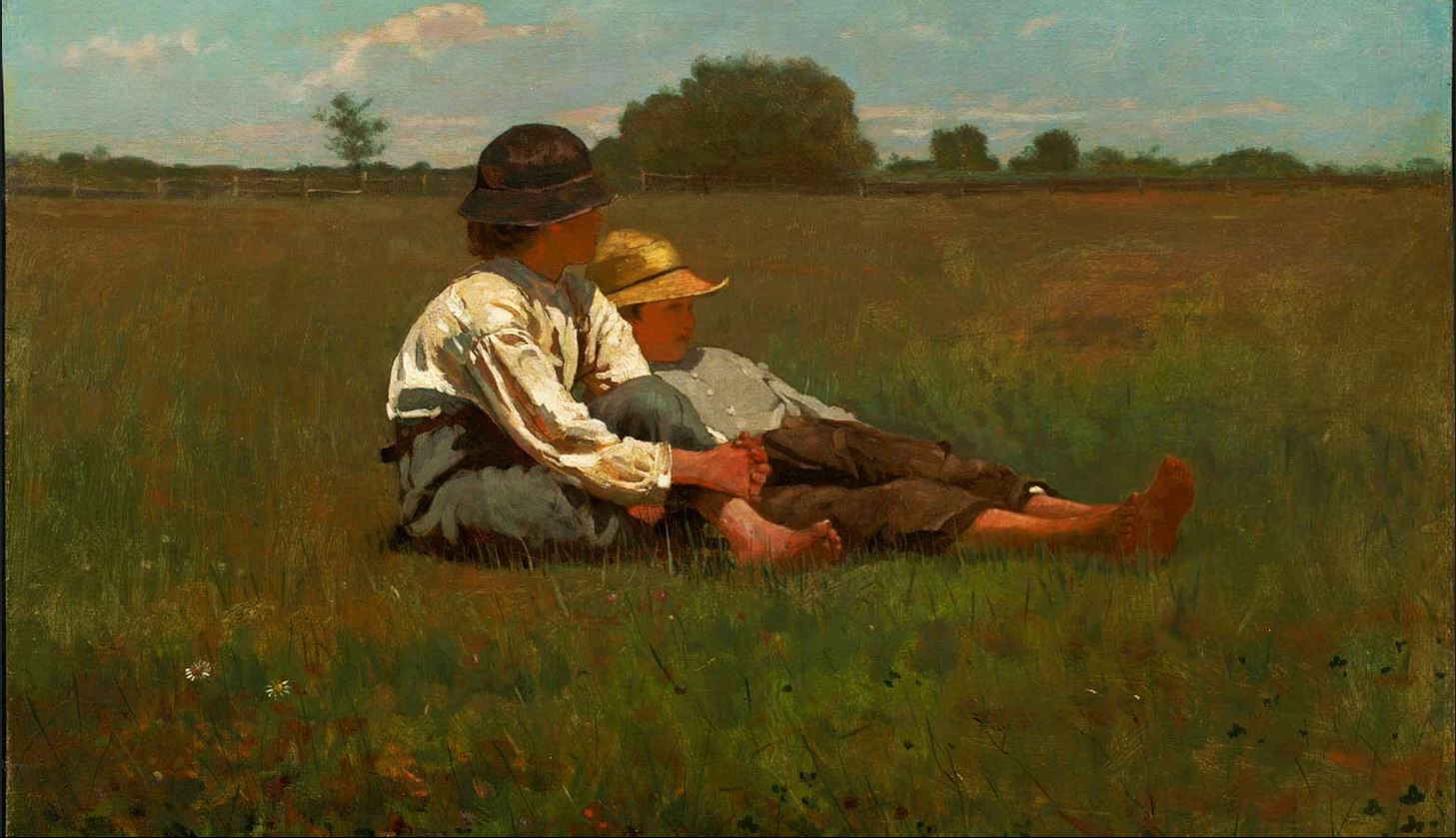
If ever there was a quintessential American artist, Winslow Homer (1836-1910) fills the bill. Mr. Homer was born and grew up in Massachusetts, in fairly middle class circumstances. His father was a businessman always seeking a big fortune. His mother was a gifted amateur watercolorist who taught Mr. Homer his first lessons. Eventually he was apprenticed to a lithographer after he finished high school. Leaving apprenticeship after a couple of years, he opened his own illustration studio in Boston, where he was immediately successful. Most of his work in those years was graphic--wood engraving primarily. By 1859 he lived in New York and kept a studio in the famous Tenth Street Studio Building in Greenwich Village, the first purpose-built studio building. Although Mr. Homer is said to have been mostly self taught, it's also true that he attended classes at the National Academy of Design and learned at least the rudiments of oil painting by Frederic Rondel, who taught there. 

Harper's Weekly illustration--"Sharpshooter on Picket Duty"

"Home, Sweet Home," oil, 1866
Although his family hoped he would travel to Europe to study painting, he instead secured a position with Harper's magazine making pictures of the Civil War, many of them wood engravings. He spent time at the front, drawing and collecting material that went into studio works like "Home Sweet Home" which he exhibited at the National Academy of Design to considerable acclaim, and an oil version of "Sharpshooter on Picket Duty," among others. But even though he did oil paintings of war subjects, much of his postwar output depicted women, children and rural settings, despite his studio being in New York. 

"Boys in a Pasture," oil, 1874


Following the war he did spend nearly a year in France, though he didn't study formally but spent time doing drawings for Harper's, seeing the art that was current and doing his own outdoor works. 

"Snap the Whip," 1872

Through the decade of the 1870s Mr. Homer focused on rural subjects, including one of his most popular works, "Snap the Whip," among a number of others that remain popular if nostalgic.

"Breezing Up," 1873-78

Something happened to Mr. Homer--perhaps a romantic loss--because in the late 1870s he retreated from much social contact. He lived in Gloucester and the UK before moving permanently to Maine in 1883. His studio was near the ocean, in Prout's Neck, and it was there that he painted a number of monumental works, including one of my particular favorites,"Undertow," a depiction of an event he'd witnessed elsewhere. Two women are being dragged from the surf by two lifeguards.

'Undertow," 1886

Mr. Homer lived in Prout's Neck until he died in 1910, though he traveled widely and painted many other works.

"The Gulf Stream," 1899
"Fox Hunt," 1893


---
Also in this series:


Friday, December 02, 2022

Echo of the Past

Sunsets are coming earlier and earlier as winter closes in. We're in the colder and darker months but memories of summer help. This is a small panorama of oak trees and prairie, based on sketches and photos made last summer. 

"Oak Savanna, Summer," oil on panel, 12x16

It's sad when you learn that this kind of native landscape once comprised much of primeval Iowa--now plowed, planted and developed. These trees are old growth and the spot has never been logged or farmed. Echoes of the centuries resonate in this patch of prairie.