Tuesday, August 28, 2018

Corel Painter Part 4

Laying in the head with soft brush tool
After experimentation and thought, I've decided to adopt Painter 2019 for part of my digital work. Painter Essentials, which I also tried out, is a considerably less expensive alternative, and a fine one. Happily, the more complex program came at a discount as part of a bundle with a new Wacom Cintiq. If you're in the market for a Wacom, check out the bundle on the Corel website.

Meantime, exploration of Painter continues. These are stages in copying an oil portrait by Peter Paul Rubens. The subject is the Duke of Buckingham, a fellow originally named George Villiers, who was the first to hold the title. The Duke was a favorite of King James I of England, and also of Charles I, for a while. He was a member of the minor nobility who worked his way into the Royal court, was knighted in his early 20s, and elevated to the peerage by James I a few years later. Eventually Buckingham controlled the entire 17th century court. Unfortunately for him a
Scrubbing in large masses
widespread whispering campaign suggested that he and the King were romantically involved, though no proof of a physical relationship has ever been unearthed. In any event, Buckingham eventually fell into disfavor with King Charles and with the British public too, so much so that Parliament tried to impeach him twice, though the King nullified those. At length he was murdered by an irate former army officer.

The Rubens portrait of Buckingham was done about 1623-5 and recently rediscovered in Scotland after being thought lost. The original has much of the same sparkle as other autograph works by Rubens, the liveliness of expression and brushwork featuring prominently. The Duke is shown against a vague multicolor background, garbed in navy blue velvet with a royal blue diagonal sash. His hair is modishly long, beard trimmed into a neat goatee. He wears broad and flamboyant mustaches and smiles at us with the same direct and perhaps mischievous look Rubens gave to his first wife, Isabella Brandt in his famous portrait of her dating to around the same time.

More massing of color in the figure and background
In copying Rubens the goal has been to test the Thick Paint tools of Painter and to learn from Rubens as well. So my beginning is like that of many, a rough envelope of the head and shoulders with just enough outline or detail to depict the volume of the head. The full head of hair, tall brow wide mustache (on the sitter's right) and pointed beard helped as landmarks and measure points. Using the oil paint tool and a dull dark red, I approximated his wide ruff and sash as well as the slope of the shoulders. In the second panel I've begun scrubbing warm darks in the hair and beard, then throttled the tool width to a considerably smaller size and sketched in the central features. These will be obscured eventually by overlying skin tones. In the third panel the background colors are being scrubbed in and the navy velvet of his tunic is indicated, as is the sash, which will be massed-in before the next stage. All of these masses have been placed using Painter's orginary Oils tool, generally the medium bristle.

Background, ruff, and skin tones initial
In the final panel of this post (but not the final portrait) I've changed to the Thick Paint set of tools to attempt to emulate the richness of brushwork and color put down by Rubens almost 400 years ago. The overlying colors and thick paint lend more substance to the ruff and to the face. Central facial modelling was actually easier than expected with these particular tools. Varying chroma, value and hue at will is a big plus when doing digital painting. For oil painters such changes require careful mixing of physical materials based on a thorough knowledge of the properties of pigments, oils and so on. So it is easier digitally.

The next steps will be to modify and brighten the painting, adding detail, lights, further color and modelling of the head and shoulders. I'm not sure how many layers or steps will be involved, but when there are sufficient images more will be posted.

---
Previously:
Corel Painter
Painter Part 2
Painter Part 3

Friday, August 24, 2018

Southwest Virginia

"Houses Near Clifton Forge," wc, 3.5x7.0
We have been vacationing in the ancient green mountains of southwestern Virginia, not far from Roanoke. This is the countryside of early settlers like Daniel Boone, originally inhabited for thousands of years by native peoples before that, and thoroughly steeped in history. The old mountains are lower and softer and tree-covered, compared to the huge Rocky Mountains most of us are familiar with. Yet these mountains harbor more history per square mile than much of the continent. There is great beauty and much tragedy in these hills.

"Lee Chapel," wc, 3x5
We stayed with friends not far from Lexington, home of Virginia Military Institute and Thomas "Stonewall" Jackson. Lexington was also the final home of Robert E. Lee in his capacity as president of Washington College (1865-1870). We visited the campus (school had yet to begin, so it was quiet and peaceful), and the hall that Mr. Lee built while he was president, and which is still in use. The pew where he sat and the office he occupied in a lower level remain, as does quite a lot of history. The chapel is actually an assembly hall, having never been consecrated. The grounds and trees surrounding the old building are very calming, in contrast to the life of Mr. Lee. He and his family are entombed in a cryptlike place below the Chapel, which also houses a small but interesting museum. The city of Lexington remains wonderfully preserved in its 19th century buildings and streets.

Another spot we visited is Clifton Forge, a small town that is a former railroad hotspot, having been the site of the Chesapeake and Ohio Railroad's maintenance shops. The town houses a C&O museum, a historic theater that hosts everything from bluegrass to Shakespeare, and a burgeoning arts movement. Although a fairly small town, there are artists and arts in abundance. I spent part of the time doing outdoor sketching in a small park across from one of the art schools. The pocket park houses a lovely
"Near the Amphitheater," wc, ~4x8
amphitheater and leads to a bridge across Smith Creek, allowing pedestrians access from the busier side. I sat in the shade of one of the new trees and sketched the view uphill. Clifton Forge is nestled in one of the crinkly valleys in these mountains, so the backdrop is often a distant slope.

Because of the economic turmoil set off by the big changes in railroading, Clifton Forge has had
"Survivors," wc, ~4x8
some difficult years, but as the town rebuilds its structures and establishes a much different future, they have taken care to preserve much of their heritage. It's always fun and instructive for me to study old buildings repurposed for other needs. There are quite a number in the town, including old gas stations, former offices and former light industrial sites. One of the art schools occupies and old tire business, for example. I managed to sketch a few of those buildings, including the old gasoline station that is being converted to a visitor center.

These mountains are small, and worn, and full of the history of the continent. They're calming and quieting, and a place where you can be centered. A visit is a privilege.

Tuesday, August 21, 2018

Corel Painter Part 3

"Frederick Douglass," digital drawing
Since the last post about Corel Painter 2019 my daily sketching has sometimes involved using Painter for drawing, rather than Sketchbook. Making drawings using Painter is simple to learn, although some aspects of the program no doubt still escape me. But drawing with the pencil and pen tool or the conte tool can be very satisfying. It's ancillary things like sizing or capturing and moving a piece of a drawing that aren't so intuitive with Painter. In Sketchbook, those features are almost indispensible. Still, drawing with Painter is quite satisfying.

This drawing of Frederick Douglass, the justly famous author, abolitionist, and former slave himself, was done using the conte tool over a cream background. The drawing tool is actually the "real soft conte" tool under the "chalk, pastel and crayon" group. The reference was a vintage photograph of Mr. Douglass that I found online and imported into the Reference Image frame in the app. The reference frame can be magnified, tapped for color information, and for other uses within the program itself. The drawing shows several values of "conte" ranging from deep black to near-white.

"Joe," digital drawing
In contrast, this drawing from one of the few reference photos of the subject available online. Joseph Leyendecker was a formidable artistic talent and a much-emulated illustrator a century or so ago. In the photograph, he has turned away from his easel to look us in the eye. The idea was to capture that look in the drawing. In this case I used the Pens and Pencils tool called "real variable tip pen" and drew the head over a mid-value grey background. Using the mid-value grey for the middle value of the drawing and then adding darker and lighter values gave this result. The program emulates this kind of drawing exceptionally well.


"The Philosopher," digital oil painting
Besides drawing I've also been painting with this new app, though my progress has been relatively slow. Work on another portrait, this time of someone well-known, was a way to work out kinks and ideas in doing painted, full-color images since achieving a likeness is easier. This particular portrait was derived from a still-frame grabbed from an online video.

The tool set is listed as "Oils" and features all sorts of brush tools including soft, medium and hard bristles. The head was drawn initially over a cream ground using the 2B pencil tool, then painted in overlaying layers. Some strokes were much larger than others, and in some places were more or less transparent (you can adjust that property as well as size, etc). The palette was purposely kept muted and a great deal of detail was omitted since the purpose of this painting was only to gain experience with Painter.

Another oil painting tool set is one called Thick Paint. That and oil paint will be the next focus in learning this program.
---
Previously
Corel Painter
Painter Part 2

Saturday, August 18, 2018

State Fair Finale

"A Steam Antique," wc, ~6x8
The Iowa State Fair ends soon but last Wednesday was my final visit for 2018. This year has been a great one, with pleasant weather , good crowds, engaging contests and exhibitions, and the usual fair food-on-a-stick. The Iowa State Fair is quintessentially American and quintessentially Midwest. As noted in other posts, a visitor is likely to overwhelmed by the "Iowa nice" effect, not to mention all of the activities.

Posted here are the final three sketches of the Fair for this year. The first is an antique steam tractor parked on the grounds. There are quite a number of these exhibited every year, hearkening back to the days of steam reapers and threshers, before gasoline power. Many of these engines are not only attractively restored, they are still functional. The other two sketches are figure studies of folks I saw while rambling around. The heavy-set fellow was nodding off in the shade, waiting for the tram to come by. The other fellow was practicing for the Seniors Horseshoe Pitching Championship on the horseshoe courts just up the hill from the Hall. Everywhere you look, something is happening--someone is doing something.

"Waiting for the Tram," wc, 3.5x6
The Fair is an astonishing hive of activity--competitions, exhibitions, sales, family outings, kids riding rides, radio stations broadcasting, politicians wringing hands and blowing smoke, tractors pulling all sorts of things. There are animals enormous to tiny to be seen and admired; corn dogs, turkey legs, deep fried candy bars, peppermint ice cream and all manner of food-on-a-stick to consume. The Grandstand hosts famous acts and the smaller stages scattered everywhere host amateurs and professional musicians, famous and not-so. There are fiddlers and pickers galore in Pioneer Hall, arts and crafts on display in the Cultural Center, antiques to consider, new home gadgets and new farm equipment to ponder. The wine industry hosts daily grape stomping competitions, or you can go elsewhere and compete throwing cow chips or rubber chickens. The sheer number of people, animals, activities, events, food and the rest is nearly overwhelming. The Fair is more than its parts, though. The Fair like fairs everywhere provides a kind of continuity, dating from the mid-19th century, and although there are changes people in Iowa still come together for days of friendly competition, music, tale-swapping, overeating and general fun. Everyone comes, if only for a day or an evening. It's the largest event in Iowa every year, and draws
"Horseshoe Championship," wc, 3.5x5.5
over a million people total. (You can do a lot of people-watching at the Fair.)

Sketching at an event like the Iowa State Fair offers so many opportunities to draw that it can be bewildering. Without a plan you don't know where to go next. One of the problems for me was simply not realizing what was happening at any single time, so that I could take time to visit the event. There's no question I missed a lot of opportunities. A good plan would actually be to set up a personal itinerary ahead of time. In any event, sketching at a fair requires some paring down of equipment, unless you want to carry a great deal. I only took along a small watercolor set, a few pencils, two waterbrushes and a couple of pens plus two sketchbooks. That small outfit was plenty.  

Now it's back to my usual subjects, but I'll go back next year, for certain.

Tuesday, August 14, 2018

Quiet Monday at the Fair

"Breakfast-goers at the Fair," wc, 3.5x5.5
When Monday came it occurred to me that perhaps the early morning would be even quieter than previous early mornings. It's such a luscious time of day on the fairgrounds when most of the thousands of machines aren't running, there is not much music (hurdy-gurdy-like or bawling rock/country) and fewer visitors. The asphalt and concrete haven't heated to griddle-like temperatures either, and a soft breeze often moves through the sleepy grounds.

Mornings at the Fair start best with breakfast in one of the concessions. There are those who swear by cinammon rolls and coffee, but fair time calls for eggs. And sausage, or bacon, and hash browns, and yes, biscuits and gravy. Most of those who work and exhibit for the eleven days of the Fair often breakfast in one or another of the tents, and everyone gets to know one another. There's something old-time about coming onto the grounds, having a farmer's breakfast, and then tramping through the animal barns and exhibitions. Yesterday morning I saw a couple who are great representatives of the Fair, and of Iowa, having the morning coffee. His ten-gallon hat isn't the usual headwear for men (that would be a "gimme cap") but certainly recalls old times.

"In the Discovery Garden," ink, 5x8
After breakfast my feet took me back to the Discovery Garden just south of the Ag Building. The garden chairs there were considerably less busy. There were people walking through, of course, but you could actually see the garden beds and landscaping most of the time. For this drawing I did the stationary items--path, pergola, fence--in pencil and added the figures as they became interesting. None of the figures drawn were actually there together, but simply placed into the drawing. Afterward
I inked the drawing, changing and enhancing here and there. In some cases this is how the beginning for a watercolor sketch happens, but doing ink first requires using waterproof ink. It's simpler to draw lightly with pencil, paint, then ink as needed to enhance.

Although it wasn't really hot, the shaded area south of the Administration Building was my next stop for drawing. The area is shaded by dozens of mature trees that spread a cool darkness over the entire grounds encompassing the Bill Riley Stage, named for the man who emceed more than fifty years of talent shows at the Fair. The stage is open-air and permanent, with surrounding permanent seating. Even if there is no show going on it's a natural gathering place, behind a long row of food booths on three sides. So I spent a profitable period of time there on a bench alongside one of the paths that wind through, watching people walk by. As in the sketch above, for this one I sketched the fixed items--tree, food booth, path--and then added the figures as they came along. This kind of sketching exercise is great fun and gives a lot of memory practice, since nobody holds still at all. Catching the gesture is everything, which adds a lot to the fun.
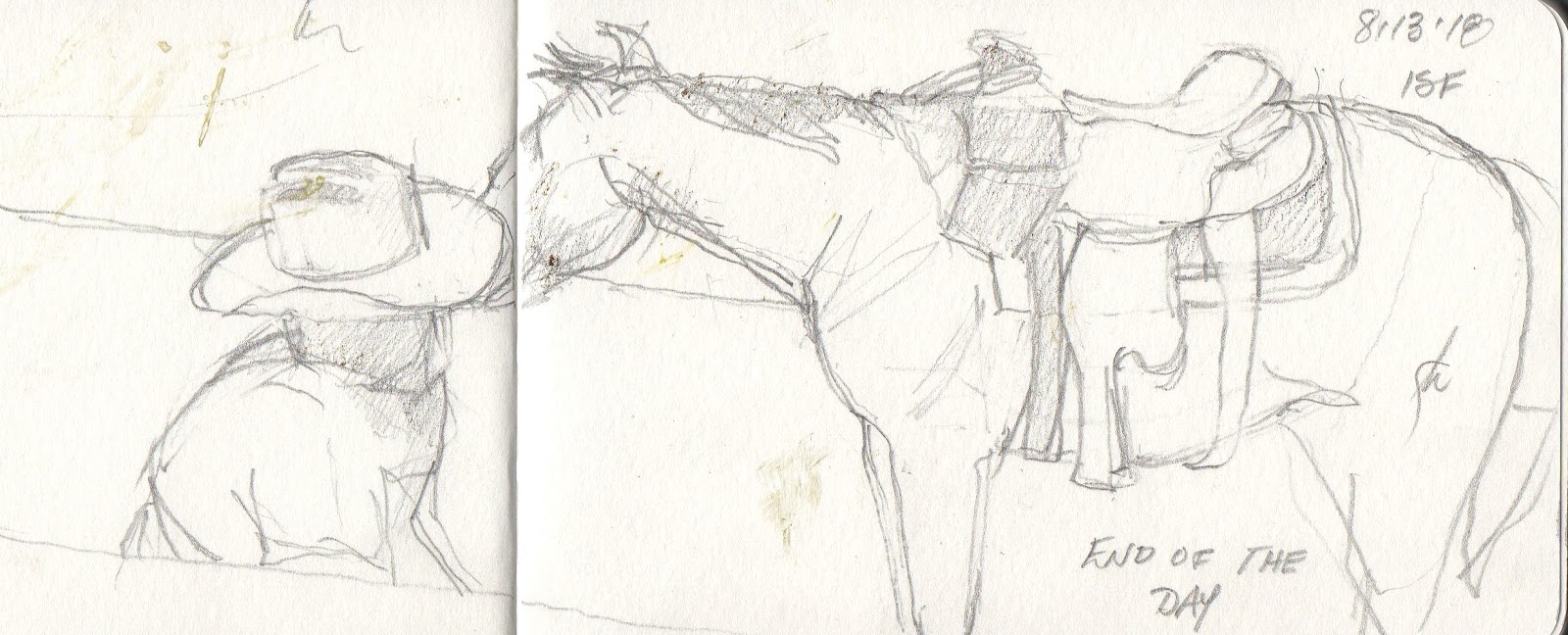
With so many large animals to manage, it's no mistake that the Fair has people to assist with animal control. Since the animals in question can be enormous, horseback wranglers are important. These folks patrol the streets around the animal barns on horseback, patiently sitting astride, smiling at children, posing for photos, answering questions, and occasionally wrangling a steer or horse that's gotten frisky. But sitting astride a horse for hours, even when the horse isn't moving, can bring on substantial soreness and fatigue. As I was leaving Monday around midday I saw this rider taking a rest from sitting the saddle, and giving the horse a rest besides. Sometimes you just have to get down. I sketched this simple scene in graphite, about 3.5x6.

The Fair ends in a few days, but I'll continue visiting and sketching and posting for the next two or three days, until other subjects beckon. More Fair fun to come!

Monday, August 13, 2018

An Evening at the Fair

"A View of the Grandstand, Iowa State Fair" ink, 7.5x5.5
With the thought that afternoon light might be different enough that various venues on the Iowa State Fairgrounds could look entirely different, I spent some twilight time at the Fair on August 12. As expected, the experience was considerably different.

The late afternoon wasn't sweltering, but plenty hot. The light was indeed different, slanting diagonally through the thin summer haze and not so golden as I'd hoped. The crowd had changed too. It makes perfect sense that there would be many differences--more young people, especially those in their mid- and late teens. More extended families were there too, probably because it was Sunday. But the crowd was the usual "Iowa nice"--polite, cheerful, orderly--and nearly everyone was having fun. Although I didn't draw it last evening, the ink drawing shows where I spent some time last evening while having a root beer float. The view is from the porch of the Administration Building. The porch is deep and shady, girdling the entire building like an apron. On a sultry Iowa afternoon, the height of the porch and the shade make it a great spot to cool off and watch the passing throngs. The top of the Grandstand shows over the roof of the Steer N Stein food and beer concession.

"Ice Sculpting" wc, 4x6
After the last slurp of root beer I wandered across to the front of the Agriculture Building where a crowd had gathered. The attraction was a man carving ice with a chainsaw. Ice carving outdoors on a 90 degree afternoon is an unusual sight, but the carver was working away with real aplomb. He had a relatively thin slab of ice tipped onto one side and had begun to carve a bas-relief of a bucking horse. The spectators stood or sat in small rapt groups. If he had been using a different tool one wonders if the crowd would be so big. The final results will be on display in the refrigerated display inside the Ag Building.

"Super Bull, Iowa State Fair 2018" wc, 4x6
A trip to the Iowa State Fair is never complete until you visit the Big Bull. He is always housed in a separate pen at the entrance to the Cattle Barn, and each year's champion is equally astonishing in size. This year's winner was a giant at over 3000 pounds, and while he looked completely docile in this pen, it was also reassuring to see that huge bulk snubbed up very close to the fence. And of course his breed are hornless, another reassuring detail.  No doubt he will be the sire of many more of his breed.

"The Behemoth," wc, 4x6
During the past several days of the Fair I've been walking past a huge farm implement--a tractor--parked along one of the sidewalks bearing a sign proclaiming it's tires to the "World's Largest Agricultural Tires" so I stopped on my way out of the grounds to sketch it. It's a John Deere implement that looks almost impossibly big. The mounted tires are twice as wide as most tractor tires, and taller besides. I can't help being fascinated by these giant machines. What kind of farm must need such a behemoth?


Saturday, August 11, 2018

Saturday at the Fair

"Giant Pumpkins and the State Fair," wc,5x8
One of the decidedly interesting features of the Iowa State Fair is the competition. Consider that more than 60,000 entries for competition are received for contests ranging from farm animals to fine art. There are all sorts of contests involving the prowess of humans and/or animals--horses pulling huge loads, pig races, and many others. But perhaps my favorite lineup of contests are those for the largest animal or other farm produce. There is the Big Bull, the Big Boar, the Big Ram (even a Big Bunny) but the best is the Biggest Pumpkin. These are an exquisitely specialized sort of pumpkin, raised for their size alone and always inspiring awe in fair attendees. This year's biggest was a sizeable 795 pounds, though that's smaller than last year's I think. And not really huge--there is a website of international weightoffs of giant pumpkins where the largest registered weighed over 1700 pounds. Nonetheless, these are respectable squashes. The weigh-in was on Friday, but I only got around to sketching them today.

"Outside the Grandstand," wc, 3.5x7
Another sketch from today is of the crowds on the Grand Concourse just in front of the Grandstand. I stopped in the shade to sketch the sign and the people as they streamed by. The giant grandstands loom to the north of the concourse, towering about three or four stories and holds something like 25,000 when completely packed. These grounds have hosted deliberate locomotive crashes, stunt fliers, all kinds of racing, and of course big musical acts from pop and country. The evenings at the fairgrounds are much different than the days. As night falls and the air cools, people stroll and snack on the incredible range of foods (many not so healthy, alas) before attending a show. It's a pleasant time at the fair, but I wasn't staying that long.

Unlike the first two days, the fairgrounds began to be crowded a lot earlier since it was Saturday. Maybe it's a holdover from the work week, but people seemed more intent and in more of a hurry today. Whatever the reason, as the fairgrounds filled up and the temperatures rose, I realized it was time to pack it in for a day. It's easier to do that, knowing that there will be several more days to explore and savor.

Friday, August 10, 2018

Friday at the Fair

"The Tram," watercolor, 5x10
This morning at the State Fair was lovely. Unlike yesterday, when the humidity and temperature were higher, there was a fine breeze from the northeast and the sky was mostly clear. For whatever reason, fairgoers were more relaxed and less hurried today, and cheerier besides.

After a hearty breakfast at one of the concessions I hopped the tram at the foot of the Grand Concourse and rode happily to the highest spot on the grounds, Grandfather's Farm. There is a grand old barn up there at the top that dates to the days when this was a homestead farm. It houses the Iowa Wine Experience now, but even before the Civil War it was a working farm barn. The house has been demolished, but happily the barn is there as a reminder of days gone by. As always, there were considerably fewer visitors in this relatively remote corner. The view from the grounds of the old homestead is simply spectacular. To the west you can see miles beyond the city skyline.

"Fiddling Contest," watercolor, 3.5x5.5
After a visit to the museum I ambled downhill to Pioneer Hall where an old time fiddling contest was about to begin. The stage is at the north end of the old wooden building. Big doors propped open at the east and west ends, plus huge floor fans, make the old place habitable. The fiddlers this morning ranged in age from 8 to 16, and all of them, even the youngest, made those bows smoke. Each was required to play a hoedown, a waltz, and a selection of the contestant's choice. They could be accompanied or not. These young people were amazingly good--one young man almost professional. He played the old fiddle tune "Orange Blossom Special" (ask your dad) about as well as anyone could, drawing prolonged applause. The crowd was big and appreciative, but today's time was a bit limited so I made my way downhill again, past an exhibit of restored farm tractors that I always love to visit, then past the chainsaw sculptors who carve big chunks of wood into many creative projects.

"Demo Garden, ISF 2018," wc, 3.5x5.5
The Grand Concourse was getting full, but not oppressive, and the light breeze held, even at the foot of the hill. Down there, by the Agriculture Building (home of the Butter Cow) is a demonstration garden, planted and maintained by master gardener volunteers. Every year in conjunction with local garden and landscape dealers they produce a garden that shows off useful materials and techniques, new species and cultivars, and provides a spot of shade and color in the midst of the hurly-burly of the fair. This year the hydrangeas are huge and there are cascades of colorful blossoms everywhere. There was an unoccupied Cape Cod chair that beckoned, so I spent some time sketching a corner of the demonstration. One of the gardeners and I spent a fine half hour discussing all manner of garden lore, but in the end it was time to head home.

But, as someone famous once said "Tomorrow is another day."


Thursday, August 09, 2018

The Iowa State Fair

Another year has gone by and the Iowa State Fair is back. Last year I spent quite a few days sketching at the fair and this year I plan on doing even more. There are opportunities for interesting compositions and subjects virtually everywhere you look. Opening Day was August 9, and all of the usual attractions were in place: the butter cow, the Avenue of Breeds, the pork-chops-on-a-stick (and who-knows what else?).

Early in the morning the crowd wasn't too big, the air was cool a bit breezy. After a farm breakfast in one of the concessions a ride around the grounds allows good reconnaissance without walking miles across the more than 400 acres of grounds. The trams are pulled by enormous farm tractors, manned by volunteers, lifesavers on a broiling August day. I rode up the hill from the Grand Concourse to Pioneer Hall, my first stop of the morning.

Pioneer Hall was built in 1886 as one of the original buildings constructed at the current fairgrounds, and it's the last one standing. Today it houses a working blacksmith, an old-time letter press, a stage that hosts various contests and musical acts, and a vintage flea market, as well as exhibits of prize-winning antiques. This year a group is rebuilding a tractor.

Steve the Blacksmith, hammering iron
It's great fun to visit and see someone spinning wool, making horseshoes, or fiddling up a storm. The blacksmith runs the smith everyday, thankfully next to a wide-open door, which provides breezes most of the time. Still, he's often bathed in sweat as he hammers hot iron on a huge anvil in the middle of the space. This morning he wasn't too busy with fairgoers which gave me time to sketch him and the wall of his smithy. Afterward I went over and showed him the sketch, which he kindly signed for me, although he said his scrawl wouldn't be recognizable. Still, a working smithy is fun, and might become food for a painting some day.

This first week the fair is going to be a daily visit for me, and I'll probably post something most days.
---
From last year's fair:
Two Tractors
State Fair Sketchbook

Tuesday, August 07, 2018

Corel Painter Part 2

Step 1 of a digital portrait (Painter 2019)
Since my last post about Painter 2019 I've worked on several pictures using the oil paint tool. This series shows how the work progressed on a portrait of a friend, Dwight. I used a reference photo plus personal observation in social settings to make these. As always I used my Cintiq tablet but in this case Painter 2019 was the app.

I began with a canvas (you can call it a background) that I toned to a light cream color. Using a medium bristle brush tool, I laid in the basic shapes and a midtone as an ebauche. Manipulating color and brush sizes, I began refining the portrait by adding patches of various colors throughout the face, rather than concentrating on any one area. That strategy works best in my experience to establish coherence of color and values. At the end of about an hour and a half, the portrait had reached the state to the right. I stopped for a day to let the picture rest in my mind and took it up again the next day.

Step 2
This is step 2 of the portrait. Working in layers, I added color in many places, trying particularly to emphasize color and shapes in the sitter's face. I also scrubbed a light blue-green around the head to place it more solidly in space. Using the oil paint tool I added color with a medium bristle tool, employing another layer to begin unifying the colors of his face. This step took perhaps another hour of adjusting the likeness, color, and value. After that I put it away until the next day, letting the image percolate in my mind.


This is the finish of my oil portrait in Painter 2019. In this stage I used a softer glazing brush as the main tool, blending and glazing colors over the previous step. In this stage I took colors from the previous portrait and punched the chroma, continuing to use value to emphasize shape and volume of the head. Although this is only a study of Painter and not a full-dress portrait, the results are encouraging. Further, it's been easier to learn the program while doing this portrait than I expected it to be. Obviously this can be refined considerably, and I've a long way to go in working with the program. Nonetheless, there is enormous potential in this new version of Painter.


My next project with Painter will probably involve using the Thick Paint tool to make a picture. If it goes well I'll make another post.

Regardless, Painter 2019 turns out to be a great addition to my digital art programs. It's pricey at $500, particularly since my go-to program is now downloadable for free. Still, if you're looking for a digital art app, Painter 2019 deserves your consideration.

---
Previously
Corel Painter

Friday, August 03, 2018

No Brushes to Wash

"Joshua Trees, Full Moon" digital painting done with Sketchbook
Learning to paint digitally is an interesting process. In some ways it's like real oil or watercolor application, depending on the program. You can mix and layer colors, sharpen or blur edges and make a digital image look almost like a traditional art work. But in other ways making digital art is a deficient thing. There are all kinds of sensory inputs that are missing--no smell of linseed oil and turpentine, no feeling of unction in paint applied with a snappy bristle brush, no spreading watercolors into wet paper as washes go down in succession, no pastel dust. It's a slightly remote experience.

On the other hand, you can produce an effective and pleasing image with nearly all of the effects of real paint and none of the physical complications, mess or cleanup. This picture, "Joshua Trees, Full Moon," was based on an online image of the Joshua Tree National Park in California. I had read something about joshua trees and looked up the subject out of curiosity. Turns out these desert plants aren't trees at all but a kind of yucca that simply grow tall and have limited foliage since they live in dry climates. They have a bristly, forbidding appearance and in certain deserts are the tallest vegetation for miles.

The harsh sun-baked landscape and foliage of the desert southwest lent themselves to this nocturne, which I drew and painted on a Cintiq tablet using Sketchbook. I started with a graded background, added a layer for the full moon and another for the mountains and background, then another for the tree and low growth in the foreground, keeping the colors and values muted. The graded background served not only as sky but also as the desert plain stretching into the distance. The colors are mostly very dark reds and almost chroma-less yellows and greens, applied using the oil brush tool.

But no brushes to wash.


Tuesday, July 31, 2018

Corel Painter

"The Apple Seller," Painter Essentials calligraphic pen
Not long ago I received an online ad for Corel Painter 2019, the newest version of the venerable program that has been available for about twenty years. Corel was one of the very first to release a digital drawing program back in the 1990s and Painter followed that one.

Corel Painter 2019 is sophisticated and multi-featured, with layers of complexity like Photoshop on steroids. It's many menus and options are daunting (occasionally even baffling) to the untutored like me. Happily, Corel also markets Painter Essentials, a limited yet full-featured version of the flagship at a significantly reduced price. The time limit to try either program free is 30 days, so I downloaded a trial version of each and spent some time with them over the past three weeks. This is my very personal viewpoint. 

The Apple Seller, drawn with thin and thick pencil tool
I tried Painter Essentials first because of its simpler interface. Like similar programs, Essentials can emulate various art media--acrylic and oil paint, pen and pencil, chalk and pastel, etc--and also emulate paper, canvas and other supports or backgrounds. Essentials' basic workspace is clean and uncluttered and simple to learn. Using a Wacom Cintiq tablet with Essentials was actually pleasurable. Most of the testing I've done with Essentials has been drawing. Here are three drawings, done with the calligraphy pen, which gives effects like old dip pens, pencil tool providing thick and thin lines, and a chalk tool. The drawing above was my first attempt ever with the program, and was partly limited by searching for the various functions of the app. I used the calligraphic pen tool (in the Pencils Pens and Markers menu), which provides nicely varied line weight, good opacity, and a realistic emulation of a traditional ink. You can of course adjust size, opacity, and color of your lines and customize the "surface" of the image
The Apple Seller, drawn with chalk tool
(found under Canvas). I chose a near-black color and a mid-value gray background for the drawing. Rather than finish the drawing by line and value I left it for a personal example.

After working with other aspects of Essentials as well as Painter 2019 (more below and in another post), I repeated the Apple Seller experiment using the thin and thick pencil tool (again under Pencils Pens and Markers) over a cream-colored, "rougher" support. In this case the drawing took more time to correct and the result varies from the first, but as with the ink tool, the pencil tool provided a believable simulation of the real thing. Other drawing tools are worth exploring too, particularly the chalk tool, which I used with a sanguine-red color in the final drawing here. In this one I attempted to change the old woman's expression to appear less benign, and I think altering the position of her hand has something to do with that, perhaps.

Painter Essentials is sufficiently useful for drawing alone that I'm tempted to buy it even before the trial period expires. At $50 it is worth every penny.
---
Painter 2019 is probably the most complex art program I've attempted to learn, except perhaps Photoshop. Painter is exceptionally versatile, with workspace setups ranging from classic and simple to specific ones for concept art and manga. The tool groups provided are standard ones such as Acrylic and Gouache, Oil Paint, Watercolor, and dry media of various kinds including pen, pencil, pastel and so on. There is so much depth and breadth in this program that a thorough evaluation in a free trial month isn't likely. Nonetheless, here are a few preliminary thoughts and a digital painting done with Painter.

"Majesty," painted with Painter
Painter has been a pleasurable program so far, but I've only scratched the surface. The workspace and interface are relatively intuitive and mostly simple to begin, particularly if you've used other digital art programs. The color selection interface is set up to allow variation in value and chroma, although the value variation is at the gray end. There is a color mixer space that emulates a palette full of paint, too, allowing tinting and shading of various colors. And there are many many surfaces and backgrounds to pick for your art. I'm going to try out as many of the tools and surfaces as feasible, but those are beyond the scope of this post. Meantime, here's a digital painting I did with Painter. "Majesty" is based on an online photo.

In the next few days I'm going to try working with the watercolor and oil paint tools.

Friday, July 27, 2018

Digital Development

During the time involving testing programs and apps and learning how to use them, one of the ideas I've always kept in mind is using digital means to develop a real-world painting. Much of my digital work has been based in the world of drawing--line rather than mass; value rather than color. Nonetheless, developing a complete oil painting using a digital-first idea is something to pursue, seems to me.

I rummaged through my digital drawings and paintings accumulated during the past year or so to see if any of those might warrant development in oil paint.

 This is the famous Chicago Theater located on North State Street in its namesake city. For a contemplated oil painting, as in thousands of photos the sign is the obvious focal point. But to punch it more, my plan is to surround it with mostly cool and muted colors. The values of the distant buildings will show them in sun while the near ground is cooler and darker. In this iteration, I put a man in the lower left corner, but on further thought it seems to me I might instead add figures on the sidewalks to provide more human presence. If it turns into an oil, it will likely be fairly large, perhaps 30x20.


The streetscape to the right features another well-known sign, this time for Minetta's in Greenwich Village. Across the street is another famous sign, this one for Cafe Wha the renowned music venue that has been there for most of the last sixty years. Both of these establishments were and are hubs of Greenwich Village. Writers like Pound and e.e. cummings frequented the place, as did some of the Beats. This view along MacDougal Street looking west, but I took a lot of liberties with the far buildings, making them cool but relatively high in value to push them away from the warmer tones in the foreground. The closest buildings will be very dark but warm. The figures will probably be different, but the awning and enclosure will stay, as will the trees. This particular view is in winter.

My oil paintings lately have been mostly city streets and buildings. As that work continues, one or both of these is probably destined to become tangible. If and as that happens, I'll post images of the progress.


Tuesday, July 24, 2018

For Dog Lovers

Dogs have always been part of my life. Since I can remember there has been a parade of beloved canines alongside wherever I've been. Dogs should have been natural subject matter, but until recently I hadn't been paying much artistic attention. In recent weeks that's begun to change. 

I did this digital sketch of a pup pouncing on a ball simply for fun. It makes me smile to watch young animals at play--regardless of species. This drawing is actually from a composite of sources, including imagination. The main goal here was to capture the puppy's utter joy at playing.

The program I generally use these days is Sketchbook (now available free for download) in conjunction with a Wacom tablet. One of the great things about Sketchbook besides its new price is how well a traditional artist like me can catch on to the interface. Unlike more complex programs such as Photoshop, the tools and settings are more easily learned. This particular sketch was saved in jpeg format for ease of upload, but you can save in other popular formats.

Anyone who's owned a dog has seen the expression I tried to capture in this digital drawing of a contrite canine. That sidelong look is universal among dogs, who seem to almost read their owner's minds. It's easy to see the source of the expression "hangdog" for a guilty look. And of course if one has a pet, domestic disasters do happen. This sketch was again a product of Sketchbook, but drawn very quickly at a single sitting. Since the most important section was the central face and eyes I de-emphasized the stocky legs and body to keep the viewer focused on the dog's expression.


The last drawing is another guilty-looking dog, long ears drooping and his eyes focusing upward at someone in authority. To me the look seems to belie culpability, making the caption appropriate. As with the other drawings in this post, the challenge here was to capture the dog's expression, not just a likeness of the animal. The body language and eye movement seem to say the most about the circumstances, seems to me, making those crucial in capturing expression.


If you've an interest in digital art, there's literally no risk in downloading Sketchbook. It's a full-featured, professional-grade program absolutely free. In the past it has sold for a fairly high price, and I've not heard why it's being offered gratis, but why not give it a try? It's available for PC, Mac, and mobile devices, which for me is a real plus since I can work on my PC as well as my iPad.

---
Animals
More Animal Drawing

Friday, July 20, 2018

Cooling Reveries

Early July has been noting but steam heat. The daily highs in the first half of the month were in the 90s and the humidity obscenely high. It's this time of year (with August and September yet to come) that get me thinking of those crisp days of fall and the thin cold air of winter. No one wishes for the ice and snow and throttling cold, of course, but just a bit of frost for a day or two could brace us for another round. Here are a few scenes that evoke cooler times.

"Fall Visitor," casein, 2016
Remember those days in fall when the leaves have just begun to turn but many trees and grasses stay green. The days are warm in the sun the evenings crisp enough for a sweater. At the edge of my woods a couple of years ago a visitor peered out to see if it was safe to emerge. Living along a water course, I see quite a lot of wildlife despite living in the center of a fair-sized city. Deer, foxes, woodchucks, the usual rabbits and squirrels, and even a stray bobcat have wandered past my studio window.

This is a casein painting on panel.


"City Snow," oil, 2002


The scene here is a city street after a late winter snowfall. The sun is already breaking through and flooding yellow light through snowy branches onto the sidewalk while someone trudges away. The image is cool enough that it sometimes makes me shiver. But the outlook is for a warming winter day, the kind of day that doesn't really feel wintry despite the snow, cheery and bright, full of promise for a new springtime .

This is oil on panel, 24x20.

Tuesday, July 17, 2018

A Texaco Star

In a post not long ago I extolled the beauties of old pickup trucks. In particular I love those old trucks of the 1950s with their curves and chrome. A vintage car dealership downtown has had this beauty on display for several weeks, giving me time to study it in watercolor.

This model is a mid-1950s Ford truck that has been lovingly restored. The doors sport a Texaco logo ("the big, bright Texaco star!") and the fenders advise that 24 hour service is available. The red and white paint shines and the white walls are spotless.

Situated along a busy downtown street, the dealership always turns heads with such displays and makes me stop and sketch. For this image I drew the truck in a fair amount of detail using an HB pencil, trying very hard to make accurate measurements. Once I had a good image I used a flexible nib pen to ink the major outline and intersections, taking care with correct proportions and sizes. Time didn't permit completing the painting on site, so I made several reference snapshots and finished the colors in the studio.
---
Old Pickup Trucks

Friday, July 13, 2018

More Animal Drawing

A lot of people enjoy drawing and painting animals. I know a number of artists whose oeuvre is animal portraiture, for example. For any realist, knowing how to make images of animals is a critical skill. A few weeks back I posted a few animal drawings, done with graphite and digitally, so here are a few more.

Chickens always look gimlet-eyed and sharp--they probably have to be. I grew up in the country where we always had a flock and spent countless hours tending them, gathering eggs, cleaning coops and all the rest. As a consequence of my upbringing, these aren't my favorite birds but the landscape of chickens' heads, combs and bills is always challenging. As with most of my animal sketches these days, this was done using Sketchbook and a Wacom tablet.


This fellow is a pit bulldog whose name, according to the caption of his photo is Tank. He definitely looks like his name and reminds me of a bulldog with the same name who lived with some friends. My friends' dog was an enormous, loose-lipped English bulldog who slobbered incessantly but was gentle as a lamb. In contrast, the guy in this drawing looked clearly dangerous to me, especially with those yellow eyes. The challenge with this drawing was to evoke that sense of menace, so I left the main portion of the drawing in grayscale and emphasized those red-rimmed eyes.


This is another dog, more of a hound really, and the drawing medium is silverpoint. The image is a copy of a well-known drawing in silverpoint by Albrecht Durer--probably his own dog. Silverpoint, unlike digital or graphite images, is quite unforgiving. You can't readily erase silverpoint marks, so each stroke must be considered carefully before being laid down. Silverpoint promotes extended consideration and observation before doing anything. For me, then, silverpoint promotes careful and accurate observation.

One final image for today is another bird, this time a pelican drawn from memory using graphite. Some years ago friends and I had an online discussion about drawing animals and came up with a challenge to produce a believable image of these fisher birds. This one was my favorite quick sketch of a successful dive. The bird has managed to scoop up a full pouch of food and sits in the surf, contented. This particular sketch was done with a 4B pencil on a piece of printer paper.
Being a realist, my take on drawing animals--or indeed anything--is the same as the famous quote from Michelangelo Buonarotti--"Draw and don't waste time."

---
Previously
Animals
Cats

Tuesday, July 10, 2018

June on Druid Hill Creek

June was one of the hottest and wettest in central Iowa. We had days and days of exceptionally high afternoon temperatures and considerably more rain than usual. Des Moines historically has its highest rainfall in June, but this year exceeded the usual by inches. Naturally, with that much encouragement the undergrowth along Druid Hill Creek grew lush
and thick. At first rapid growth was welcome, green and soft but after a while the entire creek was obliterated--wild grape, honeysuckle, tree saplings and of course grasses of all kinds grew higher and higher and more and more dense. The woods changed to jungle in only a few days.

It was as if the woods would even envelop the studio. But I hadn't thought about the creek itself, at all.
Druid Hill Creek is a quiet little stream, maybe three feet or four across its breadth and perhaps four or five inches deep, most of the time. It runs, slowly or rapidly, all year, even in the driest of months, fd by springs uphill from here. But when rain falls fast and hard, the creek can actually become a raging, monstrous beast more than five feet deep. When that happens,
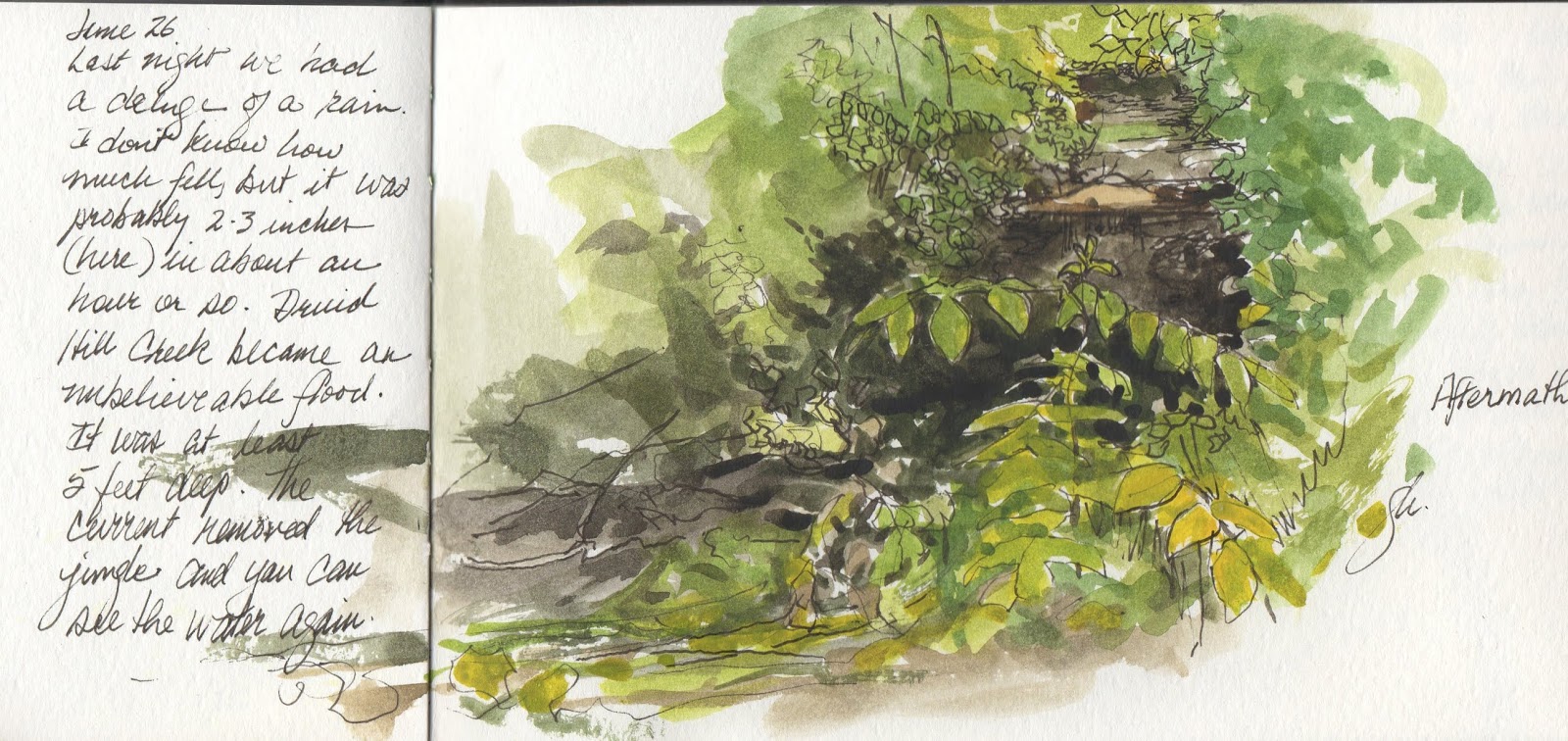
the current gets rapid and hard, charging like an unchecked cattle stampede down the narrow creekbed toward Gray's Lake and the Raccoon River. One night in June that sort of rain came, dropping a huge amount, and the creek predictably rose and rose and charged down, ripping out much of the jungle-like growth and re-exposing hidden watercourse. In accompaniment, the raging water scoured the banks of debris left earlier, dropping a different set in its place. A dead tree that had fallen somewhere upstream was left high on the bank, trunk and branches, alongside a smaller specimen just across from the studio. The tall grass on the opposite bank is completely flattened by the rushing water, even saplings. And there is sand and leaf debris everywhere along the flooding creek's margins. You can see the water again, but now it's mostly the color of coffee, an effect of the dark sediment in the stream bed and the dark overhanging branches and leaves.

For these June sketches I sat outside and drew, trying to capture the look and feel of the woods and battling mosquitoes and other pests. The sketches above were done in my  dedicated sketchbook of the creek, all using the same technique--a pencil layout, watercolor painting and ink additions as the finishing touches. These are probably the last creek sketches for now. In the fall, likely October, I'll open another sketchbook to make images of the woods and they change.

---
For anyone interested in previous posts of The Creek:
Druid Hill Creek Part 1
Part 2
Part 3
Part 4
Part 5
Part 6