Friday, February 26, 2021

Waning Winter

The end of the cold, icy grip of winter is in sight. We may not know when the exact end will come, but we know it is on the way. Last week, just over a week ago, the temperatures here in flyover land were well below zero and there was nearly three feet of snow on the ground. Yesterday the high was above fifty degrees and the snow was receding on all sides.

Here is how Druid Hill Creed looked exactly a week before this writing. The snow was deep but somehow the winter colors seemed richer. Now the creek is running dark as Cuban coffee and the snow continues to shrink. Before long there will be buds on the undergrowth. 

"After the Big Snow," watercolor on paper

Next week, when the weather warms even more, my plan is to try an outdoor session or two. In the meantime, lets all stay warm.

Tuesday, February 23, 2021

Buiilding a Painting

A few weeks back the Des Moines Rotary Club invited me to host a fellowship of a dozen or so members, providing a brief talk about painting. The suggestion was that maybe a demonstration would be fun. But unlike that famous television painter who did a fairly large oil in an hour's time, I knew I couldn't paint that fast. Instead, via Zoom, we spent time on how an oil painting is made, using a slide show of one of my recent landscapes. 

The basic steps I use in making oil paintings are pretty straightforward. Much of the time I begin on a toned surface--mostly a very thin wash of earth red--then lay in the basic shapes of the composition. Whether still life, landscape, portrait or otherwise, these are the bones of the painting. The biggest shapes (in this case, sky, water, and trees) are next. These broad shapes are blocked in with color, varying where possible, but mostly just to get the areas filled.


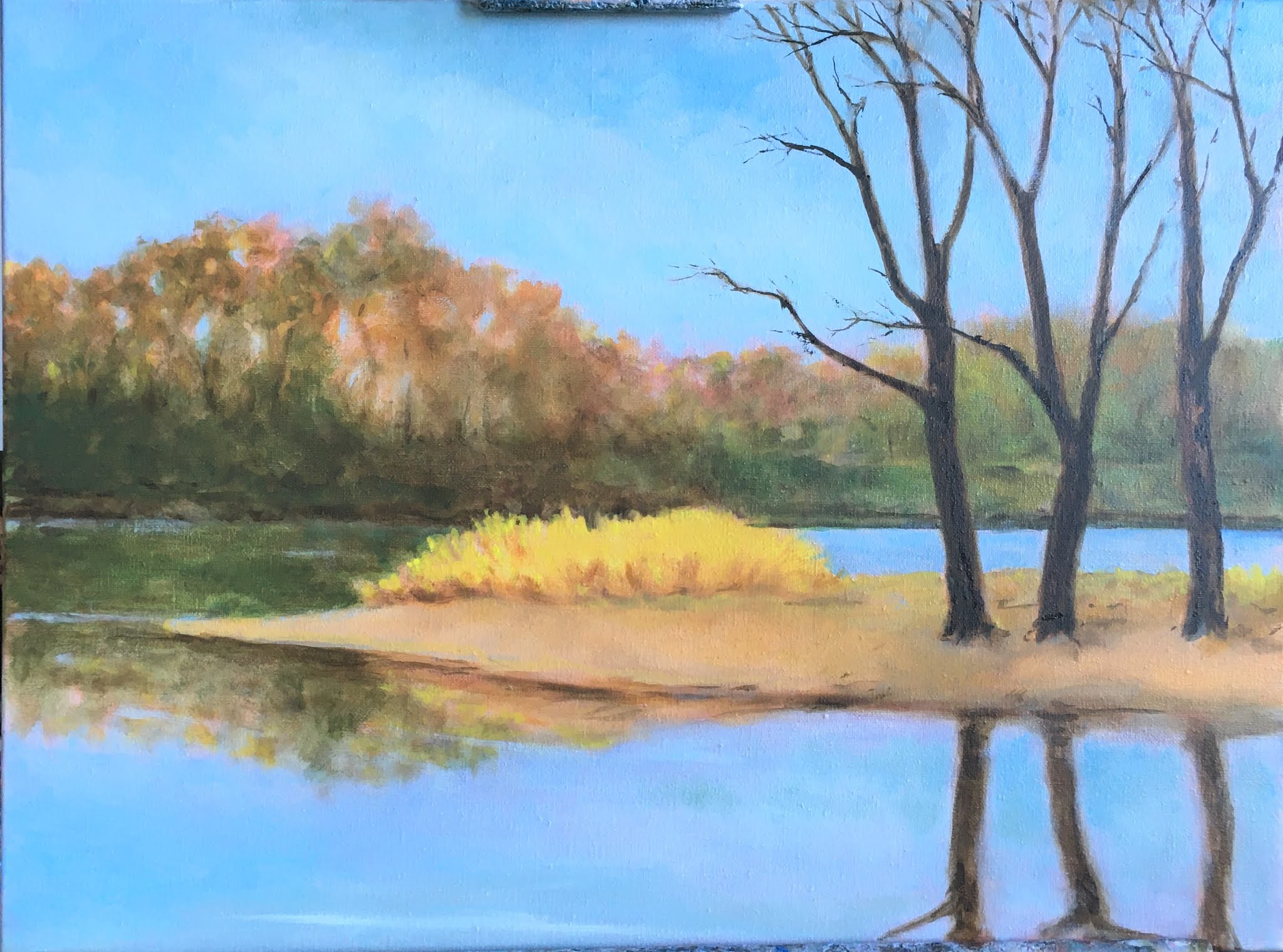
Next come refinement of color and addition of darks to begin showing the light of the scene and the shadows. In the step photo below I've added greens to show distant foliage but used oranges yellows for the trees on the left, which have mostly dropped their leaves. The reflections and shadows are darkest in the left-center, next to the brightest yellow patch. The sky and water look too patchy at this stage and the trees have yet to take on bulk and shape.

In the final stages, smaller and smaller details begin to make their way into the painting. It's important to me to avoid picky details in every section, though, and I concentrate on putting any tiny details near the center of visual interest. It's critical to avoid overworking at this point. Smoothing the sky makes it more distant and smoothing the water shows the viewer show still the surface happens to be. The seemingly sharp reflections of the yellow grasses add to the illusion of stillness. The tree branches are unfinished and the distant treeline needs some attention.

In the final version, "November Morning" shows very still waters in late fall--the trees are mostly bare. Throughout this particular work a part of my focus has been to suggest and not pick out tiny details. In the yellow grasses, most of the brush strokes are fairly large but along the top surface of the grasses I added a few tiny spots of yellow. In the far trees I scumbled some dull greens into the tops to emulate the confluence of branches and left other small patches dull red-orange suggesting filtering light.

"November Morning," oil on canvas, 2021


Friday, February 19, 2021

Wonder

One of the best experiences you can have with art is the feeling of wonder--maybe transcendence is a better term. It's come for me in various ways. When I was a young boy, reading Robinson Crusoe took me out of my Oklahoma bedroom and onto a beach in the south seas. In adolescence, the wonder of a museum room full of sculpture and paintings by Frederic Remington did something similar by taking me into the 19th century West. Years later, in the Prado Museum in Madrid, I rounded a corner and came face to face with "The Descent from the Cross" by Rogier van der Weyden, a work dating to the mid-15th century that had been the subject of a college lecture, and feeling of wonder washed over me once more. 

Rogier van der Weyden, "Descent from the Cross," oil on panel 1435


At the time I was serving in the military and found myself in Madrid with time to spend, so I had gone into the Prado Museum, knowing little about it or about European art, but curious. Not twenty steps from the entrance I turned a corner into a fairly large gallery and there it was. A jpeg doesn't do this painting justice since it is enormous--about seven feet by eight feet overall--and the figures are nearly lifesize. It was originally a piece for a chapel but eventually found its way into the Spanish royal collection. Even in its own day this was a famous painting. 

What I had learned years earlier and half a world away suddenly flooded back. The scene is the removal of Jesus of Nazareth's body from the cross. The lifeless body sags. At that moment his mother has fainted, her posture an echo of Jesus, as is the knee of the man reaching to support her and the bowed head of Mary Magdalene on the far right. You can always identify Mary by her blue robes in Christian iconography. The space of the painting is shallow and the corners of the work make it look almost like a box. Many comment on the detailed passages--folds, tears, and so on. The size, the brightness of the palette, and those stored bits made my scalp prickle with recognition, appreciation, and yes...wonder. It was unforgettable. In the decades since it's been my great good luck to experience wonder before great art many other times. 

I wish that for all of you.

Tuesday, February 16, 2021

Another River

Even though the year 2020 was a tough one because of pandemic and politics, it was a great time for painting outdoors. I've posted quite a few of the sketches and other works that resulted, but just ran across on that didn't make the cut until now. Although the covid crisis kept me away from the Saturday sketch group, for the most part, I did manage a few outings. On one of them we went over to the east side of the Des Moines River, to the Botanical Center. I set up on the river bank and did this watercolor in one of my sketchbooks. 

"Late Fall, Des Moines River," watercolor, 5x10


Saturday, February 13, 2021

Snow in Silver

The past several days along Druid Hill Creek have been unusually cold and unusually snowy. This morning the mercury hovered below zero at daybreak, and a new inch of snow had fallen overnight. The next several days are likely to be the coldest in several years, with high temperatures staying in the negatives. Although it would be great to be someplace warm, we're seasoned northerners and simply hunker down when these clear and icy days come at the end of the season. 

"Winter Woods," silverpoint on panel, 2020
Here is a group of silverpoint drawings from almost exactly one year ago, when the snows had accumulated across the creek. The drifts weren't as deep as they are now, the early February 2010 was plenty cold and bleak. Silverpoint is a medium that fits winter like a polar sweater--warm-toned lines and hatching in a monchromatic world. 

Although I haven't returned to metalpoint drawing for nearly a year, these make me want to get out my stylus. 


"Spruce in the Snow," silverpoint on panel, 2020

"Last of the Snow," silverpoint on panel, 2020

Tuesday, February 09, 2021

Missouri Valley Impressionists Show

"By the Creek," casein on bristol, 11x14


The Missouri Valley Impressionist Society is a regional organization that has been around for a decade or so. Membership in the Society is open nationwide although it was founded to enhance and emphasize impressionist and realist art in the nine states comprising the watershed of the Missouri River. This year my casein painting "By the Creek" is one of the sixty paintings in the exhibition. The 2021 Membership Show is online, owing to the pandemic. 

The show will be online until 9 May, so follow the link above or here to see the variety and quality of the show. 


Friday, February 05, 2021

Deep Freeze

A big winter snowstorm barrelled through flyover land yesterday--30-40 mph winds, heavy snow--followed by polar air that froze a lot of us in place. Current forecasts predict more than a week of single digit high temperatures and lows below zero here in Iowa. 

It seems fitting then to post this big oil sketch from January. "Snow Day" was inspired by news reports of a huge blizzard elsewhere, but it clearly applies here along Druid Hill Creek. 

"Snow Day," oil on panel, 2021


Tuesday, February 02, 2021

Winter Watercolor - Groundhog Day

One of the things that's easy to do from a snow-bound studio is stand at the window and splash down some watercolors. A little over two weeks ago we had an epic snowstorm--not like the one in the northeast US a few days ago, but close. Afterward I painted the view downstream on Druid Hill Creek from a north studio window and posted it here. 

Although we haven't had another comparable snowfall, I wondered what we might have in store before winter begins to shuffle offstage. One of last year's sketchbooks was useful to review. Last year almost to the day, the creek looked a lot like it did after the big snowfall. When it isn't frozen solid the creek flows dark as coffee and the banks are pillowed in several inches of snow. The bare trees make a tangle against the pale colors of winter. I looked ahead to mid-February of last year to see what the world might look like in ten days or so.

Late January, 2020, Druid Hill Creek, watercolor on paper


February 15, 2020, watercolor on paper

Late February, 2020, watercolor on paper


I suspect the groundhog saw his shadow. Anyway it seems to me that the best we can hope for is bright sun and cold days through the rest of this month, before the sun gets warm in March. That is, six more weeks of winter.

Friday, January 29, 2021

More on Mentors

A couple of weeks ago I posted a small appreciation of a couple of friends and mentors from years back, so naturally that got me thinking about other teachers and friends who have made a difference in my work. There are so many it's been my privilege to study and work with, from Richard Tuttle, my first real teacher, who taught airbrush over sixty years ago, to Frank Covino, a fine painter who taught me classical oil techniques decades back, to many more. Art has meant continuous learning. I'm grateful to all of them for their knowledge, patience, and friendship. 

One of them is Garin Baker.

Garin Baker, "A Buck Twenty a Bushel," oil on canvas, 2013

Here's a link to a podcast by Eric Rhoads, interviewing Garin, a truly gifted painter and great friend. We first met over a decade ago when Garin hosted a workshop for Max Ginsburg at his studio in upstate New York. Max lives and works in New York City, so it was a country getaway for him. I had purchased his Retrospective, a stunning and beautiful overview of Max's half century as a painter. I was lucky to attend, get to know Max, and to meet Garin Baker and his wife Clara. We've kept in touch over the years, and since then Garin produced a half dozen or more thoughtful and effective murals in the US and Europe, won Grand Prize at Plein Air Easton, and become an instructor at the Art Students League. He is a great artist whose roots in classic traditions and practices underpins his insightful work. And he works incredibly fast.

Here's a recent video of Garin making a master copy of a famous portrait by Ilya Repin:


Garin's classes are online right now but the Art Students League is planning reopening soon.

Tuesday, January 26, 2021

November Stillness

One of the uses of outdoor painting is development of reference material for studio paintings. Using sketches done at Gray's Lake, a park not far from my home studio, I painted "November Stillness" during the past couple of weeks. The sketches are a uniform 9x12, or about half its size, so there is considerably more room in this piece to study the fall and filtering the autumn light through changing foliage. The grasses are yellow-gold along the shore of the unruffled lake. 

"November Morning," oil on canvas, 18x24
A hard wind had blown through leaving the air still, the trees mostly stripped of leaves, and the surface of the lake smooth as a mirror on the day that I sketched on the bank. The air was crisp and the sun warmed my face while I painted. It was the last day of a season of delightful painting.

Friday, January 22, 2021

Sea Study

Though disadvantaged by distance from the sea, the ceaseless ocean has always fascinated me. Personal experiences aside, through paintings of the masters, movies, photography, and more, images of the ocean in its various moods have been in my head for a long while. These last weeks, in addition to regular studio work and a new landscape series, I've done a few more marine studies. 

"Wave Study," oil on canvas

This particular oil study was done after a teaching series by E. John Robinson, but heavily altered for my own purposes. It was valuable for a number of reasons. For one thing, the palette is limited, yet the sense of distance, color, and variety is striking. The colors were ivory black, raw umber, burnt sienna, cerulean blue, ultramarine blue, and white. The foreground, showing a tide pool with rocky bottom, is not in the original--it was added as a study. Mr. Robinson lived and worked on the Oregon coast, which I've not visited, but I think the work captures the sense of the region. 


Tuesday, January 19, 2021

Winter Blizzard

A few days back a winter storm came howling down from western Canada, bringing heavy snow and wind blasts up to 50 mph. That storm came a week or so after an enormous, ten inch snow, dropping another five or six inches. No way I was going outside, but I did manage a few sketches and watercolors from the warmth of the studio. 

"After the Big Snow," watercolor on paper, 10x8

This particular work was done with a new kind of watercolor paints called QoR, which carry more pigment that traditional watercolors, so the darks are deeper and the lights pop.

Monday, January 18, 2021

Another Pandemic Face

Over the past year I've posted sketches and drawings of people affected by the pandemic--anguished nurses, victims of the virus, and others. During these past (and alas, future) dark months it has been dreadful that so many refuse to even attempt to stop the spread of a disease that has now killed 400,000 in this country and over 2 million worldwide. It has been clear since the beginning that shielding the mouth and nose inhibits microdroplets carrying the infection from spreading. 

If you have been diligent in wearing a mask and maintaining appropriate social distance, thank you from the bottom of my heart. If you have not, out of a misguided belief that masks do not work (they do), or that they interfere with breathing (they do not), or out of from a misplaced belief that not doing so is an assertion of "personal freedom," shame on you! You are contributing to the death toll, whether you believe it or not. 


This digital self portrait is a tiny hint of how I actually feel. For the love of your fellow man, I implore you: Wear Your Masks!

Friday, January 15, 2021

Musings About Mentors


Rob Howard, Self portrait ca.1975

The other day while I was toning a canvas, a decades-old comment from one of my teachers came to mind. He was showing how he went about the task, leaving paint streaky as he drew his big brush across the canvas. Some people want a flawless, featureless tone, but "streaks were good enough for Rubens," he said, because the lighter streaks added brilliance and interest, even when painted over. Good advice that I've followed ever since. The teacher was Roberts Howard, who taught many, including me.

As the painting progressed, other voices from other times kept coming up. Words from mentors, teachers, and even famous masters come back as I work, so that once in a while I silently thank them. 


William Whitaker, "Primary Trio," oil on canvas

Bill Whitaker
was another friend and mentor. He taught individually, in workshops, and at BYU. His work spanned everything from still life to Western art to exquisite portraiture. After several years of workshops and personal talks with Bill, I built a collection of his aphorisms, each worth more every time I recall it:

  • "Go slowly." Spend the majority of your time looking, not painting. Study the subject twice as long as you use your brush. One of my worst habits is to neglect to study my subject fully, which leads to dithering brush strokes and muddy colors.
  • "When in doubt, use a bigger brush." This particular piece of advice isn't original to Bill, but he  repeated it incessantly. John Sargent was supposed to have said "Start with a broom...and end with a needle," meaning use big brushes first and leave the small ones for last. Your brush strokes will be more active and vigorous.
  • "Violate your edges," may be the most valuable of these because it comes to mind during virtually every painting I make, regardless of medium. Bill used to add, "You'll be glad you did." When done carefully, violating edges means softness in the painting. It's another bad habit to paint up but not into an edge in a painting, giving the work a completely different and less realistic look. 

There are many such moments for most artists, I suspect. And when they come, we give our mentors a silent, heartfelt nod of thanks.


Tuesday, January 12, 2021

Animation Infuencer

One of the great things about the Internet is the accessibility of information. Without the vast online resources available today it's pretty certain that a wide education about painting and painters would have been considerably more difficult, no to say impossible. These days it is a rare month when rummagng around online fails to turn up an artist I'd never heard of. That's the case with an astonishing German artist and cartoonist of the 19th-20th centuries whose influence is still being felt. 

Heinrich Kley, "Self Portrait"

Heinrich Kley (1863-1945) trained academically in Germany and for quite a few years made a living as a painter and illustrator there. In his spare time he filled sketchbooks with pen and ink drawings for his own and his wife's amusement. By 1908 he had painted murals for public spaces and completed many industrial scene for Krupp, the steelworks. But it was his cartoons,which began appearing in periodicals of the time, that are the foundation of his reputation. The cartoons, original, wry, sometimes grotesque, sometimes vaguely erotic, were a sensation. Before long two books containing hundreds of his sketches were published (still available now in a Dover edition). One of the innovative aspects of the sketches was anthropomorphized animals--crocodiles dancing, singing turtles, elephants ice skating like humans, and much more. Mr. Kley was literally able to draw nearly anything, and did.


Today many artists who draw in ink use technical pens or fountain pens, but in those days artists used a traditional pen with a flexible steel nib that had to be recharged with ink quite often. You did that by dipping the nib into an inkwell or bottle. The beauty of a flexible dip pen is the variability in line width and darkness that can be achieved, something not easily done with today's tech pens. Mr. Kley was such an accomplished draftsman with dip pens that he was very quickly hailed as a master.

Although Mr. Kley did well for a few years after his wide recognition, the World War and then the death of his wife reduced his output, and his fame faded in the 1930s, his work had a profound influence on none other than Walt Disney, who had come into possession of several of his sketchbooks and dozens of drawings. The now-classic Disney animated feature "Fantasia" in particular owes enormously to them.


Although Mr. Kley did well for a few years after his wide recognition, the World War and then the death of his wife reduced his output, and his fame faded in the 1930s, his work had a profound influence on none other than Walt Disney, who had come into possession of several of his sketchbooks and dozens of drawings. The now-classic Disney animated feature "Fantasia" in particular owes enormously to them (see clip below). Furthermore, I think his work was a likely influence on Dr. Seuss, who may have patterned at least one of his villains after a Kley drawing--"Herr Schoolmaster," above.

There are several books about Heinrich Kley that have become available in the past decade or two (easily gotten on Amazon) and are well worth the time. 


Friday, January 08, 2021

Quiet Flows the Stream

There has been snow on the ground here in Des Moines for perhaps ten days, and the temperatures have been mostly cold. For me, bare black trees, cold black creek water and deep grey skies are bearable because there are happy memories of summer painting and beautiful days. The quiet serenity along a river bank is soothing to the soul.

Here is a studio work from late 2020, casein on bristol. I did this from outdoor studies done on the spot and from photo references. Although much of my work time during the summer was outdoors, I also managed this one in the studio. Casein is a lovely paint to work with once you get used to it's really rapid drying. Casein is milk protein, so it's a water-soluble paint, but once it dries it's pretty much permanent. You can't really activate it again.  

"Rocky Racoon," casein on bristol, 2020

Tuesday, January 05, 2021

Seascapes

Although my studio is in the upper Midwest, the sea has been an artistic challenge to me, probably because of its mystery and unceasing motion, its wide moods and wider range of color. Unlike fortunate painters who've had the chance to study the sea, my horizon has been more limited. Still, marine painting attracts me, and it's pleasant to look at something beside snow this time of year.

Over the centuries, marine painting, or seascapes, have always been popular and remain so today. As is often the case when you go searching online, unknown facts and people pop up. As I was thinking about this blog post and searching, Ivan Aivazovsky (1817-1900) popped up. A Russian-Armenian painter, he was born Hovhannes Aivazian in Crimea and received a formal art education in St. Petersburg. In his day Mr. Aivazovsky was prolific, well-known and exhibited widely. By the time of his death he had produced thousands of works from portraits to landscape to many marine works. His work is highly romantic and more brightly colored than the realism of his day, and it eventually became unfashionable. Nevertheless his best works are still vigorous and engaging. 

Ivan Aivazovsky, "Rainbow," 1873

In "Rainbow," he shows us a ship foundered onshore during a violent storm. The crew has abandoned ship and is struggling to safety amid wind-whipped waves. The sun has broken through, making the sky into a rainbow (you can see it faintly at extreme left). The idea, composition, colors and narrative make this an admirable and utterly compelling work.

An American master of seascapes is Winslow Homer, a favorite of many and a particular favorite of my own. Mr. Homer was largely self-taught, although he did work for a lithographer for a short time in his youth. From that small start he made a career as an illustrator, then as a painter. His illustrations include beautifully executed pen and ink drawings during the Civil War.

Winslow Homer, "The Gulf Stream," 1899

It is interesting to compare Homer's masterpiece with "Rainbow." Each shows a vessel after a storm, the crew helpless before the heaving sea. Mr. Homer's paint handling is dense and thick, the ocean and waves mostly dark and forbidding. But unlike the escaping boats in Mr. Aivazovsky's work, this solitary fisherman seems trapped by a trough of deep and dangerous ocean, unseen by a very distant sail. Each painter, though, renders the water with consummate skill.

Hoff, "Passing the Light," oil on panel


My forays into marine painting have been few though the future probably holds more plein air work near the sea. Water is a formidable challenge. Above is one of my few seascapes, showing a sailboat on its way out of port. I did this one on a medium-grey support and played two differing blues against one another. The setting could be any place, but is actually an inland sea, Lake Michigan beyond the Chicago River. 

Hoff, "Wave study," oil on panel 2020

The last of these is a wave study done in oil on panel during early winter. This is a study of waves, done after a teaching study by another artist. There is a warm-toned failure of a painting under the study, some of which you can see here and there as dark passages. The palette here was an unusual one for me, including manganese blue, a color I had never tried. It was a challenge to model the wave and foam shapes and imply underlying earth and rock. 

Water in general and the ocean in particular are fascinating subjects. More to come.

Friday, January 01, 2021

Happier New Year

Winter may be settling onto the land but Father Time knows that the outlook is brighter ahead as the days grow longer. Warmest thanks for you who may read this. A happy, safe, and prosperous 2021.


Tuesday, December 29, 2020

2020 Annus Horribilis


Outside the studio window, snow is falling hard and the ground is white. Days and nights are dark and cold, and the end of the year is almost at hand. Reflections on the year behind us and the one ahead are usual here in the dregs of the year. 

The first few months of 2020 were deceptive and calm here on Druid Hill Creek. January through March (and the onset of pandemic) kept me busy with metalpoint drawing, watercolors of the creek, and digital paintings of endangered species. Two of the endangered species paintings went on to be exhibited in a virtual show benefiting a great ape sanctuary. 


"Red Wolf," digital painting


Winter on Druid Hill Creek, silverpoint, 2020

By March, as the pandemic swept into the United States from Asia and Europe, as the numbers of infected and ill patients began to overwhelm hospitals and health workers in New York and the east, my digital work began to deal with events. A series of drawings of people in the pandemic, particularly nurses and physicians, was the result. At the time we hadn't begun to see the emergency that faces the nation now, but it was horrible enough to cause lockdowns, mask mandates, and more that we have dealt with over the ensuing nine months or so. My own response was to keep working but at a distance from others. Starting that month began a long series of plein air oil paintings devoted to nearby landscapes. In the spring summer and fall months much of my time was spent painting at Gray's Lake Park and along the Raccoon River. Eventually these works formed the core of a virtual exhibition A Season in the Sun, of plein air works (which is still running). 

Although the watchword since the beginning of the pandemic has been isolation or social distancing, on a few occasions I did manage a sketching excursion or two in autumn with the Saturday Sketch Group, but mostly 2020 was an exceptionally solitary year for this painter.

"Along the Raccoon," oil on panel, June 2020


"The Point at Gray's Lake," oil on panel, October 2020

Besides oil paintings, I also did watercolors outdoors, both with the Sketch Group and solo.
"Downstream," watercolor
2020 truly has been a horrible year. More people have died in this pandemic than most of us can even comprehend. The world is suffering terribly but with vaccinations, increased personal responsibility (wear your masks, folks), and vigilance it will pass.

Next year, if the pandemic eases (fingers crossed), my plan is to spend more time with other painters and with people in general. 


Friday, December 25, 2020

Holiday

The holiday comes, with much less to celebrate. This Christmas is certainly less merry, given that more than 300,000 Americans have died so far, intensive care beds are full and the world's society and economy are in tatters. But even in these dark times, light is on its way, vaccinations are beginning, and there is hope for the nation.

In spite of everything, Merry Christmas, Happy Hanukkah, Good Kwanzaa, and enjoy Solstice. Whatever holiday you and yours celebrate, be happy and be safe. Wear your masks.