A site for rumblings and ruminations about traditional oil painting, art, aesthetics, and the wider world of art. And for posting examples of my current and past work too.
If you have an interest purchasing a work, or want to commission a portrait, or if you just want to talk about art, drop me an email at ghoff1946@gmail.com.
All writing and original art on this site is copyright Gary L. Hoff, all rights reserved. All other images are copyright their respective owners.
These last days of February seem to last longer than they are. There are days of grinding cold here in Iowa, punctuated by a day or two of sunny warmth, then more days of gray sky and sweeping wind. Snow sometimes falls heavily. In 2018, snow was disappearing, color was coming into the big bluestem along Druid Hill Creek, and the remainder of the month was seasonable.
February 2019
On the other hand, the following year the snow covered the banks and drifted deep over the frozen creek. Nonetheless, this time of year the light changes and goes a little more golden. Like hope in times of travail. We would need it. The pandemic followed.
February 2020
Then in 2020, at the height of the covid crisis, though the light was warm on the frozen trees and land, the snow was as deep as it had ever been.
This year the pandemic seems to be less a raging fire and more and more an evolving aftermath. The news is more encouraging as case numbers and deaths decline. It's tempting to declare the pandemic finished, but one suspects and fears a return. In the meantime, the light goes more golden and the earth warms. The season creeps forward as do we all.
This week in the Guardian there was a notice of a new exhibition at the Ashmoleon Museum in Oxford, England, devoted to Camille Pissarro (1830-1903), a neglected member of the Impressionist group that included Monet, Renoir and Degas among other luminaries. Known to his fellow painters as Father Pissarro because he was a decade older (Monet was born in 1840), Camille Pissarro did seem to be a kind of paternal presence for at least some of his contemporaries. Unlike his younger contemporaries, he had abundant life experiences, having been born in the tropics, and lived in South America. After moving the Paris in the 1850s he met Claude Monet and Paul Cezanne. He was later tutored by Camille Corot (1796-1875), who inspired him to paint outdoors. Other early influences were Courbet and Millet.
Although he worked and was influenced by a number of the early group and post-impressionist painters too, unlike them he painted out of his interest in the reality of his subjects, without prettifying. That is, he painted subjects that were decidedly noncommercial such as barges, butchers, and sometimes confusing landscapes. He was an idealist and a role model. One of the concepts he espoused to his younger colleagues was to finish the work outdoors, confronting the subject.
"Farm at Montfoucault in Snow," ca.1875
"Pond at Montfoucault," 1874
Mr. Pissarro has most commonly taken a back row seat in the pantheon of his times, but this new exhibition, running February 18 to June 22 of this year, provides a wealth of his work and others. The object is to demonstrate his centrality and influence. In another way, the exhibition gives us a painter whose work reflects that of his friends and peers. In work from the Impressionist period, his work can resemble that of Claude Monet, as in "Pond at Montfoucault" and "Farm at Montfoucault," (above). A decade or so later it is pointillism, and his friendship and studies with Georges Seurat and Paul Signac that as in "The Apple Harvest," and "View from my Window," (below). Both of these are featured in the exhibition and on the Ashmoleon website.
"The Apple Harvest in Eragny," 1887
"View from my Window, Eragny," 1888
Later he would return to a more realistic style, and painted with a more subtle but knowing touch. His work deserves more attention, and this exhibition provides it. Alas, I will not be able to attend. An exhibition catalog has been published.
Here in the upper Midwest we don't count on springtime's arrival until March, but even so, warm days set my fingers itching to be outside painting. December and January were cold, and the first half of February too. But a few days above freezing, some sunshine, and plein air beckons. The last time I managed some time outside was the first day of December. It was cold, and windy, but the air was crystalline and trees along the river were still holding colorful foliage. Th bright sun made them glow.
"North of the Park," oil on panel, 9x12
This particular spot is by the Raccoon River, just north of Gray's Lake. As usual, I toned the panel with a thin wash of burnt sienna, then sketched the composition with the same color. In my experience the best way forward after lay-in is to block big masses of color, then smaller and smaller ones as the picture is refined. In particular I try hard not to focus too closely on minute details in any one place until the time comes for a few tiny strokes at the end.
Antique automobiles are wonderful. Many make us smile simply because they exist. Some are genuine works of art, and you can find them in museums where they are displayed alongside paintings and sculpture. Not quite a year ago, the Museum of Modern Art in New York mounted an exhibition called Automania, celebrating the automobile in all of its controversial glory. The show exhibited nine cars, including a Volkswagen beetle, a Willys Jeep, and an Airstream travel trailer, among others. Count me among those who missed the show but wishes he could have gone.
Years ago I owned an early Volkswagen--early enough that it had a tiny rear window and the inefficient heater they were known for. Before that I owned a 1950 model DeSoto, and forty years afterward a 1950 Ford pickup truck. Antique cars are wonderful memory machines. Here are a few.
"1957 Hudson Hornet," digital drawing
Although I never owned one, the Hudson Hornet is still a favorite of mine. Back in the day they were sleek, low-slung, and handsome. By my high school years many a young man owned a Hudson, a 1950 Mercury, or perhaps an early Buick Skylark because by then they were widely sold as used cars.
"1954 Buick Skylark," digital drawing
Of course, these two were common assembly line Detroit machines, unlike fancier foreign cars but their design shared the same nod to Art Deco.
Alice Neel (1900-1984) was an American painter who spent decades painting in obscurity in New York City. In recent decades she has been celebrated and exhibited but in the early decades of the 20th century she was clearly out of step with abstraction and the various other movements that gained attention. Instead she pursued her own path, painting landscapes, still life, and mostly people in her individual and distinctive style.
Ms. Neel was born in Pennsylvania in 1900, a time when women were expected to marry, bear children, and maintain a home, but her ambition in life was always art. After high school, she worked as a civil service clerk fo several years to assist her parents, but in 1921 she enrolled in the Philadelphia School of Design for Women where she was an apt student and was influenced by Robert Henri, who taught there. During her student years she met Carlos Enriquez, a Cuban painter, whom she married in 1925
"Well Baby Clinic," 1929
after graduation. The couple soon moved to Havana, where she bore a daughter, Santillana. She and Carlos returned to New York within the year, where her daughter died of diphtheria. A second daughter, Isabella (called Isabetta) was born in 1928. Influenced by the Cuban avant-garde as well as the death of her first child, Ms. Neel's work thereafter was infused with themes of loss, fear, motherhood and a deep abiding interest in individuals. Her horrific view of hospitals is evident in "Well Baby Clinic," based on the birth of Isabetta. In 1930 Carlos returned to Cuba with the stated intention of obtaining sufficient money from his parents to move the family to Paris. He took Isabetta with him but did not return and instead settled in Cuba. It would be several years before he returned with Isabetta and then only for a short period. In reaction Ms. Neel had a serious psychiatric issues requiring hospitalization. After almost a year she left the hospital and after staying briefly with her parents and others she returned to New York City.
In New York she worked hard painting individuals of all kinds and became an artist for the Works Progress Administration, a public works program instituted to provide work for many of the millions of unemployed (they built bridges, roads, and public buildings, to name a few), and it was during that period that she gained a bit of recognition for her work. Unfortunately, much of that work was destroyed by a disgruntled lover.
"Portrait of Ethel Ashton," 1930
During the 1930s Ms. Neel began painting female nudes with the idea that the female body had been idealized and sexualized by the male gaze, to the detriment of women. Instead of strictly realistic paintings she began to rely of vibrant color, expressive gesture, and a psychologic penetration she felt were missing from the male gaze. One of the first such works is a nude of Ethel Ashton, a fellow painter and school friend. In it, she employed an unusual viewpoint and a dull, nearly monochrome palette. The sitter seems abashed, vulnerable, and afraid, her body cascading downward. When it was exhibited more than four decades afterward it was roundly criticized for departing from the "standards" of female nudes. Nonetheless, Ms. Neel continued to paint with the same penetrating insight and style for the remainder of her career. But it was more than twenty years afterward before she received much public recognition. In the interim, she lived in penury while painting continuously.
Portrait of Frank O'Hara, 1960
It was only in the 1960s that her work gained wider acceptance. Her interest in character was clear in two portraits of a New York poet named Frank O'Hara. The first (now in the National Portrait Gallery) is a good likeness in profile, with his prominent nose and forehead well-drawn. The second, though, is considerably less flattering, if more penetrating. Both gained her notice in print during the decade, and appreciation of her work began to increase. During her latter years, Ms. Neel painted many people from her neighborhood but also famous sitters. She also painted nudes of pregnant women, seeking, she said, to show a part of life that had been ignored, calling others who had avoided the subject "sissies."
"Pregnant Maria," 1964
For the rest of her career, Ms. Neel worked hard to show what she called "the basic facts of life," unblushing and straightforward. In her 1970 unflinching portrait of Andy Warhol (below) she depicted the by-then mega-famous artist nude from the waist up, complete with his surgical scars from a gunshot wound of several years earlier and the corset he had to wear for the remainder of his life.
"Andy Warhol," 1970
If you aren't familiar with her work, I urge you to take time to see it now, and also take time to view the video below. She was certainly not a sissie.
This week my new solo show Town and Countryside opens at the Oskaloosa Art Center. The Center is not only a public gallery but also offers classes in various media, studio spaces, and a public performance venue. The show comprises more than twenty of my new oil paintings, both cityscapes and landscapes. A majority of the landscape paintings were executed outdoors at various locales in Iowa and elsewhere.
"The Bike Path," oil on panel, 9x12
"At Grays Lake," oil on panel, 9x12
Cityscapes in the show, likewise, include Des Moines but also feature scenes of other cities including Boston and New York.
The show runs until March 15, but you can see these new paintings and others on my website, www.garyhoff.com. Drop over and take a look.
Once in a while when trying out new materials--paper, canvas, paints and so on--my practice is to make studies to understand the physical properties involved. Late last year while working with a new kind of coated, heavy drawing paper, it occurred to me that perhaps it would be useful for watercolor. Light papers tend to winkle, or "cockle" when wet, but Legion Coated Cover paper felt heavy enough to tolerate the wetness. As a test, I made the small watercolor below and found it reasonably useful. To make the painting I used a reference shot of a city street but made it into an imaginary country road.
The reference photo (right) is considerably different, although the basic composition is almost the same. In the reference the street is rain-slick and the sky is dark, for instance. But in the painting I made the hill steeper, eliminated houses and driveways, and turned the street into a gravel road. So although the painting looks as if it was done on the spot outdoors, it's actually a studio experiment.
A lot of my work over the last couple of years has been traditional landscape, quite a bit of it outdoors. Some of my plein air work has been on city streets, though. Like many cities ours has a kind of entertainment and bar district with an eclectic assortment of cafes, performance venues and watering holes, and I spend some of my outdoor time there, sketching.
"Positively 4th Street," oil on panel, 16x24
Outdoor work has led to a number of cityscapes, including "Positively 4th Street,' showing the facade of a well-known coffeehouse (above), and "The Mews," showing a performance venue just next door (below).
"Vaudeville Mews," oil on panel, 16x20
The first is from late afternoon, when the street is in open shade while the second is a view of the same street in morning light. Both of these occupy space in the same late Victorian building.
This painting is from on the spot studies of a dredge that was hauled ashore on the Hudson River in Newburgh Harbor, about sixty miles north of New York City. We were in a workshop there, but before painting the view downriver I did a few graphite sketches of this dredge. A few weeks afterward was this studio piece.
Newburgh Dredge," oil on panel
For me, industrial an un-lovely subject matter can be a departure point because there is often beauty in unexpected places.
Many who make art, whether drawing or painting or sculpture, owe something to Paul Cezanne (1839-1906}, the great French painter of the late 19th century. Scholarship in the history of art suggest that it was his work, more than most, that broke the traditions of representative and realistic art. Writers as diverse as Ernest Hemingway and Emil Zola explored his importance. Painters like Picasso and Henri Matisse (who famously said Cezanne was "the father of us all") were profoundly influenced by him. His work hangs in major museums worldwide. And yet I don't like his work.
Paul Cezanne
That's right, I don't care for the majority of Paul Cezanne's oeuvre. His early works were dreadful both in execution and content, involving themes of abduction, murder, and rape. Although he attended life drawing groups and had some minimal instruction, he really had no formal training. Refused entry to the Ecole des Beaux Arts in Paris, he went his own way, in much the same way as Vincent van Gogh. And it shows. Neither of these two giants in the history of art drew figures fluently or even accurately (see "The Card Players,"or "The Bather," below, for example), and Mr. Cezanne in particular had difficulty with traditional perspective. Mr. Cezanne's sense of color always seems a bit off, too, particularly his greens which to my eye are bilious or acid.
Nevertheless, the unlikely Paul Cezanne has been a profound influence. It may be argued that his breaking of traditional perspective, off-key color choices and the rest were intentional, but the counter argument is his lack of formal training. Regardless, the influence of his work is undeniable.
The Card Players, 1894
The Bather, 1885
Modern Olympia, 1870
Why such work was and is influential has little to do with its attractiveness. Works by Claude Monet, now revered, were called ugly during his lifetime, but as understanding of his aims in painting them became apparent they were hailed. The thing is, Mr. Monet knew what he was doing while Paul Cezanne may not have done. In fact, his wife said, after his death, "Cezanne didn't know what he was doing." Of course she may have meant that he didn't know what his work was doing in the world of art, but that seems unlikely. Nevertheless, the works have been widely praised. Writers discuss his search for form, his breaking of perspective, his vigorous brush, and more. A number of movements in art--Cubism, Fauvism for two examples--owe a great deal to his work. Even so, to my eyes his work is hardly attractive and certainly not beautiful. The colors are odd the figures inaccurate, the perspective often skewed. And yet.
And yet Mr. Cezanne undoubtedly influenced the work of many who came after. His skewed and broken perspective gave life to Cubism. His colors and planes opened a path to Fauvism and the work of Henri Matisse. And from there his ideas in paint echo through the decades.
Apples, 1878
Pyramid of Skulls, 1901
Nonetheless, Mr. Cezanne's work is not pretty, not like much of
Impressionism. Instead the work demands that you stop and study. Perhaps
he did in fact know what he was doing and his lack of training meant he
didn't have to absorb and then unlearn any of the classicist training of many of his
peers. Or maybe his lack of training made for distorted figures, different and more odd brushwork, unusual colors and the lot. Regardless, all that remains is the work--arresting, un-pretty, highly influential. So who cares if he knew what he was doing or not.
Gouache is a medium that isn't used very much. Back in the day, gouache was the go-to medium for illustrators because it is water soluble, dries matte and therefore photographs well, and is not expensive. Gouache paintings are typically made on a fairly firm paper support like poster board or Bristol. The paint is much like transparent watercolor but has added ingredients that render it opaque. Like watercolor, gouache is re-activated by water. That is, the paint can be lifted, smeared, or otherwise altered if exposed to wetting. I've a few tubes of gouache but it isn't a medium I've done much with in recent years. Still, gouache is a lovely kind of paint.
Untitled, gouache on paper, 6x8
While tidying files and paintings I discovered a gouache from a few years back. The subject is a view from my studio window, painted while standing at the windowsill. The support was already smudged and dotted with paint here and there but I sketched the subject rapidly with full-bodied juicy strokes, using a limited palette. It was one of those bright sunny days that often follow mid-winter snowstorms, lighting the tree trunks golden and throwing dark blue shadows.
The winter season has finally settled in. Three days back we had almost fifteen inches of snow here along Druid Hill Creek, followed by some deep cold. Seems likely to me that the weather won't shift dramatically again until some time next month. We did have a brief thaw after the really frigid weather that started the month, but the deep snows came, inevitably.
This first watercolor of the year is from a couple of weeks or so ago, after our first big snowstorm. The fun of this particular painting was in the limited palette and slanting shadows over the snowed-in creek. This view from my home studio window is one I've painted many times.
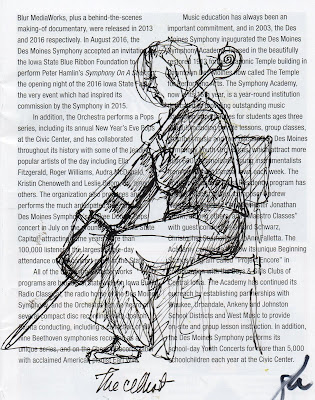
It's been a couple of years since we've attended a concert in person. Back in the days when we managed several a year one of my favorite things was to sketch. Most of the time that meant drawing with a ballpoint or technical pen on whatever paper came to hand--most commonly the program we were given. The musicians are generally immobile except when playing, offering fine opportunities for figure sketches and head and shoulders too.
The seats we typically occupy at symphony concerts are a little closer to the violins and violas so I've had more opportunities to sketch those musicians. Here's one of the back row violinists, heavyset and very energetic. As is the case with most classical music ensembles, the musicians wear formal clothing, black dresses and pant suits for ladies.
The second violinist. sketched here, always wears her long hair pulled back on the sides, no doubt to keep it out of the way. She has a graceful way of tossing her head in time to the most emphatic pieces, her face nearly always a joyful mask as she attacks the piece being performed. She's probably my favorite player.
The cellist in this drawing occupies the first chair, close to the edge of the stage.
Although sketching during concerts is great fun, you have to take care not to disturb your fellow audience members, and with the house light dimmed it's not always easy to capture what you want. But during warmups, between pieces, and at the close are great times to scribble down an idea or two. I highly recommend it.
Here is a small landscape study in oil, 9x12 on panel. Although it's bitterly cold in Iowa and the snow from over a week ago is still covering the ground, a painter can go anywhere he likes in his imagination. This is a cascading spring adding its artesian water to a small creek. The fun in this one was in looking deeply into the darker passages then translating that seeing into paint.
One of the things about snow is that it actually isn't white. That is, the snow crystals are white, certainly, but the snow surface generally reflects the colors around it, whether in sun or in shadow. Our eyes and minds tell us that the snow is white, but painters need to know better.
These small oil sketches were all done in winter but at different times and in different weather conditions. In each the snowy ground has a much different color and appearance. In the first, the view is generally northwest as sunset is casting a red to pink glow over a blanketing snowfall. The tiny size of the support allowed me to do a very rapid impression of the spruces and trees from my studio window.
In the second sketch there is much less snow, barely enough to begin covering ochre-colored grasses that covered the slope beyond Druid Hill Creek. The fallen tree has been a motif for several years, since it suddenly fell one night..
The final sketch in the series shows cris-crossing dark blue shadows against yellow to pale ochre snow. The whole thrust of that particular sketch was the colors on the snow, which still reads as white to the viewing eye.
Every year I spend some time reviewing past work and blog posts, mostly because it's hard to remember exactly what I was doing yesterday, with last month being utterly fuzzy. A year ago is out of the question. This time I took a look back over several Januarys. There was a lot to catch up on.
"Fallen," casein on panel, 2017
Nearly every January in past years has included notice of the weather--usually snowy, often quite cold. Sometimes the landscape outside my Druid Hill studio was simply a subject of opportunity as I tried various mediums or techniques. At the end of 2016 I was investigating casein, for example, so in January 2017 I made a landscape of the woods across the creek using casein paint and posted it. The subject was a fallen tree on the far slope that had caught my eye. The painting has a generally warm tone because December had been almost snow-less, which I lamented about in the body of the post.
"Winter Light," oil on panel, 2018
But in January of the following year, a couple of weeks later, we had had plenty of the white stuff. and I had reverted to my favorite medium, oil paint. I did a landscape of a house farther up that slope opposite the Druid Hill Studio, but by then the snow was almost a foot deep. From the warmth of the studio window you could see how the early morning sun set the tops of bare trees aglow. One of my favorite works.
A mixed media painting (acrylic, gouache and watercolor--above) a year later shows the creek dark as coffee under overcast skies. The water is actually frozen, with a blue hazy surface. The cold, snowy weather was once again the norm.
"Winter Storm," wc on paper 2020
In 2020, just before the pandemic, I posted a retrospective of that January and once again mention a "snowy and cold") month that drove me indoors. A lot of that month's works were watercolors, including a small work (above) done during a particularly "white" snowstorm.
"January," wc on paper 2022
Finally, here's a very recent watercolor sketch (above) on the coldest day of the year so far. The snow is now about 5 inches deep and with clear skies the temperature plummeted overnight. Brrrrr.
Reviewing one's work once in a while seems to me ought to be a routine for most who make things, especially because it's useful as a memory but also because it might just trigger new work.
The Great Picture Book of Everything is the grandiose title that was attached to an unpublished encyclopedia illustrated by the Japanese master Katsushika Hokusai (1760-1849). Hokusai is doubtless the most famous Japanese artist. Although it was known that the master had made the more than one hundred drawings, they have never been exhibited in public, until now. The small drawings (each maybe the size of a postcard) are being shown by the British Museum. Happily, there is a companion book published last week.
"The Great Wave Off Kanagawa," 1830, woodblock print
Without question, Hokusai's print known popularly as "The Great Wave," one of the "Thirty-Six Views of Mt. Fuji," begun in 1830 and completed a few years afterward. But the master worked daylight to dark most days of his ninety years and left behind thousands of prints, drawings, paintings and other works. These newly exhibited works are probably part of a much larger group, given that the Boston Museum of Fine Arts holds nearly 180 similar-sized works with similar style.
"Cats and Hibiscus," ink on paper, 1820-40
Perhaps one of the most important facets of these images is they aren't prints, unlike so many famous works by Hokusai, but are actual drawings by his hand. Drawings are lost in traditional wood block printing so that very few exist. Here we can examine the genius of the master's hand rather than as interpreted by a block cutter. These were for an unpublished book and were therefore preserved.
"Water Fowl," ink on paper
The book that accompanies the exhibition is well worth the time and money involved.
Wayne Thiebaud has died at 101. One of my favorite artists, Mr. Thiebaud was a titan in the world of painting. Although the casual observer remembers his mostly early paintings of food--pies and cakes, ice cream cones, pastries, and hot dogs—in his later years he painted dizzying cityscapes of San Francisco as well as northern California. He was also noted for his figure paintings.
"Pies, Pies, Pies," oil on panel, 1961
Mr. Thiebaud had a very long career more than eight decades. His first work as an artist was as an apprentice at Walt Disney Studios when he was still in high school. During World War II he was an artist for the Army Air Force First Motion Picture Unit. Afterward he attended college in California, earning bachelor and master degrees in art. From that time onward he observed, taught and painted. And with a few short exceptions he spent the majority of his career in northern California.
"Up Street." oil, 1993
Although his subject matter was mundane in many ways, his interest wasn't specifically in the items but in their shapes and colors, and the fall of light. He was a master at manipulation of paint. His still life works of food are manifestly just oil paint but his handling makes them mouth watering, even so. He loved gum ball machines not because they were machines but because of the repetitive colored circles of gumballs within the globes of the dispensers. Because of subject matter like that, more than handling, he was often lumped into the circles of Pop Art but his aesthetic sense was never ironic in the way, say Andy Warhol's was, and he often rejected the label. A realist down to his toes he still strove for the abstract, later realizing that goal in his aerial landscapes of San Francisco streets and the countryside near Sacramento.
In part, Mr. Thiebaud has been an inspiration to me simply because he worked daily at his art until his death. He was quoted by his gallery as saying he had a "...neurotic fixation of trying to learn to paint." Because painting is more than the output of the artist; it's a learning process start to finish, if you let it be.
Goodbye and thank you for a wonderful career and for your inspiring role model.