Friday, October 15, 2021

Florida

"Fan Palm," wc, 4x8

We arrived here a few days ago for a long-delayed family visit, hindered by the pandemic as so many have been. Unlike the Midwest, Florida stays green all year round, more so the farther south you go. Here around Tampa Bay the plants and foliage are always green. Palm trees grow wild and species we know as house plants grow tall in the gardens outdoors. Even in the depths of winter, like January in the watercolor on the left, people walk their dogs in shirt sleeves and huge palm trees flank the buildings and gardens. 

"Bradenton Green Belt," wc, 8x10

In Iowa, when we talk about green space or green belts the trees we know are cottonwoods, willows, elders, oaks, even elms. But in Florida its palms but also many many other species. In south Florida, green spaces are effectively jungle, choked with undergrowth, middle tier and high tier native trees, and commonly damp, muddy, or actual wetlands. Where there is water, even in residential areas, you see alligators, wading birds like sandhill cranes. Deer and all manner of bird life thrive in the warm, wet, and green environment.

The green belt behind us is a good example of the jungle-like areas you see around here. Although it is only thirty or forty yards deep, this space is in many ways like rainforest or jungle. I spent some time painting the green wall next to a walking trail that's perhaps forty yards away, back in 2016. If anything the green belt has become more dense and darker.

"Bradenton Bird," wc on paper, 4x7
The weather was rainy and humid during the early days of our visit, but here are a couple of subjects from sunny Florida. The first is a bird of paradise that blooms continuously outside the front door. It's an astonishingly healthy clump of plants. The second is the view from the back of the house, showing a distant line of trees and three of the bright red ti plants that so many here employ as garden accents. These plants can grow tall--perhaps six feet or more. 


"Florida," wc on paper, 5x9


Tuesday, October 12, 2021

Weekend Watercolor

Ten days or so ago the Saturday sketch group spent a warm sunny afternoon at Greenwood Park, which south of the Des Moines Art Center. The park contains an amphitheater, woods, walking paths, gardens, artwork, and a big pond. I spent a couple of hours along the bank where ornamental trees were just starting to change color. The bright yellow-orange of their foliage against the dark emerald greens of the surrounding woods was almost artificially bright. 

"Greenwood Park, Autumn," watercolor on paper, 8x10

Fall is a great time for sketching. I'm traveling this week in Florida, where autumn never penetrates, but expect more of these when I return, as Autumn reaches its peak.

Friday, October 08, 2021

Metal Month

Late last month while considering another Inktober--the worldwide event of drawing and posting a daily pen and ink drawing--I decided instead to do a metalpoint drawing every day of this month, posting the results. We're now about a week into the month and so far I've managed to follow through. Of course, metalpoint is a much different drawing discipline than inking. Both invove drawing with materials that aren't easily erased, only effaced; both are considered antique, if not archaic; and both have a limited following. No matter. The point is to work with the medium repetitively, becoming familiar with its strengths and limitations. 

Working with metalpoint requires an exacting approach, a carefully prepared surface, and considerable time. Whatever support one uses for metalpoint drawings, the surface must have some "tooth," a mildly abrasive surface, to allow the metal to be rubbed onto it. Soft metals like silver, gold, even lead, work fine and make marks that vary in darkness and color. Silver makes a cool, medium-dark line while gold makes warm but paler lines. The need for an exacting approach is similar to ink--another unforgiving medium--since erasure isn't really possible. Depending on the support and surface you can erase metal marks with exceptionally-fine sandpaper, but usually the surface is damaged too much. And since even silverpoint marks can only be deposited in a limited range of values, shading and volume rendering need care with line weights and hatching, both of which require considerable time. I'm hoping that a month of working with silvepoint will give me much experience and advance my skills with the medium.

These are a few of the daily metalpoints from the past week.

"Breaker Boy," silverpoint on board, 3x5

The first silverpoint for October, "Breaker Boy," was actually finished September 30. It is a drawing on a piece of gessoed hardboard, which provides a good surface with enough tooth for silverpoint. The image is from an antique photo of boys who worked in deep-shaft coal mines in Appalachia at the turn of the 20th century. These school age boys worked 60 hour weeks and had no schooling. Breaker boys worked to remove impurities from coal that had been broken into lumps--by hand. Eventually child labor laws stopped the practice of children in coal mines.

Figure study, silverpoint on paper, 7x9
The figure drawing on the left, from a reference photo, shows the fine lines you can achieve with a sharp stylus. The challenge with this drawing was exactness. For me that meant long study before making a single mark, then extreme care, placing a mark and then leaving it alone. The idea was to do each piece of the figure accurately the first time. In the end that approach means very little fiddling with the drawing, cleaner lines, and a good figure. The paper used for this drawing was prepared by brushing a liquid silverpoint ground onto each page of a sketchbook. The paper weight was enough to allow application of the ground without cockling, and the ground is more abrasive than gesso, which allowed for very thin yet dark silver lines.

After Buonarotti, silverpoint, 5x6.5

The drawing below is another silverpoint drawing on paper but the paper itself accepts metal without preparation. Unlike the thinner paper in my sketchbook, this paper has a bit of "give," or compressibility, which actually prevents making exceptionally dark lines, plus a sharp point will incise the paper, which I wanted to avoid. This drawing is a detail of a sculpture by Michelangelo that he abandoned. It was to be part of his own tomb but the stone was flawed and he quit working on it long before he died. A student kept it. This is a detail of the head of one of the figures, which is said to be a self portrait.

As the month progresses my plan is to continue working with a variety of supports. Most of these works will be silverpoint but perhaps I'll throw in a goldpoint or two.

Tuesday, October 05, 2021

A Memory

Sometimes an image, a video, a snatch of melody can trigger a memory. Just today while reviewing some old drawings a remembrance of things past struck me.

Hoff, "Old Times," pen and ink, 2008

Around 1950, maybe a bit earlier, my grandmother lived on the edge of a tiny town in Oklahoma wheat country. There were a few hundred who lived there and a few hundred more who farmed within maybe ten or fifteen miles. During the summer a train came almost every day to load wheat from one of the elevators in town. The railroad tracks passed a few dozen yards from my grandparents' place, and I developed a habit of running out to the tracks and waving to the crew as the big engine came slowly by. Sometimes they would blow the steam whistle--it was a big steam engine of the kind we don't see any more. I used to stand and gape as the huge line of cars rattled past. 

Today I know that the huge engine was really only middling in size and the long line of cars was much shorter. No matter. To this little boy it could have been the Orient Express or maybe the California Zephyr. The big black engine, the mixture of hot oil, coal smoke and dust was intoxicating. 

But one day, the train stopped. Astounded, I craned my neck to the man in the engine's window. "Hey, Little Bud," he cried. "Want a ride?" Without a thought I clambered over and he lifted me into the cab, full of dark oily levers and rods. In those innocent days no one thought twice about such things. Although I didn't know it, the engineer and fireman on the train knew my family. And it was probably no more than three or four blocks to the elevators where they would load. And off we went. 

Hoff, "Setting Watches," pen and ink, 2008

He let me blow the whistle, lean out the window the way he usually did, and dropped me off two blocks away, across from a gas station in town. Men in the station chuckled as I hitched up my jeans and strutted over. "Hey Little Bud! Does your mommy know you're here?" Of course she didn't, but a quick call and my grandfather took me home. You could do things like that in those days. 

Perhaps that memory is why railroads have always fascinated and attracted me. A couple of decades back I made a series of drawings of classic railroad subjects--mostly steam engines and early diesels. The majority of the drawings were done using standard black ink, but a few (eg, right) were done using a very old kind of ink known as iron gall--favored by masters of the Middle Ages and Renaissance. Although none of these made it to the market, they remind me of old times, now only memories.

Hoff, "The Big Diesel," pen and ink, 2008

Hoff, "Long Gone," pen and ink, 2008


Friday, October 01, 2021

October Daily

Two years ago was the first time I participated in the phenomenon called Inktober. Originally it was created by an artist named Jake Porter, who conceived of daily ink drawing as a way to improve his skills. Last year he copyrighted Inktober, causing significant controversy, then got embroiled in a claim of plagiarism against him. The result has been a general shunning of the event known as Inktober. Instead artists have come up with alternative events. Like the original event, each has published a list of suggested subjects for an image. The idea of ink-only images seems to have gone in favor of nearly any medium, even three dimensional. 

My plan is to do something to stretch my drawing skills and commitment, which is an echo of Mr Porter's original idea. Although it is quite a commitment since part of October I will be out of town and away from my studios and equipment. Nonetheless my plan is to produce a daily metalpoint drawing during the month of October. None of these is likely to be large, of course, but the main point of doing these is to practice the ancient skill of metalpoint drawing. 

daVinci, "Head of a Girl," silverpoint on paper, 1483

Metalpoint is an ancient way of making marks. Romans and probably peoples before them used lead rods to scribe on wooden boards. (They also employed reusable wax tablets.) In the Middle Ages, lead and silver were used for marking on boards, either to write or to lay out a tempera painting. Over centuries, silver became the primary metal used for marking, probably because it makes lines as dark as lead but is harder than lead. And over a period of time those initial silver marks tarnish, as silver does, to a lovely tea color. By the time of the Renaissance the use of silverpoint was waning, though masters like Leonardo da Vinci and Raphael certainly used it, as did the great German, Albrecht Durer.

Albrecht Durer, "Dog Resting," silverpoint, 1520


Joseph Stella, "Self Portrait," silverpoint, 1925

In the past few decades metalpoint drawing has undergone a surge of interest. Besides silver, artists these days use gold, copper, and other metals. The revival of silverpoint began with Joseph Stella (1877-1946), an Italian-born American painter and graphic artist. and continued during final decades of the century.

Silverpoint and other metalpoint have been interests of my own for several years, so there won't be a "learning curve" for the medium. And I have several styli to use during the month. The challenge will be to finish a daily drawing because metalpoint is a very exacting and demanding medium. For one thing, it's very difficult to efface a silverpoint mark, though not impossible. So any drawing must be done very carefully, and necessarily that means slowly. Alas, the likelihood of keeping up a daily pace seems small but even if I can't finish a drawing a day my plan is to draw with metalpoint, either goldpoint or silverpoint, every day in October, and I'll post results. Meanwhile here are a couple of previous silverpoint drawings.

Hoff, "Rosebud," silverpoint, 6x8, 2017

Hoff "Spruce in Snow," silverpoint, 6x8, 2020


Tuesday, September 28, 2021

Jester Park Paint Out

Last weekend I was privileged to participate in a paint out at Jester Park, in northwest Polk County. The paint out was organized the the county conservation board as a way to publicize county parks, conservation, and art. Happily, the weather cooperated with sun and moderate temperatures and humidity. 

The park lies on the shore of Saylorville Lake, a Corps of Engineers lake about seven miles or so north of Des Moines. It is huge and features golf, camping, hiking, boating, and other outdoor activities. 

Hoff, "At the Nature Center," oil on panel, 9x12

The six participating artists rotated among several assigned places around the park's Nature Center and not far away at a pond nestled among old growth woods that's full of fish and other wildlife.  

On Saturday I set up on the patio of the Center, a shady place that offered vistas of prairie and woods in three directions. As I was setting up I caught a glimpse of an elk, standing on a low ridge to the west--it is a life size bronze, one of several such along a sculpture trail that follows the high ground. There is other outdoor and indoor art there, too. The morning produced an oil and a watercolor, and the afternoon another oil. I did the oil paintings the usual way, starting with a thin wash of burnt sienna then sketching in basic compositional shapes with the same color and brush. After the very thin washes dry--generally only a few minutes--I lay in darks first then mid-tones and lights and highlights last. Because there wasn't much time left before lunch I sketched an image in graphite on a piece of 6x9 watercolor paper and did a quick study of the woods. This time I kept the paint very watery--"juicy"--and layered paint. When the colors were dry I used a technical pen to establish masses and emphasize edges. 

Hoff, "Jester Park Woods," watercolor on paper, 6x9

The next morning I spent several hours on the bank of that pond a half mile or so from the Nature Center. The varied woods, still water, and slanting light were great fun. 

Hoff, "Pond at Jester Park," oil on panel, 9x12
This was the first time a paint out has been held at the park, with a plan to make it an annual event. If so, my plan is to be back next year.


Friday, September 24, 2021

A Saturday Sketch

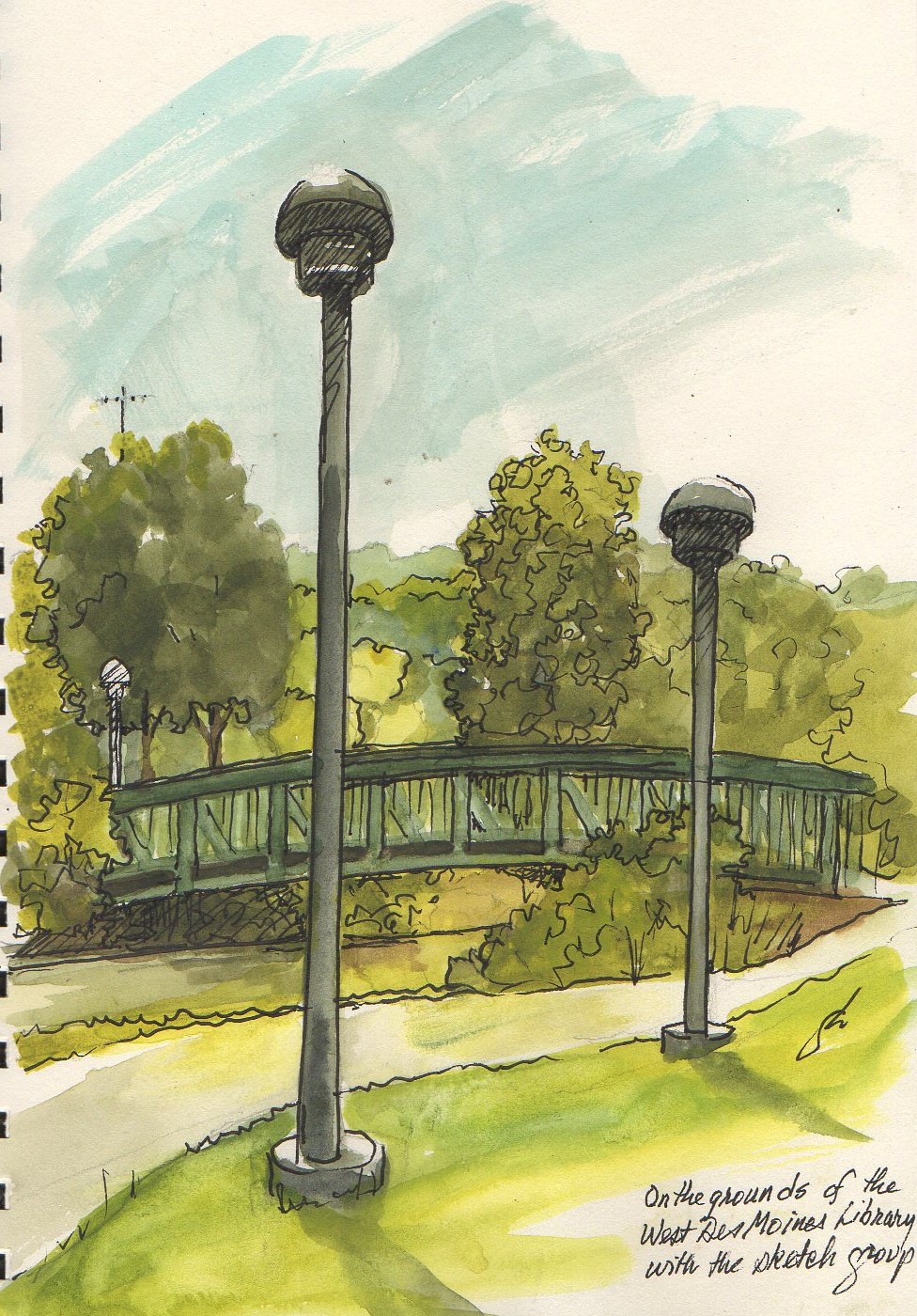
The Saturday sketchers were at it again last weekend. The weather last Saturday was beautiful, sunny and warm, and the site we chose--a local city library--offered a lot of opportunities. Almost all of us found shade along the banks of a graceful pond that flanks the main building. The grounds there have been landscaped beautifully and include new and old growth, walking paths, benches and sculptures. The pond isn't all that large but it's flanked with trees and shrubs and at one end a blue-green bridge crosses a creek. The bridge reminds me of Monet's famous one at Giverney. (No water lilies though.) The breeze from the south was cooled just enough as it spread over the water, and I sat and painted the scene for a couple of hours. 

Hoff, "The Bridge," watercolor on paper, 9x6

I set up along a walking path not far from the "Monet" bridge. The sketchbook I'm using these days gives me space to make an image about 6x9. This time the beginning was a careful drawing because I wanted to make certain of angles and perpendiculars. After that I washed in colors in various spots and then layered colors one over another. When satisfied I added ink to emphasize foliage the bridge, and the tall lights.

Tuesday, September 21, 2021

Artists in Action

This coming weekend, the Polk County Conservation Board is holding a paint out event, Artists in Action, at Jester Park, near Granger. The event is intended to highlight the beauty of the park, a 1400 acre gem, and further the mission of conservation of natural resources. As one of several painters were selected from applications submitted a few weeks ago, I'll be painting and meeting the public to discuss the creative process, oil painting and other media, and showcasing the park. We will be painting around the Nature Center grounds.

Hoff, "Across the River, August," oil on panel


Hoff, "Gray's Lake, Northeast," oil on panel


In addition, an exhibition of selected works by participating painters will open in the gallery at the Nature Center and run until December 26.  

Come out and enjoy the park, the art, and the conversations at the Jester Park Nature Center, Saturday and Sunday 9-3pm each day.

The Galleries at Jester Park

Friday, September 17, 2021

Landscape Artist of the Year

Some time ago I posted a link to a program from Britain called Portrait Artist of the Year, a reality show competition among painters. Each week a new group is tasked with doing a portrait of a prominent person in a few short hours. The winner of the competition is then commissioned to make a portrait of someone famous. 

Now, to my surprise I've run across the companion program to the portrait competition: Landscape Artist of the Year. Like it's sister show, this one features rounds of competitions around the United Kingdom, but the work is done outdoors--en plein air. Both professional and amateurs must produce a landscape painting of a well-known site in a timed event. Each weekly winner (selected by three judges)  advances to a semifinal and then a final. 

For a painter of landscapes the opportunity to watch others at work is wonderful. Although the programs are necessarily fragmented, you get a chance to understand the thinking of others, the ways they use their materials (and what those are), plus hear comments and criticisms from experienced judges. The whole series is available via YouTube, each lasting about 45 minutes. 


Tuesday, September 14, 2021

In the Midst of the Plague

Harvey Dinnerstein, "Self Portrait," pastel, 1976

Harvey Dinnerstein (1928-) is a realist painter who is working well into his tenth decade. A life-long New Yorker, he attended the Tyler School of Art (Temple University) and later taught at the School of Visual Arts, the National Academy of Design, and the Art Students League. Although he came of age during the ferment following World War II, he disdained the abstraction movement of that time for an exploration of realism and the human figure. 

Harvey Dinnerstein,"The Plague," pastel, 2020


Just like other artists Mr. Dinnerstein has been profoundly influenced by the covid pandemic of the past couple of years. Although he is well-known as a portraitist and illustrator, Mr. Dinnerstin is also comfortable with allegory, as seen in his pastel from last year, "The Plague," a work that shows us people clinging to a subway post, along with the skeletal hand of Death. 

Dinnerstein's work is in collections, including the Metropolitan Museum of Art, the Whitney Museum of American Art and numerous others.
--- 
Harvey Dinnerstein: In the Midst of the Plague 

Friday, September 10, 2021

Cities

Hoff, "Goodbye," oil on panel, 2009

Although landscapes have occupied the majority of my time these last months of pandemic, cities and the life of the street still catches my interest. 

In a city street life happens everywhere. People meet and part, hurry and loiter, aloof or engaging, and the world swirls and eddies around them. An artist can capture the moment. Cities comprise all of mankind's foibles and failings as well our heroism and selflessness. We humans reach the heavens with our arts and our buildings and plumb the sewers with our stupidity and our trash. Beauty and ugliness compete. The human comedy plays on.


Hoff, "Eat," oil on panel, 2009
Hoff, "Pushcart," oil on panel, 2011


Hoff, "Invictus," oil on panel, 2013


Tuesday, September 07, 2021

Saturday Sketchers

Someone asked me about the sketch group I've mentioned here a few times. It has an interesting story.

The Saturday sketch group began long ago, in a very different era. It started in 1948 when a handful of men--Drake art professors and a writer for the Des Moines Register and Tribune--decided it might be fun to drive into the countryside and draw or paint watercolors. The original members seem to have been Karl Mattern (an artist and teacher at Drake University); Jim Morrison, a fine artist; and George Shane, a feature writer. They enjoyed themselves enough to recruit others to join them on Saturday afternoons. Leonard Good, a noted painter who had come to teach at Drake, joined in 1952, as did numerous others as the years went by. Rain or shine, ice or snow, they spent their Saturday afternoons sketching. The group grew to twenty or more (all men) to include artists, art teachers, attorneys, physicians, bankers, a cartoonist, and even a detective. Women only began coming during the 1970s and today comprise a majority of the group.The sketch group is very informal, having no constitution or rules, nor dues, and yet has continued for eight decades, meeting and sketching together regularly after lunch on Saturdays. 

One member with a very long tenure is Dwight James, a retired attorney who has been coming regularly since 1968. Dwight hadn't painted before coming to the Saturday group, though he'd taken a few drawing courses at the Des Moines Art Center. From watercolor landscapes, the forte of the Saturday group, he later branched out to acrylics and oil portraits. Dwight is the source of much of the information in this post, both from personal memory and from his files, having been given archives of the group dating into the 1950s. He also invited me to participate a few years ago.

At first the Saturday sketch group met at a member's house to decide on the day's location. Later on it switched to the current spot in the parking lot west of the Des Moines Art Center. Then as now the group meets after lunch on Saturday, decides on a place to paint after a brief discussion, and heads out. After about two hours we meet at a local cafe for conversation and discussion of the work. The original group met similarly but would knock off a pint or two at various local bars instead. Most still adhere to the watercolor medium because of its portability and simplicity, though a few do pastel and occasionally someone makes a small oil painting. The looseness of the organization means that some of us come regularly, some sporadically. Regardless, the Saturday sketch group goes on.

Gary Hoff, "Grandview Park," watercolor on paper, 2020

Leslie Leavenworth, "Des Moines Botanical Center," wc, 2021

Current members include respected professionals like Leslie Leavenworth, who says, “I have spent most Saturdays afternoons since 2003 with this intrepid group.  The camaraderie of painting outdoors is inspiring and motivating.  I love that there are no dues, no membership, and no rules except to be on time or be left behind! We all share a mutual love for painting plein air in beautiful Des Moines." Leslie has recently begun teaching outdoor watercolor workshops.

Chuck Mertes, "Winterset Bridge," pastel on paper, 2021


Chuck Mertes is
a member of the group who completes large pastels en plein air during our Saturday forays. He's also at home in other mediums and says he feels lucky to have "the vast experience of the plein air group as a resource." He looks forward to each Saturday as an adventure. His brilliantly colored pastels like the bright red covered bridge above, are beautifully composed and painted.

Mary Helen Grace is an avid painter with more than 30 years experience teaching art in public schools. She is a regular participant and loves our afternoons at various locations, from sites along the Des Moines River, the Botanical Center, and many others.

Mary Helen Grace, "At the Botanical Center," watercolor on paper, 2021
The Saturday sketch club is basically a comradeship of painters, a group of friends who spend two or three hours together on Saturday afternoons. The Saturday sketch group--it has never even had an official name!--is a unique opportunity to let the pleasures of nature and making a picture take over, as it has for three generations of Des Moines artists.